


How to Roast Chestnuts in the Oven
Sep 08, 2026
Leave a message
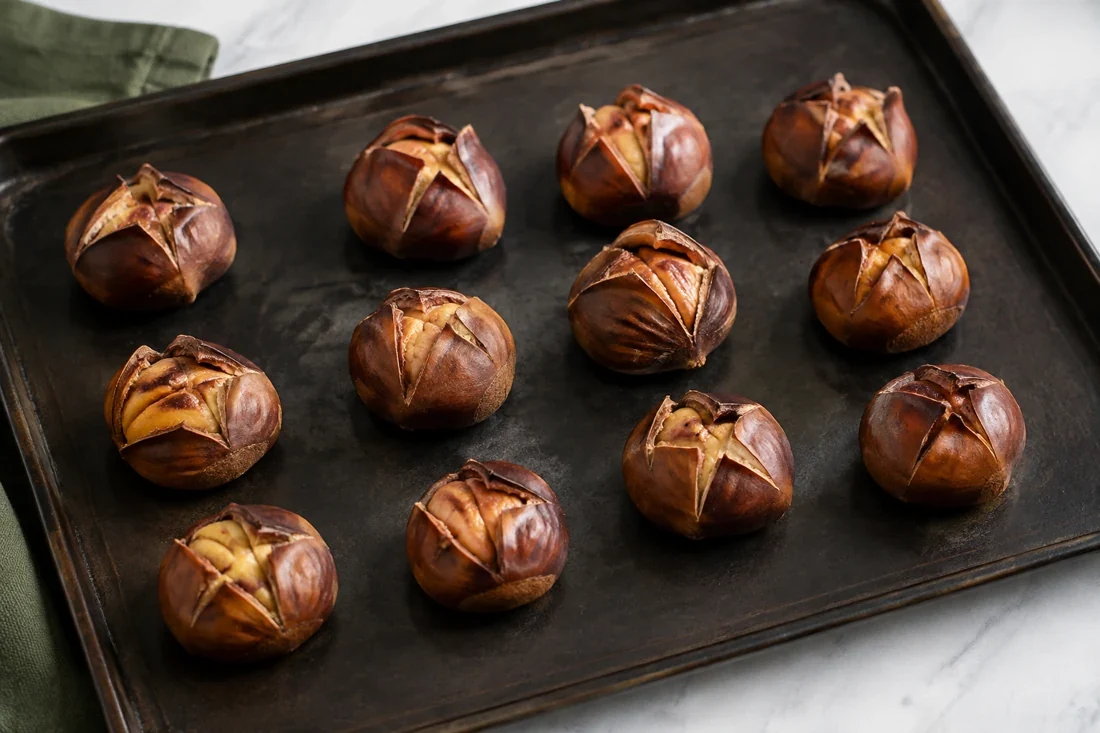
Peeled frozen chestnuts need a separate approach. They have no shell to score, and the bag may contain raw, blanched or previously cooked kernels. Follow the product's cooking instructions and judge the actual center. The method below explains the in-shell process first, then the changes needed when using a prepared frozen ingredient.
Choose edible chestnuts that will roast evenly
Buy chestnuts sold as food by a reliable retailer or food supplier. Sweet chestnuts and horse chestnuts are different plants; horse chestnuts, often called conkers, are not a substitute for edible chestnuts. A cooking article is not a foraging identification guide. If the source or identity is uncertain, resolve that before preparing them. Roasting does not make an unidentified nut suitable to eat.
Among edible chestnuts, look for sound shells and nuts that feel substantial for their size. Avoid visible mold, obvious insect holes, leaking damage or an unpleasant odor. A shell can hide a damaged kernel, so the final inspection continues when you open the roasted chestnuts. Discard any that show mold or deterioration inside. Do not try to rescue a spoiled kernel by roasting it longer or covering the flavor with seasoning.

Whole sweet chestnuts with brown shells. Check the condition of whole in-shell chestnuts before scoring and roasting.
Chestnuts behave differently from the dry nuts often kept in a pantry. They contain considerable moisture and are perishable. The University of Florida chestnut production guide discusses cold handling as part of maintaining market quality. Keep purchased fresh chestnuts refrigerated according to their packaging and use sound stock promptly. A bag that has dried out before cooking may never produce the tender result shown in a recipe photograph.
Sort an especially mixed bag into broadly similar sizes before roasting. A small nut and a very large nut can share an oven temperature, but they may not reach a tender center together. Separating them makes checking easier and helps avoid drying the small ones while waiting for the large ones. You do not need laboratory precision; a quick visual sort into comparable groups is useful for a household tray.
Choose the quantity around your tray and your peeling time. A single layer allows a more even exposure to the oven. It also gives you a manageable batch to peel while warm. If you are preparing a large quantity for stuffing or soup, several controlled batches may be easier than one crowded tray followed by a long peeling session. Allow time for the shells and inner skins, not just the oven timer.
Rinse away loose surface dirt and dry the shells enough to handle securely. Set out a stable cutting board, a suitable sharp knife or chestnut scoring tool, an oven tray and a clean towel before starting. Keeping the work arranged makes the scoring stage calmer and reduces the temptation to hold a slippery nut in the hand while cutting. The knife should always have a stable surface and a clear path away from your fingers.
Score the shells before heating
Every in-shell chestnut needs a deliberate opening before it enters the oven. A cross on the domed side is a common method. Cut through the hard outer shell and the thin skin immediately beneath it without carving deeply into the kernel. The opening gives expanding steam a way out and creates edges that are easier to lift after cooking. An unscored shell can split forcefully as pressure builds.
Place the chestnut with its flatter side on the board so that it does not rock. Work one at a time with a tool you can control. If a nut will not sit securely, reposition it instead of forcing the cut. A chestnut scoring tool may be more comfortable for some users, but the important result is the opening itself. Do not balance the nut in your palm and press a knife toward your hand.
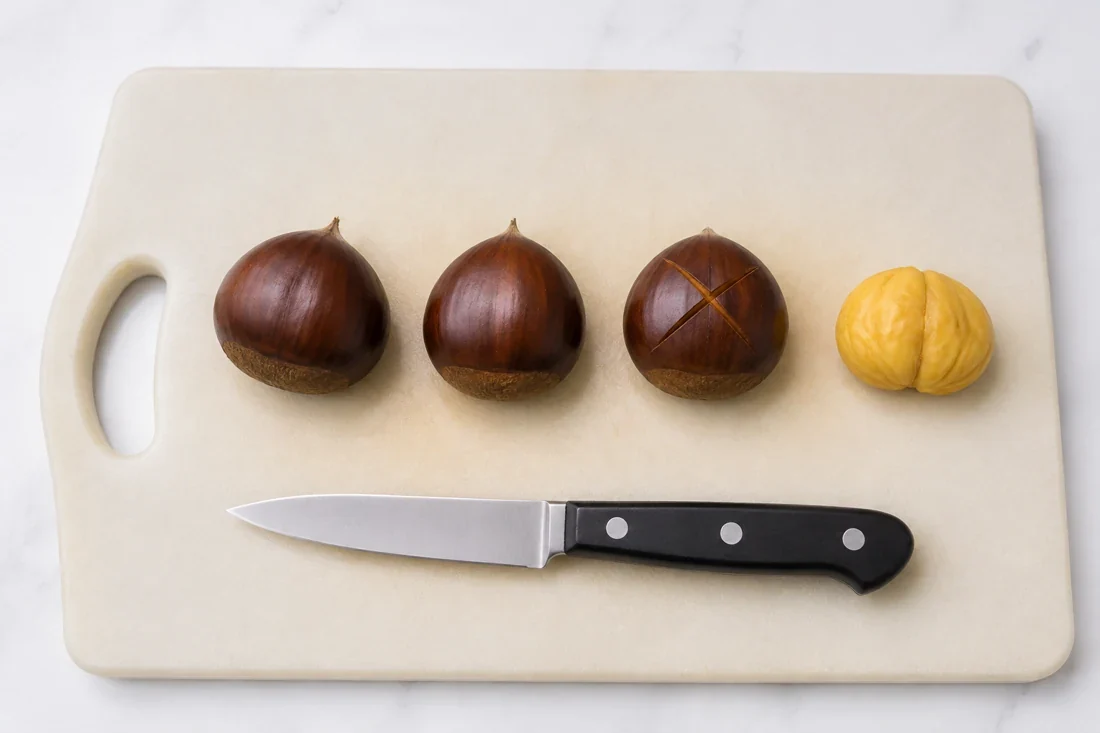
Score through the shell and inner skin with the chestnut held securely on a board.
The Italian Recipe Book oven method discusses cuts that open both shell and inner skin. A shallow mark scratched only onto the shiny surface is insufficient. Conversely, deeply quartering the kernel is unnecessary and can make it break into pieces during peeling. The aim is a controlled slit or cross that opens the covering while preserving the edible center as much as practical.
Check the scored nuts as you transfer them to the tray. It is easy to miss one when working through a bowl. Keeping unscored nuts on one side of the board and completed ones on the tray creates a simple visual check. If you interrupt the preparation, resume from the unscored group rather than assuming every nut in a mixed bowl has already been cut.
Some recipes include soaking or a brief water treatment before roasting. Those methods can work within the recipe that specifies them, but soaking is not a substitute for scoring and does not guarantee easy peeling. Freshness, variety, shell condition and the cooking process still affect the result. If you use a soaking method, follow that complete recipe and avoid borrowing its time while omitting the preparation steps on which it depends.
For a first batch, a straightforward scored, single-layer method is easier to evaluate. Note whether the shells open, whether the center becomes tender and how the skins release. If you change the preparation on a later batch, change one major factor at a time. That makes it possible to tell whether soaking, scoring shape or cooking duration helped, instead of changing everything and being unable to explain the result.
Roast at 400°F and check the center
Preheat a conventional oven to 400°F, approximately 200°C. Arrange the scored chestnuts in one layer with the cuts facing upward. Place the tray in the oven and begin checking a representative larger nut after about 25 minutes. Open it carefully, let the exposed center cool enough to handle, and test for tenderness. Continue cooking the remaining nuts if the center is still hard, checking again after a short interval.
Published methods vary because their ingredients and setups vary. BBC Good Food's roast chestnut recipe uses 200°C, or 180°C fan, for about 30 minutes. The Kitchn's method uses a hotter 425°F oven. These are useful starting methods, but their times should stay connected to their temperatures and preparation. Combining one source's temperature with another source's shortest time can leave a hard center.
- Preheat the oven to 400°F, or about 200°C, and group sound edible chestnuts by similar size.
- Score each shell and inner skin securely on a board, then arrange the chestnuts in one layer.
- Begin checking after about 25 minutes; continue as needed until a representative center is tender.
- Rest briefly under a towel, then peel both coverings while comfortably warm. Inspect the opened kernels.
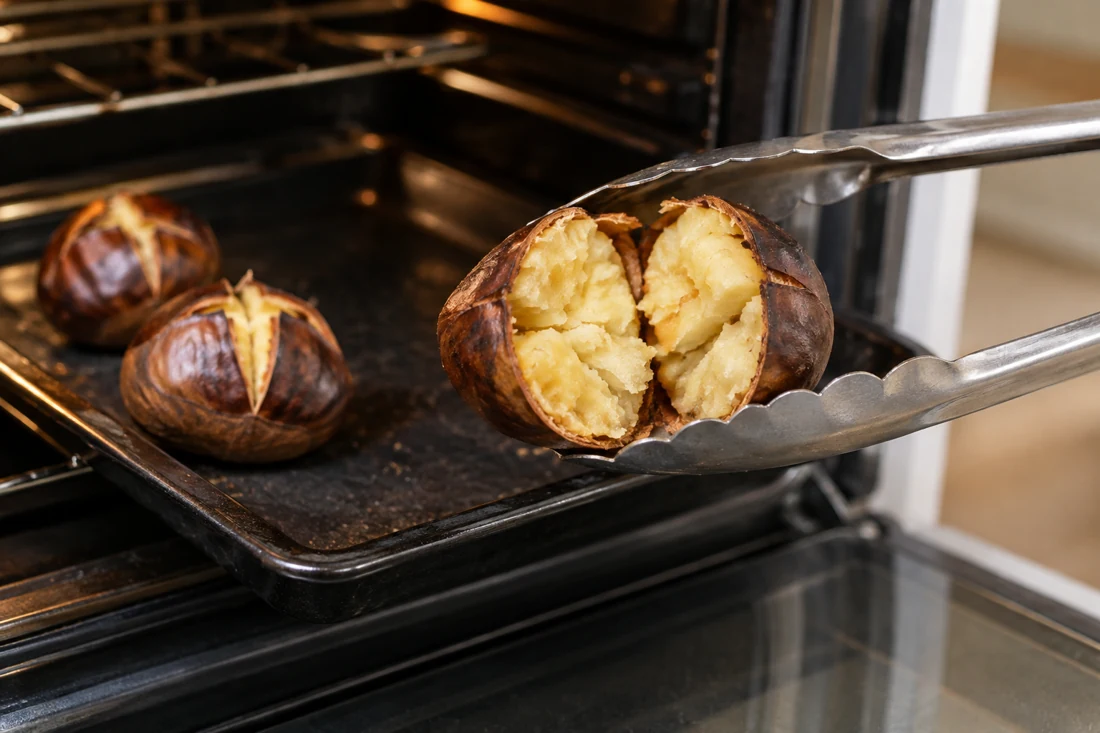
A split roasted chestnut exposes the center for a tenderness check. Illustration.
For the 400°F method here, think of 25–40 minutes as a working range rather than a deadline. Size, initial moisture, starting temperature and oven behavior all influence the result. Fan ovens can also behave differently from conventional ovens. If your appliance instructions recommend an adjustment, use that guidance and check earlier. A tray of unusually large or dry chestnuts should not be judged solely by an average time from a different batch.
The shell opening is a useful visual cue, but it is not enough on its own. A shell may curl back before the kernel is pleasantly tender. Break open a sample from the larger end of the batch and examine the middle. A properly roasted chestnut should offer a tender, starchy bite rather than a hard raw core. Check more than one if the batch contains substantial size differences or the tray heats unevenly.
Avoid crowding the tray or repeatedly opening the oven without a reason. Crowding changes how the nuts heat, while frequent door opening makes the process less predictable. If the back of your oven browns faster, rotate the tray as needed and keep the exposure consistent across batches. The goal is to cook the centers while retaining enough moisture for an enjoyable kernel, not to drive every shell to the darkest possible color.
Once the sample is tender, remove the tray carefully and move to the resting stage. Do not leave the chestnuts in a switched-off hot oven merely to keep them convenient for later. Continued heat can dry them after the center is ready. For a large preparation, organize the next scored tray while the first cooks, then handle each batch through roasting and peeling as a complete sequence.
Rest briefly and peel while warm
Transfer the roasted chestnuts to a clean towel and fold it over them for a brief rest. Around five to ten minutes is a practical starting interval, allowing steam to settle and the nuts to become manageable. The exact moment to peel is when you can handle them safely while they remain warm. Avoid a long wait that lets the entire batch become cold before you begin removing the skins.
There are two coverings to remove: the firm brown shell and the thin inner skin, often called the pellicle. The shell usually lifts from the scored opening. The pellicle can cling in the grooves of the kernel and may need more attention. Leaving large patches of it attached can affect the eating quality. Check the surface and creases rather than assuming that a kernel is finished as soon as the outer shell is gone.
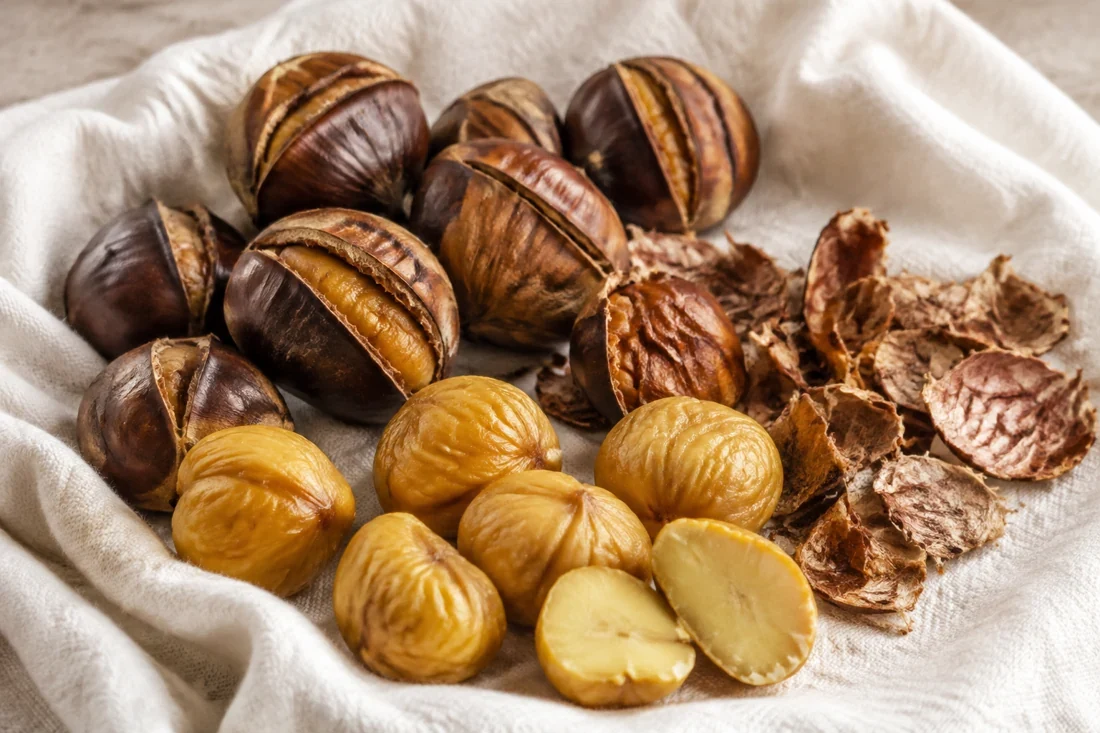
Separate the shell and inner skin while the chestnuts remain comfortably warm.
Warm peeling is a recurring step in Australian chestnut roasting guidance. Work through a few nuts at a time, keeping the rest loosely covered so they retain warmth. Protect your hands from hot steam when opening the towel and from the hot centers when splitting a sample. If a nut is too hot to handle, give it more time; speed should not require a burn.
Peeling also provides the final quality check. A sound-looking shell can conceal a kernel with discoloration, mold or an off odor. Set aside questionable nuts for disposal rather than dropping them into the bowl of finished kernels. Keep shells and skin fragments separate from the edible portion. This is particularly useful when the chestnuts will later be chopped or blended, because small defects become harder to recognize once mixed into a recipe.
Some kernels will break during peeling. Sound pieces can still be useful in stuffing, soup or puree, while attractive whole kernels can be reserved for visible garnishes. That is an application choice, not a reason to include spoiled material. If nearly every kernel crumbles or the skin remains stubbornly attached, inspect the cooking and raw-material condition before assuming that more force is the answer.
After peeling, use the chestnuts in the planned dish or cool and refrigerate them promptly for later use. Do not leave a large bowl on the counter through the rest of a lengthy cooking session. Roasting and peeling are preparation stages, not a preservation method. If the recipe will include a second long cooking period, consider the combined effect on texture when deciding how much tenderness you want from the initial roast.
Adjust the method for peeled frozen chestnuts
Peeled frozen chestnuts begin after the shell-removal stage, so there is no shell to score or towel-assisted peeling to perform. Their exposed surfaces also respond differently to dry oven heat. The first question is whether the kernels are raw, blanched, roasted or fully cooked. "Frozen" describes storage state. It does not answer the cooking-status question, and blanching should not automatically be interpreted as ready to eat.
We supply frozen peeled chestnuts in forms and processing options that are confirmed for the order. Ask for the exact preparation and intended-use instructions with the sample. A raw frozen whole kernel for further cooking needs a different treatment from a previously roasted kernel being warmed for service. The package directions and agreed specification should take priority over a generic in-shell roasting schedule.

Frozen peeled chestnut kernels with visible frost. Confirm whether the kernels are raw, blanched or cooked before choosing the heating method.
| Starting product | Shell scoring | Preparation decision |
|---|---|---|
| Fresh, in shell | Required before roasting | Use the in-shell method and check a representative center. |
| Peeled frozen, raw or blanched | No shell to score | Follow the product's further-cooking directions. |
| Peeled, previously cooked | Not applicable | Use the labeled reheating or recipe instructions. |
For a product intended to cook from frozen, follow that route without adding an unnecessary counter-thawing stage. Arrange the required quantity as directed and allow for moisture released during heating. If thawing is specified, use the instructed refrigerated method and manage the thawed product within its stated conditions. Never assume that leaving a bag on the worktop until convenient is part of the cooking method.
Dry oven roasting is not always the best first step for a peeled raw kernel. A recipe may need a moist cooking stage to produce the center texture before a brief surface finish. A previously cooked kernel may need only careful reheating. We do not assign one minute count to all these states. For product development, test the exact supplied kernel and record the combination of moisture, temperature and time that produces the intended finished dish.
Check a representative large kernel through the center, and assess the surface at the same time. A hot exterior can become dry before a large center has softened adequately. If the recipe includes a sauce, stuffing or soup, its moisture may be part of the cooking process. Follow the recipe and product instructions as a combined method rather than roasting the kernels aggressively and then adding another prolonged cooking stage.
For a foodservice operation, confirm whether the process can deliver the desired number of intact kernels after cooking and handling. For a puree, breakage may be less important than smoothness and flavor. A frozen peeled ingredient can remove labor from shelling, but that benefit should be evaluated alongside usable yield and the final eating quality. The appropriate trial compares finished portions under the kitchen's actual service conditions.
Solve hard centers, dry kernels and stubborn skins
A hard center usually calls for checking the cooking process and the raw material together. Open a large sample: if the outer flesh is tender and the middle remains firm, the batch may need more time. If the whole kernel is unusually dry and hard, the chestnut may have lost quality before cooking. Extending the roast indefinitely can make that problem worse by removing still more moisture from the outside.
Dry, crumbly kernels can result from excessive oven exposure, delayed use or poor starting condition. Look at the pattern across the batch. If smaller nuts are dry while larger ones are just tender, size sorting may improve the next attempt. If all nuts from one bag behave poorly despite a sensible method, compare their raw condition with a fresher batch. A method adjustment cannot restore moisture and quality that were already lost.
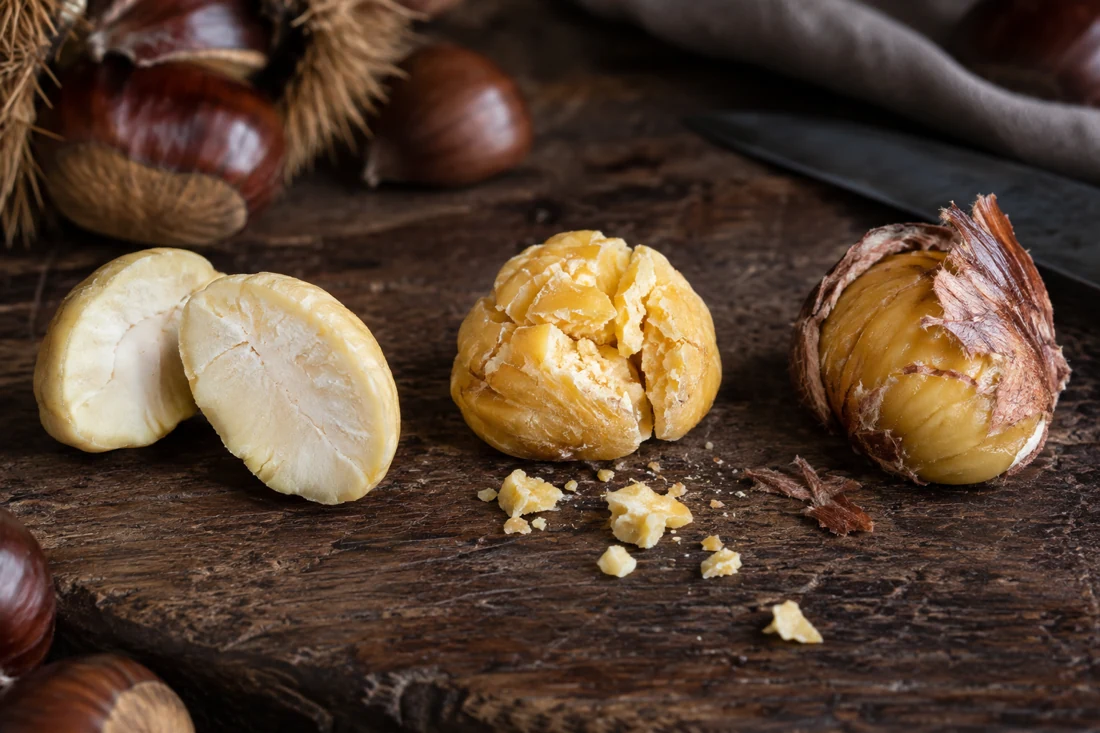
Kernel texture and clinging inner skin need separate checks. Illustration.
Stubborn skins can have several causes, including insufficient cooking, delayed peeling and the characteristics of the chestnuts themselves. First check that the cuts passed through the coverings and that the center is tender. Then consider whether the batch cooled before peeling. Change those controllable factors before assuming that an elaborate extra step is necessary. Even with a careful method, not every variety or individual nut releases its skin equally easily.
Dark shells with hard centers suggest that appearance has been allowed to stand in for doneness. Check the actual oven setting, tray position and size of the nuts. An excessively hot area may darken the outside quickly while the center needs longer. For the next batch, use the intended temperature, a more even tray position and a representative center check. Do not make the oven hotter simply because the shell is not opening as dramatically as expected.
Unexpectedly low usable yield deserves its own record. Weigh the purchased in-shell quantity and the sound peeled quantity if cost matters to the operation. Record rejected nuts separately from ordinary shell and skin losses. That distinction helps a buyer see whether the problem is preparation labor, natural shell weight or raw-material defects. It also makes a comparison with purchased peeled kernels more meaningful.
Keep troubleshooting tied to observable results. "Not good" tells a supplier little; "large kernels remain hard after this recorded oven cycle" gives a starting point for review. Photographs of the unprepared product, the cut center and the finished tray can support that discussion. Include the lot and method, and do not describe a single household attempt as a validated commercial cooking instruction for every pack in a product range.
Plan roasted chestnuts for foodservice and production
Start with the role chestnuts play in the finished dish. A plated side may need whole, attractive kernels. A stuffing can often use sound pieces. A smooth soup or filling may benefit from a form that reduces chopping or blending work. The oven method is therefore only one part of the decision. The ingredient form should support the portion, texture and workflow that the kitchen or factory actually needs.
For an in-shell seasonal service, include scoring and warm peeling in the labor plan. A tray may spend half an hour in the oven while preparation and peeling take substantial additional attention. The work also produces shells and rejected kernels that must be kept away from finished food. Evaluate the complete preparation period when comparing fresh in-shell chestnuts with prepared frozen kernels, rather than comparing oven time alone.
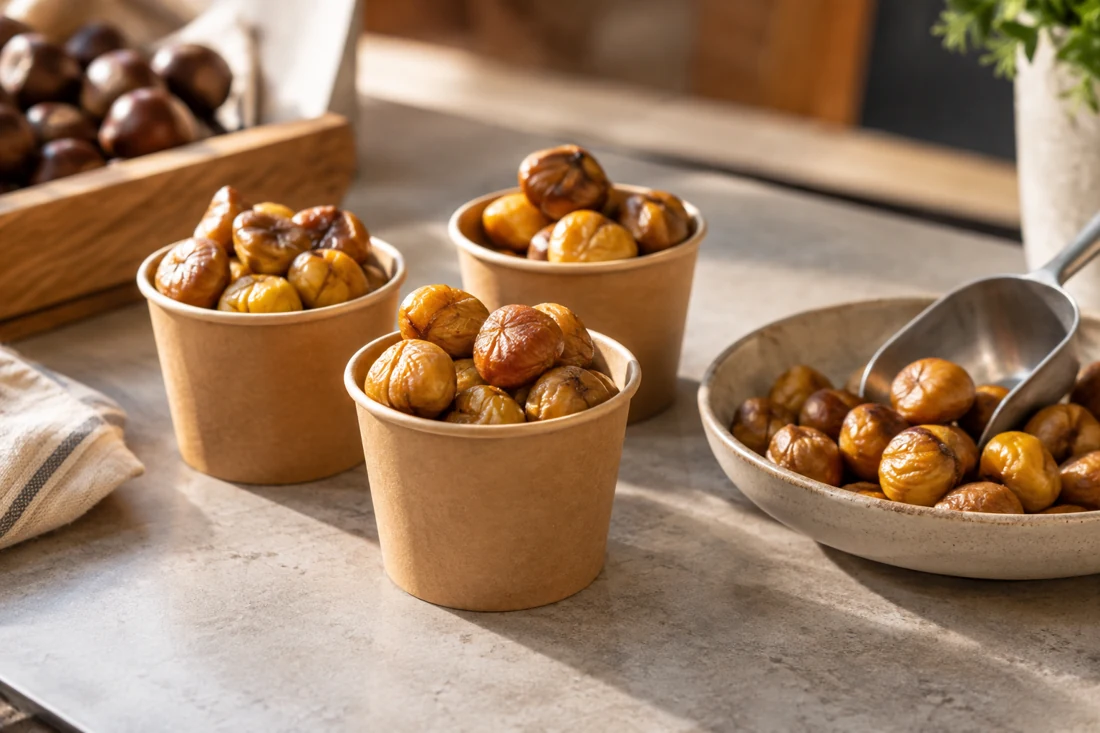
Roasted chestnuts portioned for foodservice. Illustration.
For a frozen ingredient, request the preparation state, whole-kernel tolerance, size description and acceptable skin remnants. Confirm whether the product is supplied for further cooking. If a roasted note is essential to the menu, ask whether the available processing option supports it or whether the kitchen will create it during cooking. A pale blanched kernel and a roasted kernel should not share an assumption about flavor simply because both are peeled.
Run a representative production trial before setting instructions. The tray size, load, oven type and later holding period can differ substantially from a small recipe test. Record the actual product used and the finished result after the full service sequence. A processor selling an assembled meal also needs its own validated cooking and handling instructions for that product. Published chestnut recipe times are useful development references, not a substitute for that work.
Packing and supply timing should reflect the production calendar. Let the supplier know the volume per batch, preferred pack size, destination and delivery period, along with any private-label or documentation requirements. We review those details against the frozen chestnut supply range and confirm the offered form. That gives the development team a definite ingredient to approve and purchasing a clear basis for the order.
The reliable roasting habit remains straightforward: begin with sound edible chestnuts, open every in-shell nut before heating, check the center and peel while warm. When the product arrives already peeled and frozen, begin again from its documented state. That keeps a useful traditional oven method connected to the ingredient it was designed for and gives prepared chestnut products the separate handling they need.
Discuss frozen chestnut supply with GreenLand-food
GreenLand-food is a professional frozen chestnut supplier and manufacturer in China, providing factory-direct wholesale supply for importers, food manufacturers, foodservice distributors and private-label programs.
Send the chestnut format, processing state, kernel size, pack and application, with your quantity and destination.