


Mixed Berry Jam from Frozen Fruit: Acidity, Pectin and Blend Changes
Oct 19, 2026
Leave a message

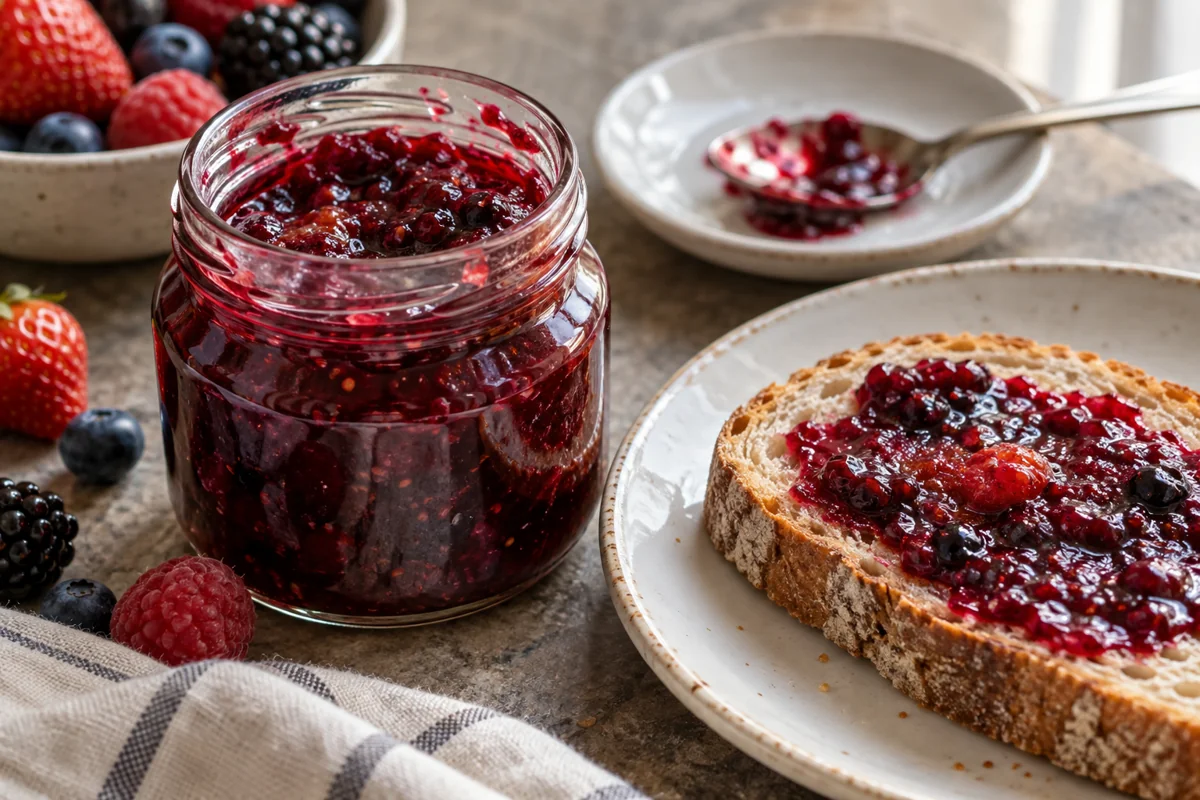
For home preservation, follow a current tested recipe from an authoritative source or the exact instructions for the named pectin product. For commercial development, agree the raw-fruit specification with the formulation and process team, including how acidity, soluble solids, seeds and fruit particles will be assessed. We focus here on the decisions that make mixed-berry inputs easier to compare. The article does not provide a new shelf-stable canning recipe or a universal processing schedule.
Choose the preservation route before the formula
Begin by deciding whether the finished product is a refrigerator spread, a freezer jam, a home-canned preserve made from a tested recipe, or a commercially processed product. These routes have different storage and processing requirements. A change in container or a longer cook does not automatically move a product from one route to another. The intended route should be clear before ingredients are purchased or a batch is made.
A refrigerator spread offers flexibility in texture and flavor development, but it still needs appropriate preparation, cooling and refrigerated storage. Freezer jam follows a method designed for that use and remains dependent on its stated storage conditions. A home-canned jam requires a tested recipe with the relevant fruit, ingredient proportions, jar and processing instructions. A commercial product needs its own applicable formulation, processing, packaging and shelf-life basis.
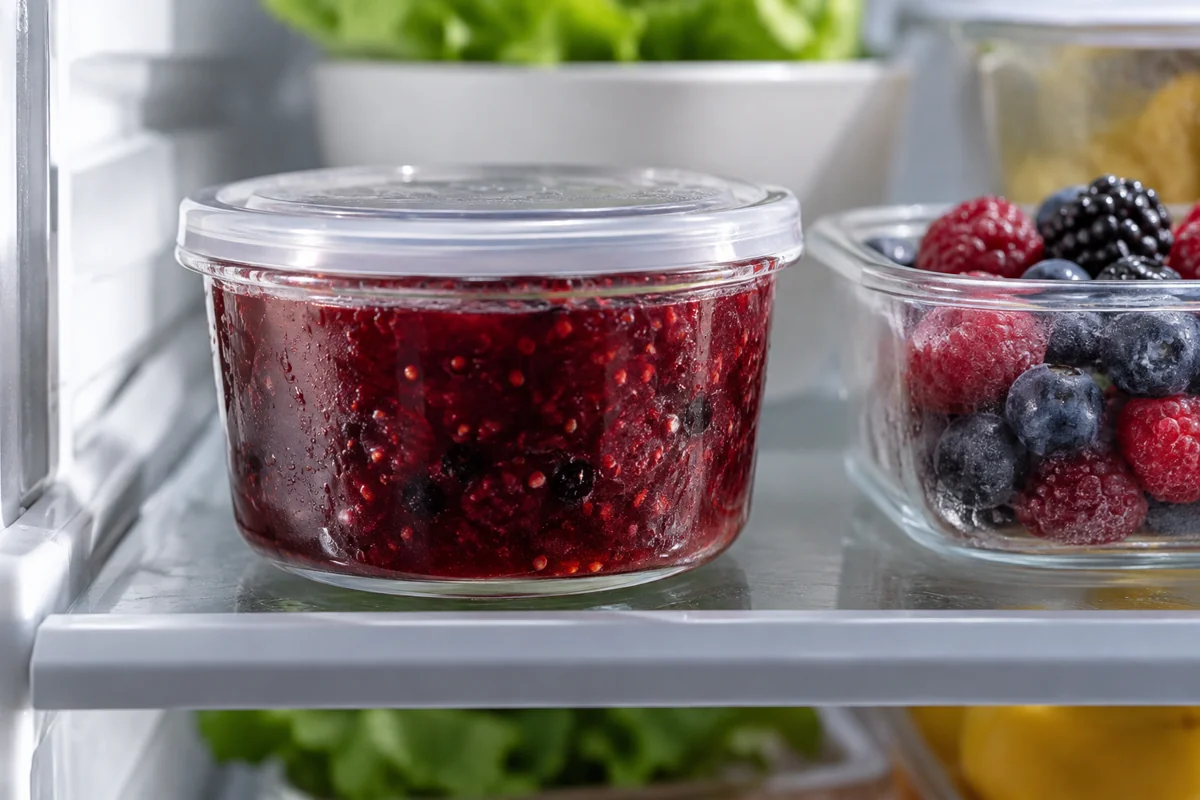
Berry spread in a covered container under refrigeration.
The National Center for Home Food Preservation guidance on added pectin emphasizes following the instructions associated with the pectin and the processing method. The SURE-JELL mixed berry freezer jam recipe is an example of a specifically defined freezer-jam method. Its existence does not authorize substituting another pectin or treating the finished spread as shelf stable.
| Intended route | Starting point | What still needs control |
|---|---|---|
| Refrigerator spread | Suitable recipe for refrigerated use | Preparation, cooling, refrigeration and keeping period |
| Freezer jam | Exact freezer-jam recipe and pectin instructions | Prepared-fruit basis, container and frozen storage |
| Home-canned jam | Current tested canning recipe | Ingredients, jar size and complete processing directions |
| Commercial jam or fruit spread | Approved formulation and qualified process assessment | Raw materials, processing, packaging and shelf-life evidence |
For a buyer, this decision changes the raw-material discussion. A jam manufacturer may need a defined acidity and soluble-solids range for formulation, while a foodservice kitchen may prioritize portion size and simple handling of frozen packs. Both need accurate ingredient identity and traceability. Neither can infer the finished product's storage requirements from the frozen fruit's product name or from a photograph of an attractive jar.
Keep the route visible in development records. A sample labeled only mixed berry jam leaves the next person to guess whether it is a texture trial, a refrigerator product or a preserve made under a tested canning method. Record the recipe or formulation revision and intended storage. That small administrative step prevents a successful tasting sample from being mistaken for an approved finished product with a different distribution requirement.
Measure the thawed blend on a consistent basis
Frozen berries contain spaces between pieces, and those spaces change as the fruit thaws and collapses. A cup of loose frozen berries is therefore a different measurement from a cup of crushed prepared fruit. Use the basis named in the recipe. If it asks for crushed fruit, prepare and measure it accordingly. For a commercial weight-based formula, define the preparation state and the treatment of all released liquid so each batch starts on the same basis.
The juice released during thawing is part of the fruit system. It carries soluble material and flavor, and removing it changes the formula. Do not drain it simply because it appears inconvenient unless the selected recipe or approved formulation instructs that treatment. If a development method deliberately separates and recombines juice, record each weight. The resulting formula should identify whether its fruit quantity includes all thawed juice or a defined drained fraction.

Mixed berries with strawberry pieces on a sorting surface. Confirm component ratios and cuts for the order.
Use controlled thawing and handling appropriate to the ingredient and operation. A bowl left on the bench for an uncertain period is a poor foundation for either a comparison or a production process. Record the sample lot, starting quantity and preparation method. If the recipe permits fruit to be measured before freezing, preserve that measurement record; otherwise follow its prepared-fruit instructions rather than trying to reconstruct the quantity from a partly empty frozen bag.
The NCHFP ingredient guidance recognizes canned or frozen fruit as possible inputs and discusses the roles of fruit maturity and added pectin. For mixed berries, the practical consequence is to identify the actual fruit and its condition. A commercial frozen blend should not be assumed to provide a predictable amount of natural pectin simply because its components are familiar. The chosen recipe and pectin system remain important.
Record the component proportions by weight for commercial purchasing. Two packs can contain the same four berry names but in different proportions. Their crushed volume, seed level, color and flavor can differ. A trial prepared from one pack cannot establish the performance of every product sold as mixed berries. Where a supplier offers a buyer-defined blend, retain the approved ingredient list and ratio with the sample record.
Added sugar in the incoming product must also be visible. Unsweetened berries are easier to fit into recipes that assume unsweetened prepared fruit. A sweetened pack or syrup pack changes the total sugar and liquid balance. Do not compensate by an improvised sugar reduction in a tested canning recipe. Select ingredients that match that recipe, or have the commercial formulation reassessed through the appropriate process before treating the substitute as equivalent.
Understand what acidity measurements can tell you
Acidity influences flavor and pectin behavior, but the word can refer to different measurements. pH describes the acidity condition measured by the electrode under the defined test method. Titratable acidity measures the amount of base needed to reach a specified endpoint and is commonly reported on a stated acid-equivalent basis. A result expressed as percent citric acid equivalent is not a pH value, and the two should not be substituted for each other in a specification.
The USDA Agricultural Research Service discussion of titratable acidity explains that there is no fixed relationship between pH and titratable acidity in food. For a berry buyer, this means a request for acidity should name the measurement. A laboratory report can be perfectly accurate yet answer a different question from the one the product developer intended. State the method, sample preparation and reporting units with the requested result.
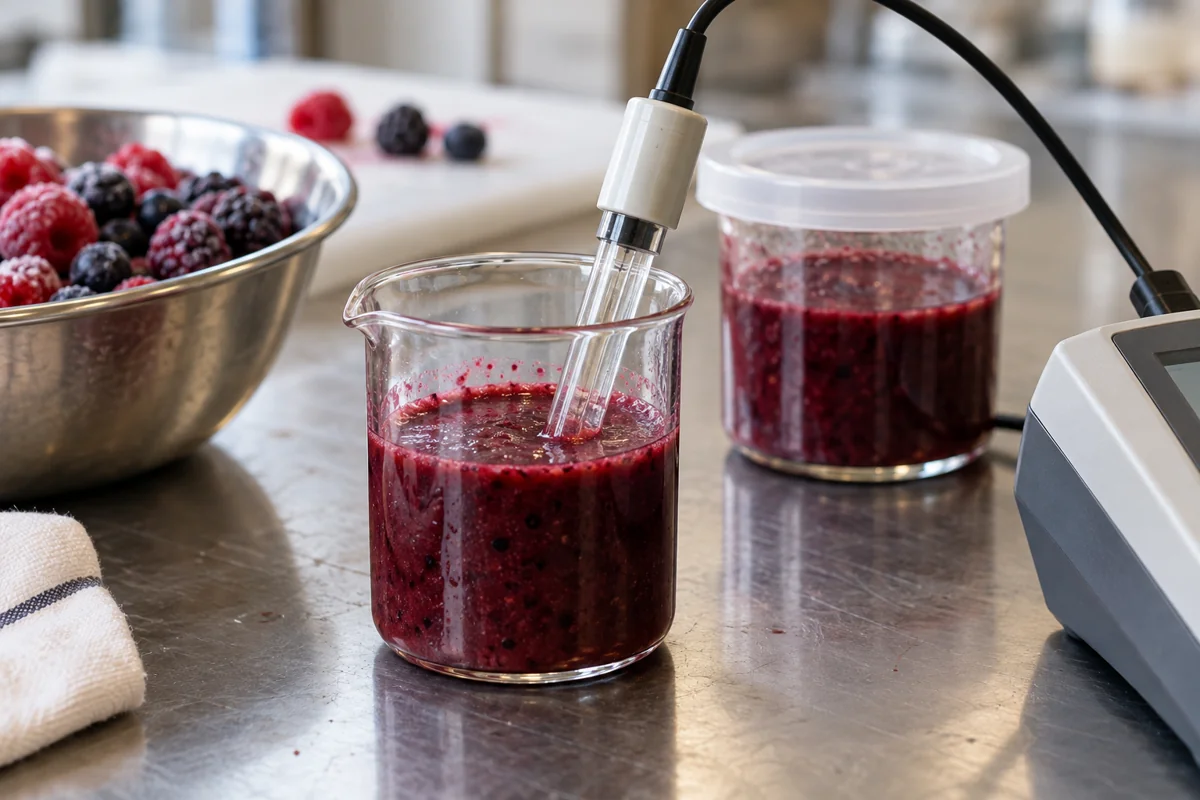
A homogenized berry sample prepared for pH measurement.
Measure a representative, appropriately prepared sample. Testing only clear juice separated from a heterogeneous blend may not represent the whole prepared fruit used in the formula. The laboratory or qualified technical team should define homogenization, temperature and the relevant procedure. Use a calibrated instrument suitable for the sample, and keep the calibration and sample identity in the record. Dark berry color also makes casual visual interpretation of simple indicators an unsuitable basis for consequential formulation decisions.
Flavor assessment remains useful, but it answers a sensory question. Sweetness can mask tartness, and different berry aromas can change the impression of sharpness. A pleasant taste does not establish a measured pH or a validated preservation process. Conversely, an analytical value within the agreed incoming range does not guarantee that a new blend will taste the same in jam. Use sensory and analytical information together, with each result kept within its scope.
Acid additions in tested home-canning recipes should be followed as written. Penn State Extension's acidification guidance cautions against changing the amount or source of acid unless the recipe permits it. For commercial formulation, acid type, addition amount and timing should be part of the approved procedure. A technician may need to adjust a formula within a defined system, but that is different from adding lemon juice until the product tastes right.
Avoid turning one pH reading into a complete safety conclusion. The relevant formulation, processing, package and storage conditions still need their proper basis. A raw-fruit pH result also does not automatically describe the finished jam after sugar, acid, pectin and cooking have changed the system. Keep incoming-fruit acceptance and finished-product verification connected, while recognizing that they are different measurements taken at different stages.
Match the pectin system to sugar and process
Pectin is sold in different forms and systems. A packet intended for a traditional cooked jam, a low-sugar product and a no-cook freezer jam may require different ingredient proportions and mixing sequences. Read the exact product instructions. Powdered and liquid products should not be exchanged by volume or by the assumption that one package serves the same quantity of fruit. The name pectin identifies a family of ingredients rather than a single universal method.
At the industrial level, high-methoxyl and low-methoxyl pectins have different formulation behavior. High-methoxyl systems are commonly used with suitable sugar and acid conditions; low-methoxyl systems can use calcium-mediated gelation and support lower-sugar applications. The Cargill fruit-pectin overview distinguishes these families and their application roles. The useful purchasing action is to identify the exact grade and obtain its application guidance, rather than selecting a system from the family name alone.
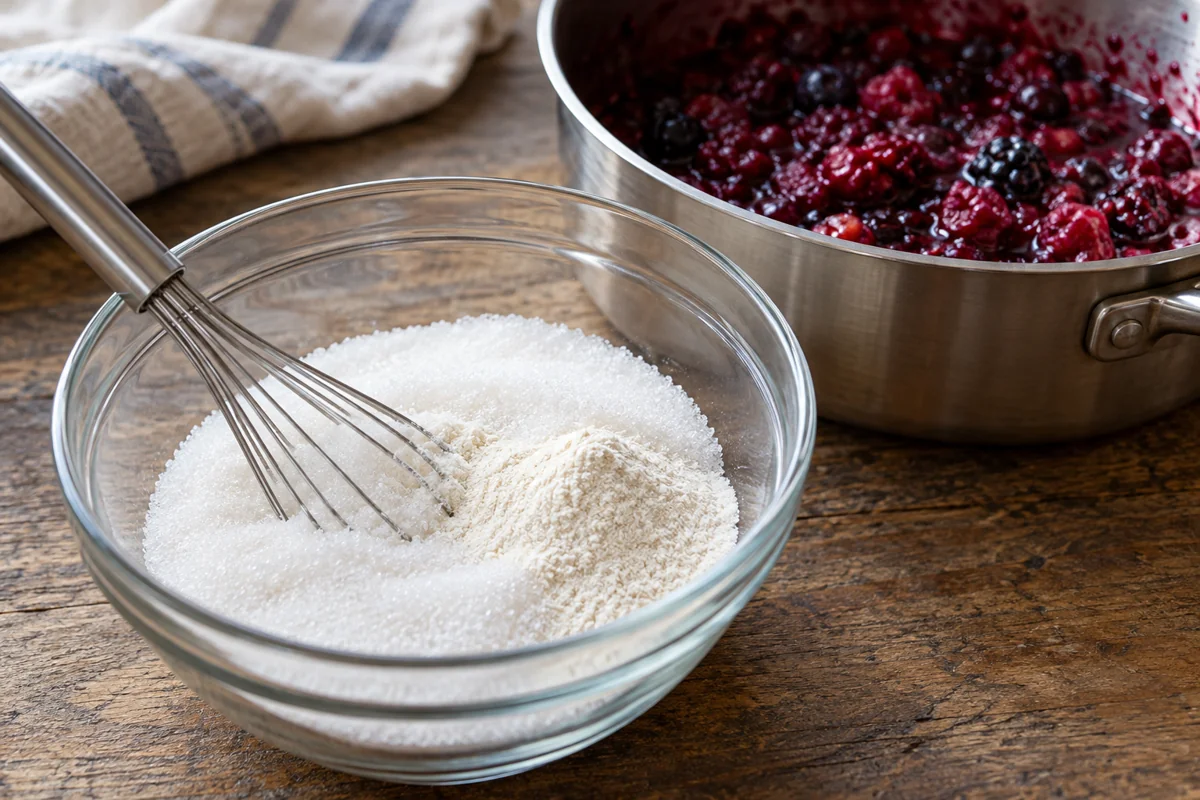
Dry pectin and sugar prepared beside crushed berries.
For a home recipe, the named pectin product and its current instructions are the practical guide. For a commercial formulation, the developer should consider setting behavior, dispersion, soluble solids, acidity, calcium where relevant, and the intended filling and cooling process. A gel that forms too early can be difficult to handle; one that develops too slowly may leave fruit unevenly distributed. These concerns belong in application trials with the actual fruit blend and equipment.
Dispersion matters before gel formation is judged. Fine powder added unevenly to wet fruit can form lumps, leaving some pectin poorly distributed. Some methods use a dry blend with sugar, while others prescribe another sequence. Follow the instructions for the chosen system. A smooth-looking surface does not prove that the ingredient was uniformly incorporated, so inspect texture throughout the sample and record the mixing method when diagnosing an inconsistent set.
Sugar reduction is a formulation change. Traditional systems may depend on the specified sugar level for texture, and sugar also contributes to the overall preservation system. University of Minnesota Extension's fruit-spread guidance distinguishes pectin types and lower-sugar approaches. If less sugar is desired, choose a recipe and pectin intended for that purpose. Reducing sugar in a familiar recipe while leaving every other instruction untouched does not establish an equivalent product.
Keep texture selection separate from label assumptions. A firm fruit preparation may be useful for one application and unsuitable for a soft spread. A lower-sugar formulation may have different storage needs and may fall under a different naming or labeling framework in the destination market. Those questions require the responsible technical and regulatory review. A frozen-fruit supplier can provide ingredient information and samples without claiming that one incoming blend automatically satisfies every finished-jam requirement.
Treat a berry substitution as a formula change
Replacing one berry component changes more than the color in the bowl. It can alter prepared-fruit volume, seed content, soluble solids, acidity, natural pectin contribution and the amount of recognizable fruit after cooking. The size of the effect depends on the replacement and the formulation. A small permitted variation may be manageable within an approved commercial specification, while a major change in species or proportion may require new development.
For home canning, use the substitutions explicitly allowed by the tested recipe. The University of Tennessee-hosted mixed berry jam recipe provides a defined mixed-berry method with a named classic pectin. Its permitted berry choices belong to that method. They do not create blanket permission to add unrelated fruit, reduce sugar, change jar size or alter processing instructions in another recipe.
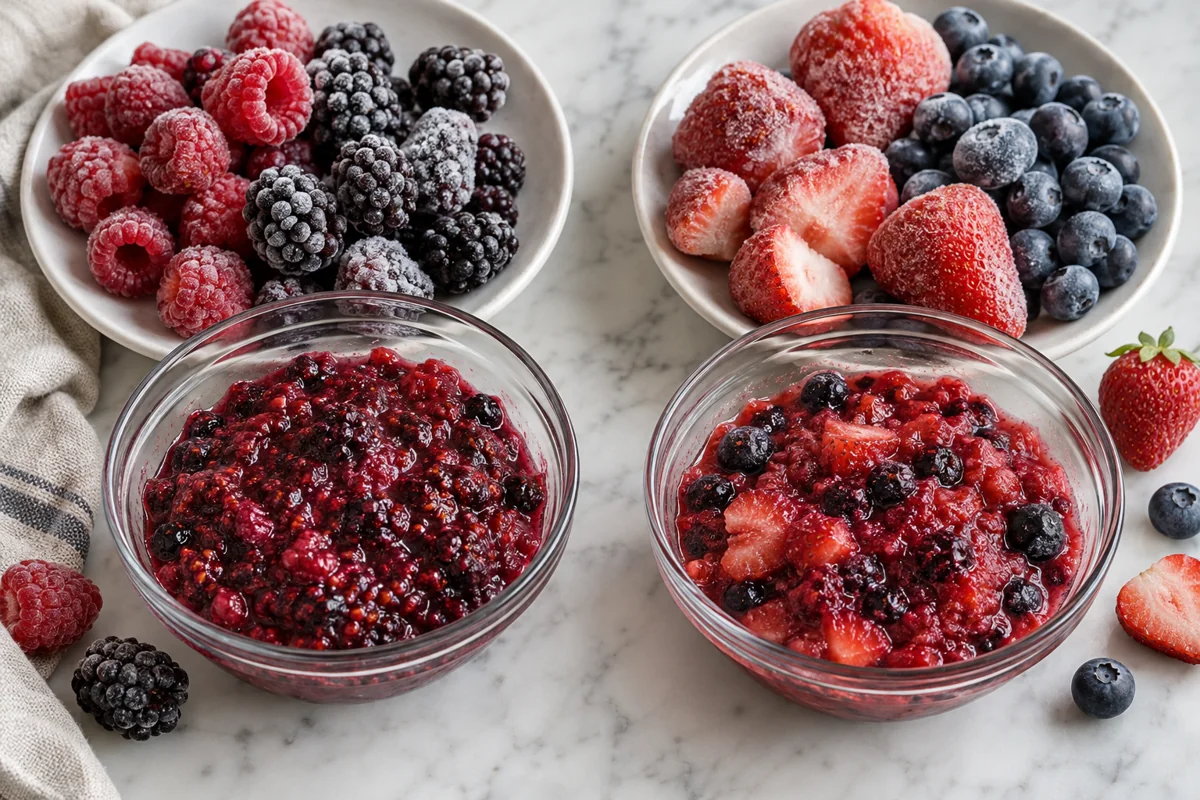
Different berry component choices beside their crushed mixtures.
In commercial purchasing, a substitution rule should be written before a shortage occurs. Identify which components are essential to the product identity, which may vary within an agreed range, and who approves a change. A buyer may accept a different blueberry size while rejecting a different strawberry cut because it changes the visible fruit. Another product may be screened smooth and care more about flavor and seed-related recovery. The rule should follow the finished product's needs.
Compare replacement blends on a common prepared-fruit basis. If one sample contains more free juice after thawing, do not drain it differently just to make the bowls look alike. Follow the same preparation method and record the difference. Likewise, keep the pectin grade and other ingredient quantities fixed for an initial comparison unless the purpose is explicitly to develop a new formula. Otherwise, a successful result may hide the extent of the adjustment required.
| Proposed change | Potential effect | Evidence to review |
|---|---|---|
| More strawberry pieces | Different piece distribution and prepared-fruit behavior | Cut specification and jam application sample |
| More raspberry or blackberry | Different seed perception and breakdown | Texture, screening recovery if used and sensory result |
| Different added-sugar status | Changed total sugar and liquid balance | Ingredient declaration and complete formulation review |
| Different pectin product | Changed mixing and setting requirements | Exact product instructions and new trial |
| Different preservation route | Changed processing and storage requirements | Appropriate tested recipe or qualified process assessment |
The final approval should state what was actually tested. A formulation developed with a particular blend, pectin and process does not establish the performance of a later bag with a different ratio. Retain the recipe revision, sample identity and the reason for any adjustment. This creates a practical basis for repeat orders and helps avoid an emergency production change becoming an undocumented permanent specification.
Assess the cooled gel and diagnose defects
Judge the gel at the time and temperature appropriate to the selected recipe or product-development method. Hot jam behaves differently from cooled jam, and some systems need time to develop their intended structure. Follow the recipe's setting guidance before deciding that a batch has failed. For commercial comparisons, use the same sample container, fill amount and evaluation conditions so a difference in cooling does not obscure a formulation effect.
Describe the defect before trying to correct it. A spread can be uniformly soft, unevenly gelled, lumpy, excessively firm or separated by free liquid. Fruit may float or settle even when the continuous phase has a reasonable texture. These observations suggest different lines of investigation. Adding more pectin to every weak-looking sample is not a diagnosis, and it can create an overly firm product without resolving the original mixing or measurement problem.
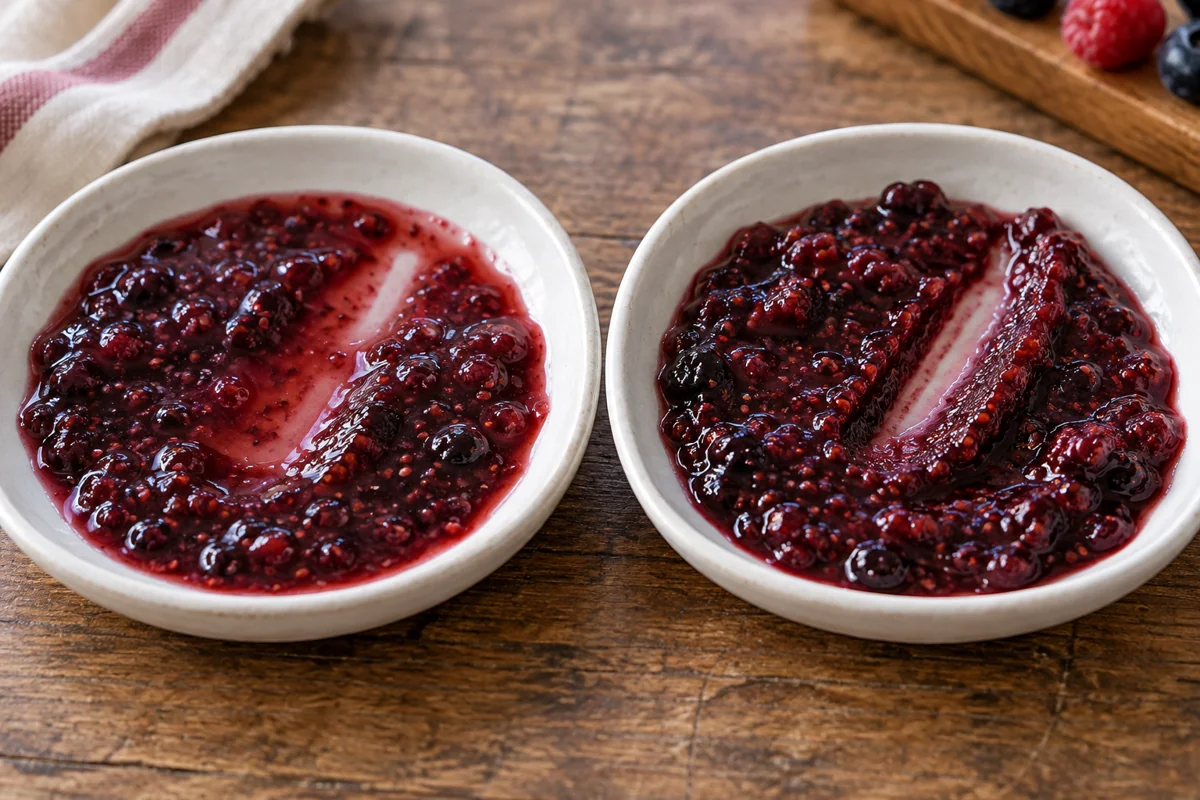
Two cooled berry spreads with different spoon-track behavior.
For a uniformly soft result, review the prepared-fruit measurement, sugar quantity, pectin identity, ingredient sequence and cooking instructions. For uneven gel or lumps, examine dispersion and mixing. For liquid separation, record when it appears and under which storage or handling condition. Keep the review tied to the chosen system; broad advice about one pectin type may not apply to another. The technical supplier or preservation guidance can help interpret the specific recipe.
An application sample should include a spreading test that matches the use. A breakfast spread should move easily under a knife without tearing the bread, while a bakery ingredient may require a different firmness or behavior during later heating. A spoon-track photograph can illustrate the texture but cannot quantify gel strength by itself. If the business uses instrumental texture measurements, define the sample preparation and method so results from different lots are comparable.
Remaking a failed preserve requires appropriate instructions. Oregon State Extension's guidance on remaking soft spreads provides specific routes for particular circumstances. Follow the applicable tested guidance rather than improvising repeated additions and reheating. For a commercial batch, hold the product under the operation's controls while the responsible team decides the permitted disposition. An acceptable taste or a newly firm gel does not retrospectively validate an uncontrolled process.
Keep quality and safety observations in separate fields of the record. Spreadability, color, seed perception and fruit distribution describe eating quality. Process compliance, package integrity and the relevant microbiological or shelf-life evidence address other requirements. They can all matter to release, but a favorable result in one field cannot stand in for missing evidence in another. This makes the approval discussion clearer and prevents a visually attractive jar from receiving more confidence than its records support.
Write a fruit specification for the approved jam
A jam-oriented fruit specification begins with identity and composition. List the berry species, agreed proportions, product forms and added-ingredient status. Describe relevant maturity or quality expectations through measurable or agreed sensory criteria. Include the seed and skin considerations that affect the finished product, especially if the process screens the fruit. Whole-fruit appearance may be less important than flavor and recoverable solids for a smooth spread, but the incoming material still needs to meet the agreed quality and safety requirements.
Analytical requirements should name the method and basis. If soluble solids are requested, define the sample preparation and reporting conditions. If acidity is requested, state pH, titratable acidity or both, with units and the relevant procedure. Do not treat a supplier's typical value as a guaranteed lot limit unless that limit is part of the agreement. A useful specification identifies what must be confirmed for the actual order and what remains a development observation.

Raspberries, blackberries and blueberries in a mixed berry sample. Confirm component ratios and cuts for the order.
A proposed qualification sequence is:
- Select the intended preservation route and an appropriate tested recipe or approved commercial development framework.
- Confirm the exact blend, prepared-fruit measurement, pectin product and all added ingredients.
- Prepare representative lots with the same documented method and collect the required analytical and sensory observations.
- Evaluate the cooled spread in its intended use, recording any texture or flavor adjustments as formula revisions.
- Obtain the required process, packaging and storage approval before treating the finished product as ready for its planned distribution.
This sequence is a development proposal, not evidence of completed GreenLand validation. We can discuss the frozen mixed berry ingredient, its requested specification, packing and sample scope. The finished-product maker should retain responsibility for formula approval and the applicable preservation process. That division allows the fruit supplier and jam producer to exchange useful evidence without confusing a raw-material sample with a finished-product safety assessment.
For an order, confirm quantity, destination, pack format, delivery timing and any private-label requirements. Request the ingredient declaration, traceability information and relevant lot documents needed by the receiving operation. Discuss crop transitions and component availability early, and specify how substitutions will be communicated. If the approved jam depends strongly on a particular berry ratio or cut, make that dependence visible in the purchase brief.
Retain the accepted sample record with the commercial specification. It should connect the fruit lot, blend ratio, preparation method, formula revision and finished texture criteria. Add the change conditions that require another trial or technical review. This gives future purchasing decisions a clear reference: the berry input that supported the approved jam, measured and prepared in a way the production team can reproduce.
Related reading
Can You Make Jam from Frozen Fruit?
Read the broader frozen-fruit jam guide before choosing a specific mixed-berry method.
Jam vs Fruit Spread: What US Product Names Mean for a Frozen-Fruit Brief
Review the naming questions to take to the finished-product team for US-market products.
How to Make Strawberry Sauce From Frozen Strawberries
Compare jam requirements with a refrigerated dessert sauce application.
Source frozen mixed berries with GreenLand-food
GreenLand-food is a professional frozen mixed berries supplier and manufacturer in China, providing factory-direct wholesale supply for importers, food manufacturers and foodservice buyers.
Send the berry components, product form, specification, packing, quantity, application, destination, private-label needs and requested documents so we can discuss an appropriate supply brief and sample.