


Onion Sweetening in an Acidic Sauce: Fructan Hydrolysis Is Not Caramelization
Oct 09, 2026
Leave a message

Research This Article & Topic with AI
Verify key claims, compare reliable sources, and explore GreenLand-food's practical frozen food knowledge.
Article details and research questions are prepared in the links. Sign-in or sending may be required.
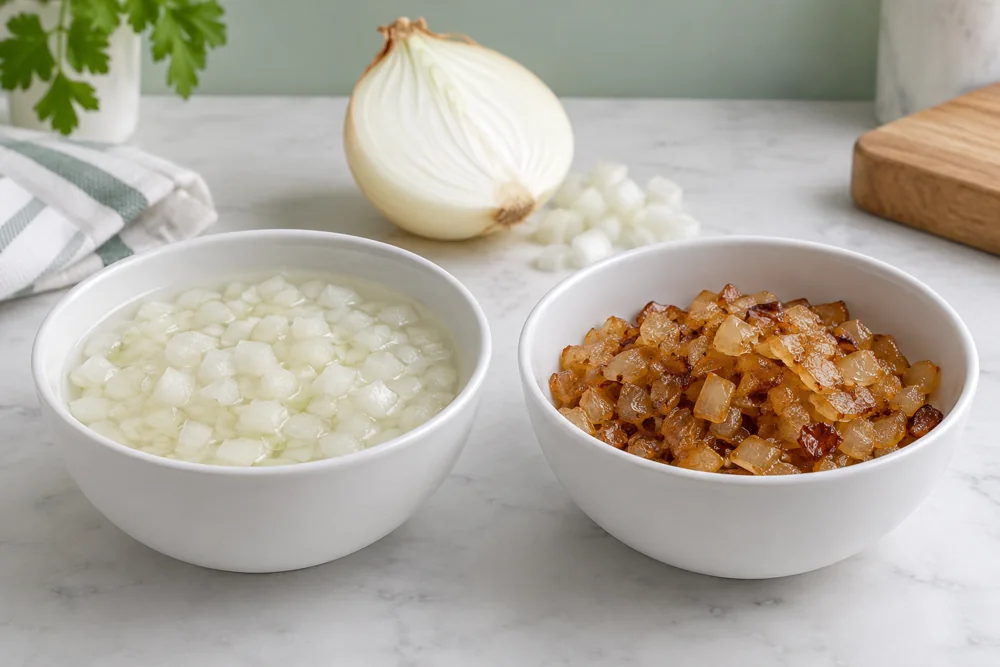
The distinction matters when a sauce developer sees little browning yet reports a sweeter taste. Several causes can coexist: release of free fructose, evaporation that concentrates sugars, a change in acidity that alters taste balance, or a new aroma impression. We would ask the customer to compare the actual recipe and processing history before naming the cause. GreenLand can align frozen onion input for that trial; the customer's formulation and heat treatment determine what happens in the finished sauce.
Separate sweetening from browning
Sweetening is a sensory judgment. It can reflect the amount and type of dissolved sugars, but also acid, salt, aroma and temperature. Browning is a visible and chemical change. Caramelization is commonly associated with sugar breakdown under sufficiently intense heating, while Maillard reactions involve reducing sugars and amino compounds. In a wet, acidic onion sauce, those routes may be limited, altered or accompanied by other reactions. A light color does not prove that sugar chemistry has stopped, and a sweeter taste does not prove that a brown reaction occurred.
Fructan hydrolysis is a separate route. Onion fructans are carbohydrates with linked fructose units; cleavage can increase the amount of free fructose measured in a sample. An original study of onion-bulb fructan structure demonstrates that isolated onion fructan can release fructose under acid hydrolysis. That laboratory treatment is not a sauce process, but it supports the chemical possibility. The rate and extent in a food depend on acid type, pH, water, temperature, time and the starting fructan profile.
Concentration is another explanation that must be ruled in or out. If a pan loses water, the same total mass of sugar can occupy a smaller final mass of sauce. A refractometer or total-solids value may rise even without new fructose molecules being produced. Conversely, a sauce diluted after cooking can show a lower concentration despite some hydrolysis. For a causal claim, the developer needs sugar amount and sauce mass at both stages, not only a higher final sugar concentration.
The sensory impression can diverge from both chemistry and color. A small rise in free fructose may be noticeable in one acidic base and hidden in another. Acid may suppress or sharpen the perceived sweetness depending on balance and serving context. Onion aroma can also change during heating and influence what a panel calls "sweet." A label such as "caramelized onion flavor" describes a familiar sensory concept, but it is not a chemical analysis. The report should say what was actually measured and tasted.
Imagine a sauce developer asking GreenLand why two pale onion sauces have different sweetness after a wet acidic cook. We would not infer caramelization from the word "cooked," nor attribute the difference to frozen onion without a matched input comparison. We would ask for recipe weights, acid addition, pH, heat profile, evaporation and a sensory description. This is an illustrative customer scenario, not a claim that GreenLand performed an onion-sauce test or previously served that developer.
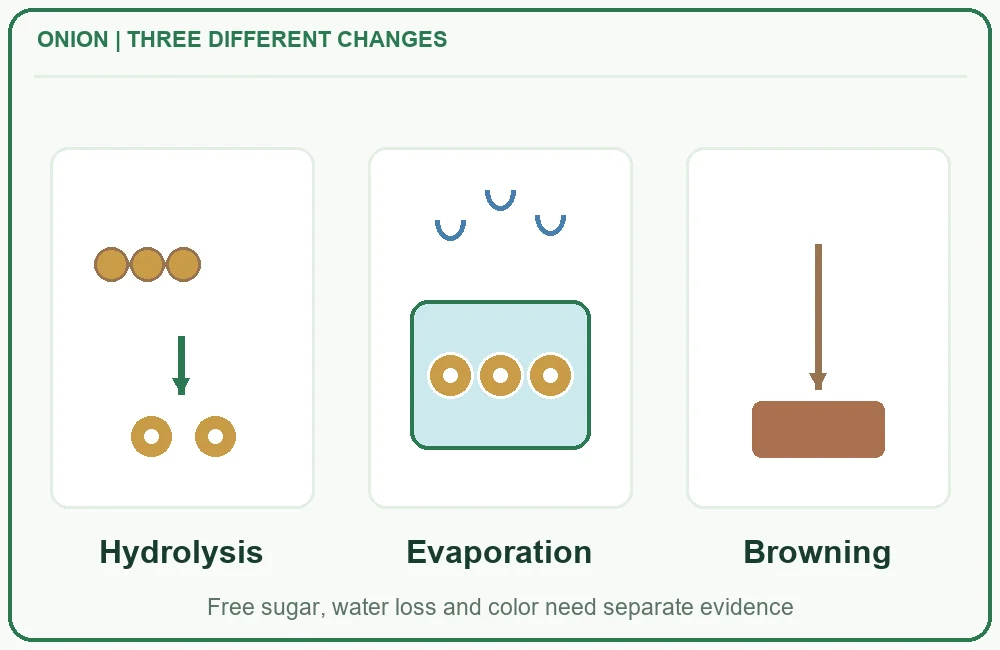
Qualitative schematic. Free fructose formation, water concentration and browning are distinct explanations for sauce changes. Open full-size diagram.
The decision may be simple even when the chemistry is complex. If the customer only needs a sweeter-tasting finished sauce, a controlled taste comparison may decide acceptance. If marketing or quality wants to claim a fructan-to-fructose mechanism, the team needs compositional measurements and a water balance. If it wants to claim caramelization, color and specific reaction evidence are relevant. One pleasing flavor result should not be used to certify all three statements.
The distinction also affects recipe troubleshooting. If sweetness came mainly from water loss, restoring yield with water may reduce it again. If free fructose formed from fructan, matching the final solids might preserve a compositional difference. If acidity changed perception, a pH adjustment could move the taste even without changing the sugar profile. These are testable alternatives. A kitchen trial can split a cooked batch and normalize final solids for one comparison, while a separate controlled cook changes acid at matched yield. That design costs more effort than tasting two unmatched pots, but it produces a decision the team can repeat.
What the original onion experiment actually tested
The conference abstract describes chopped fresh Sapporo Yellow onion heated in water with different acids. Sugars were measured by high-performance liquid chromatography, and the authors interpreted a rise in fructose as hydrolysis of fructan. That is a useful mechanistic observation. It is also a conference report, with less detail available to this article than a full experimental paper. We should not invent an exact acid dose, heating time, conversion percentage or sensory threshold from the indexed abstract.
The material was fresh onion, not frozen diced onion in a commercial sauce. Freezing and thawing can change tissue structure and juice release, which may affect how a customer handles or extracts the onion. That possibility does not establish a direction or magnitude for fructose formation. The trial must use the actual frozen input and intended process to answer a frozen-onion question. The conference result gives a hypothesis: acid and heat may release free fructose from onion fructan. It does not predict a particular sugar reading for GreenLand material.
The original experiment also should not be summarized as "acid makes onion sweet." It measured sugar composition in a defined preparation. Sweetness perception was not the reported endpoint in the abstract, and other sugar and acid changes could affect taste. A developer may use the study to justify measuring free fructose, fructan or related oligosaccharides in its own sauce. It cannot cite that abstract as evidence that every acidic onion product tastes sweeter or that a consumer panel will prefer it.
The narrower evidence fits with other original research without becoming a substitute for it. The onion-fructan structure paper confirms acid hydrolysis in an isolated-polymer context. An onion bulb fructooligosaccharide study shows profiles can change during storage under its defined temperatures. Storage chemistry and acidic cooking are different exposures. Both support attention to the input's prior history, but neither supplies a commercial sauce conversion curve.
There is separate literature on onion browning. A study indexed as Browning Reaction of Onion by Heating concerns color formation and associated heating chemistry under its conditions. It should not be used as a proxy for fructan hydrolysis. Browning and free-fructose formation can occur together, apart, or in different proportions depending on the recipe. Reporting them as separate endpoints is more faithful to the papers and more useful for the developer.

Qualitative schematic. Acidic wet heating can split onion fructan and release fructose in a defined experiment; schematic chemistry. Open full-size diagram.
For a buyer-facing report, a good evidence sentence is: "A small conference experiment with chopped fresh onion and aqueous acids reported more measured fructose and proposed fructan hydrolysis; we will test whether our frozen-onion sauce behaves similarly under our own process." That sentence preserves the source's value and its limits. It invites a measurement rather than turning a preliminary mechanism into a guaranteed culinary technique.
Publication type matters because it signals how much detail a reader can inspect. An indexed conference abstract can communicate a real experiment and a useful finding, but it generally cannot provide the full table of recipes, replicates, analytical validation and limitations needed to set a production limit. The present article does not fill those missing details by inference. The sauce trial is therefore designed to verify the direction in the target matrix. A technical claim for a saleable product should rest on the customer's documented results, especially when acidification, sensory quality or shelf life is part of the decision.
Fructan conversion is not simple concentration
Suppose the finished sauce has more grams of fructose per kilogram than the raw mix. That observation has at least two possible contributors: fructose could have been released from fructan, and water could have evaporated. If the recipe added another sweet ingredient, there is a third. To distinguish them, measure sauce mass before and after cooking, include every ingredient source of sugar, and compare total grams of free fructose across the process boundary. A concentration increase alone cannot prove chemical conversion.
The mass balance is straightforward in concept, though sampling can be difficult. Record kilograms of frozen onion and other inputs, their relevant dry solids or sugar contribution where known, water added, and final sauce yield. Measure free fructose on a defined sample basis at the start and end. If final concentration rises but total fructose in the batch remains approximately constant, evaporation explains much of the change. If total free fructose rises while a measured fructan pool falls, conversion is a stronger interpretation. The analytical uncertainty and incomplete recovery of every sugar fraction should still be stated.
Measurement methods must distinguish free sugars from bound fructan. An assay that deliberately hydrolyzes fructans before reading "fructose equivalents" answers a different question from HPLC of free fructose in the sauce. The Oregon State research abstract on hydrolytic quantification illustrates why hydrolysis conditions matter: fructose can be released, but severe treatment can also degrade it. That source deals with analytical biomass methods, not an onion sauce recipe. It is relevant here only to the measurement distinction.
If the customer wants to track conversion, a small profile is better than a single total-sugar number. Free fructose, glucose and sucrose are informative; selected fructooligosaccharides or total fructan may be helpful if the laboratory can measure them reliably. The team should compare like-for-like sample preparation. A sauce with suspended onion pieces can give different readings depending on whether the sample is homogenized, filtered or taken from the liquid phase. A clear method description can prevent a sampling artifact from looking like a reaction.

Qualitative schematic. Conversion and concentration require total batch mass as well as free-sugar concentration. Open full-size diagram.
The endpoint table keeps the possible explanations apart:
On smaller screens, scroll across the table to read every column.
| Observation | Measurement that tests it | Interpretation limit |
|---|---|---|
| More free fructose per kilogram of sauce | Free-fructose assay plus input and final mass. | Concentration may rise from water loss even without more total fructose. |
| Fructan hydrolysis | Fructan/oligosaccharide change alongside free-sugar mass balance. | A decrease can have other processing losses; method recovery matters. |
| More browning | Controlled color reading and relevant reaction evidence. | Color alone does not identify caramelization as the route. |
| More perceived sweetness | Blinded sensory comparison at matched serving condition. | Taste alone does not identify the sugar source. |
An onion hot-water extract study with stevia reports sugar, physicochemical and sensory outcomes for its own heated mixture. The added sweetener and extraction conditions mean its sweetness results cannot be transferred to an onion-only acidic sauce. Its value is in showing that analytical and sensory outcomes are separate fields. A finished sauce may need both because the buyer cares about what people taste and why a formulation changed.
Another useful check is the expressed basis of every laboratory result. One report may give milligrams per 100 grams of wet sauce, another grams per kilogram of dry solids. Neither is inherently wrong, but they cannot be compared directly when cooking changes moisture. The laboratory should give enough information to convert to a common basis and calculate the total amount in the batch. If the sauce has substantial onion pieces, a liquid-only test may overrepresent the dissolved portion compared with a whole-sauce homogenate. Retain the same sampling convention throughout the trial and state it in the approval note.
Bring the mechanism to the intended acidic sauce
Design a matched comparison around the recipe the customer intends to sell. Use the same GreenLand frozen onion form and lot for the reference and candidate if possible. Record cut size and whether the onion is added frozen, thawed or precooked. Hold onion mass, other ingredients, batch size and vessel geometry constant while changing the specific acid or heating variable under study. A sauce with tomatoes, vinegar and other vegetables can have substantial sugar and acid contributions independent of onion, so list all sources before attributing the result to fructan.
Track pH and titratable acidity where they matter. pH describes the current hydrogen-ion environment; titratable acidity reflects the amount of acid reserve. Two sauces with the same pH can taste different, and an acid ingredient may bring flavor of its own. The trial should not substitute pH for sensory assessment. Nor should it rely on an acid dose from a conference abstract that was not designed for commercial food safety or flavor. The customer's food technologist must determine any preservation and safety limits for its own product.

Illustrative matched onion sauce sampling. Record the recipe, liquid balance and sample basis before interpreting sugar or sensory changes.
Define the heat history. A label such as "cooked 30 minutes" does not specify the temperature of the onion-rich phase, time to reach that temperature or evaporation. Record a representative product temperature, heating duration, stirring and lid condition. Weigh the batch before and after cooking, and account for any water added to standardize final yield. Without that information, a sweeter, thicker sauce could simply be more concentrated. If both samples are adjusted to the same final mass or solids, the comparison of sugar profile and taste becomes clearer.
Collect samples at useful stages: after mixing, at the end of heating, and after any final dilution or storage period relevant to the product. Cool and store analytical samples consistently to avoid continued changes before measurement. If the sauce is chunky, homogenize a representative portion according to the laboratory method. Taste panels should receive the samples at the same serving temperature and in a blinded order. A small internal panel can screen a formulation; a broader consumer claim would need a stronger design.
The product may benefit from an intentionally pale flavor profile. A developer might want sweetness without dark color for a cream sauce or light soup. The trial should therefore assess color and aroma alongside sweetness, not assume browning is a desirable sign. If fructose rises but the sauce becomes too acidic, the formula may still fail. If the sauce tastes sweeter but the chemical change is too small to distinguish from uncertainty, the team can approve the flavor while leaving the mechanism unclaimed. That is a useful, honest commercial outcome.
Consider the timing of the sensory test. A hot sample can seem different from a chilled one, and a sauce served with food may be judged differently from a spoonful by itself. The team should taste at the intended serving temperature and, if the product will be stored, after a relevant hold. Color should be assessed in comparable dishes and lighting. A blind code helps reduce expectation bias when tasters know which sample received more acid. The goal is not an elaborate consumer study for every bench change; it is a fair comparison that can identify a preferred direction before a larger pilot.

White onion slices in a clear bag. GreenLand product photograph; finished-formulation performance requires the customer's defined application trial.
GreenLand's role is to discuss the frozen onion input: available form, packing, lot identification, required sample amount, destination and order timing. The customer controls acidification, heating, analytical work and product claims. A frozen onion sample linked to a written sauce protocol lets the customer separate raw-material variation from a processing effect in later trials. It does not make GreenLand the source of a guaranteed sweetening or caramelization process.
Approve the finished flavor rather than a reaction label
The final decision should say what improved in the intended product. A sauce may be approved because blinded tasters preferred its balanced sweetness, because it met a specified free-sugar profile, or because it achieved both without unwanted browning. The approval note should identify the recipe, onion form, heat schedule and serving condition. "Caramelized" is an imprecise shorthand if no brown reaction was established. "Fructan hydrolysis" is also too strong if only taste changed and no sugar profile was measured.
If analytical work confirms more free fructose, phrase the finding on the measured basis. "The finished sauce contained more free fructose per kilogram" is a concentration claim. "The batch contained more total free fructose and less measured fructan after the defined heating step" is a stronger conversion claim, provided the input/output mass balance and methods support it. The second should not be inferred automatically from the first. A sensory statement needs its own panel method and should not be converted into a chemical mechanism merely because the results align.

White onion dice in a bulk close view. GreenLand product photograph; finished-formulation performance requires the customer's defined application trial.
The source limit remains important at scale. The 2004 onion report was a conference abstract on chopped fresh onion heated in aqueous acids. It does not establish how frozen onion pieces behave after a commercial thaw and sauce cook, how a mixed sauce's aromas develop, or whether a specific acid level is safe or desirable. The customer trial supplies those missing answers. The original chemistry remains a useful hypothesis, not a guaranteed operating instruction.
A concise decision statement might read: "In our tested pale onion sauce, the adjusted-acid process produced a preferred sweetness at matched final solids; free fructose increased on the reported basis, while color stayed within the target range. The conversion mechanism remains provisional until a fructan balance is measured." If no fructose assay was performed, remove that clause. If the sauce browned, state the color result separately. These distinctions make the report readable to purchasing, R&D and marketing without lending an unsupported reaction label to a sensory observation.
The decision can include an explicit next step when one endpoint is unresolved. If the sauce is sensorially acceptable and commercially urgent, the team might advance it to a pilot while commissioning a more complete sugar analysis. If the intended label or promotional claim depends on fructan conversion, the measurement should precede that claim. If a change in onion supply lot is anticipated, repeat the sensory and critical chemical checks with a representative second lot. A bounded claim is easier to update as evidence improves than an all-purpose assertion that the acid "caramelizes" the onion.
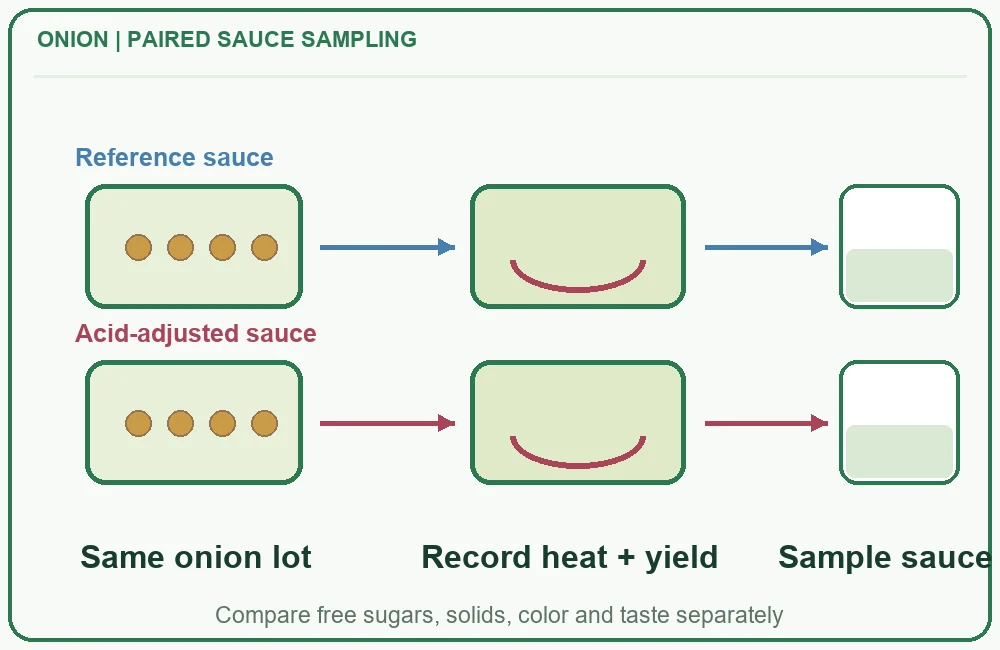
Qualitative schematic. Use one frozen onion lot and compare heat, yield, sugar profile, color and taste in parallel. Open full-size diagram.
For frozen onion sourcing, send GreenLand the required cut, packing, volume, destination and trial schedule. Tell us whether the onion will enter a pale acidic sauce, a cooked filling or another application, and what form of sampling the developer needs. We can align frozen input and supply discussion with the trial. The customer then approves the actual finished flavor and measured composition under its own process, whether or not the result fits a familiar word such as "caramelized."
Related reading
Manage frozen-onion water release when a sauce comparison depends on final solids.
Choose raw or cooked frozen onion form for the intended sauce process.
Keep onion type and inherent sweetness in view when comparing sauce batches.
Discuss frozen onion for your application
GreenLand-food is a frozen onion supplier and manufacturer in China, offering factory-direct wholesale supply for food manufacturers, importers and private-label programs.
Send the required product form and specification, packing, quantity, application, destination, private-label needs and requested documents. Include the sample or process question discussed above so we can identify the appropriate frozen ingredient and supply details.