


What Is a Spanish Onion? Size, Sweetness and Frozen Use Compared
Sep 27, 2026
Leave a message

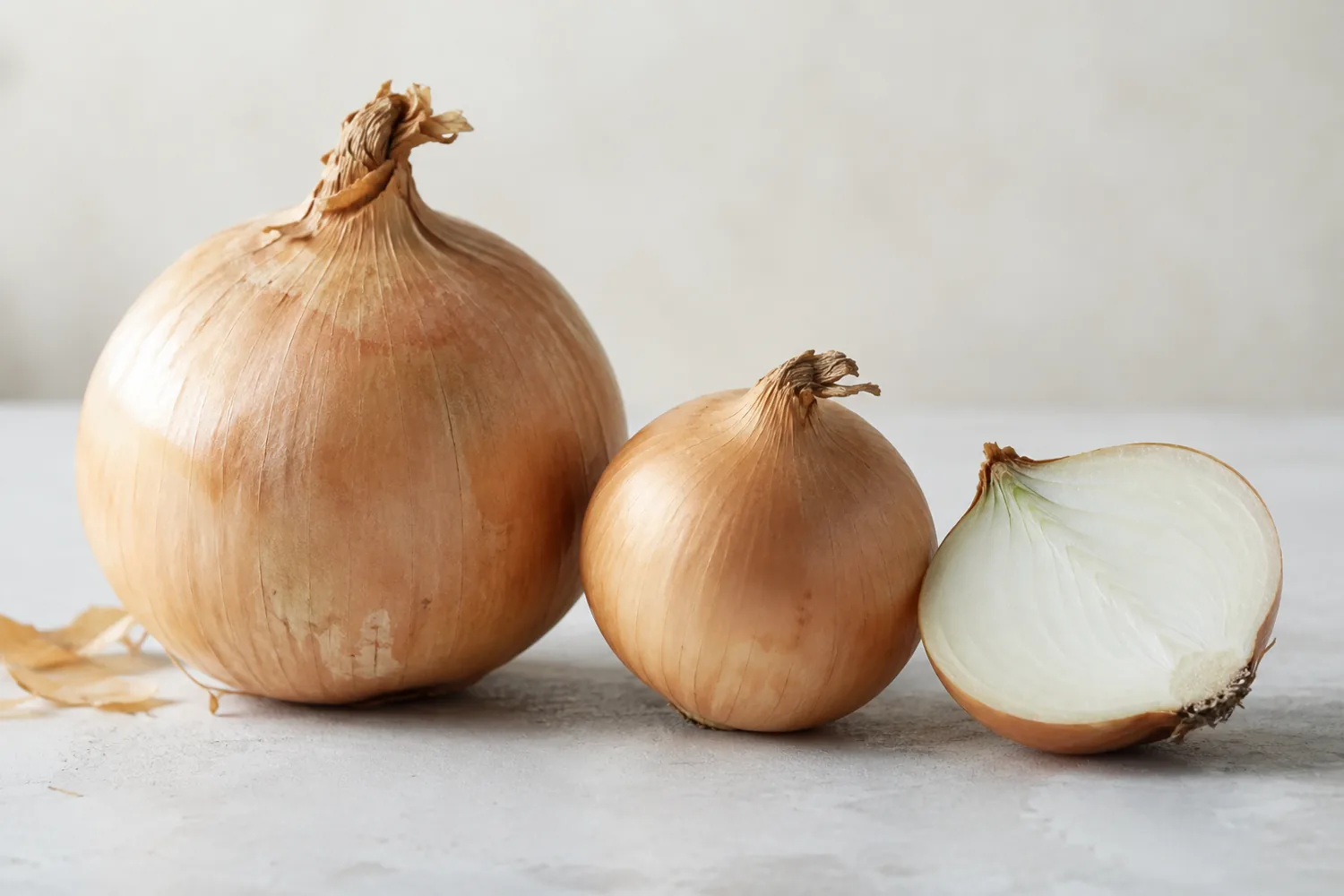
If your recipe developer wrote "Spanish onion" because a sandwich requires broad, crisp raw rings, a frozen onion cut will change that result. If the same recipe needs a mild onion note after sautéing, a suitable frozen slice or dice may do the job with less in-house peeling and cutting. The answer turns on the cooking step and the measurable characteristics of the incoming ingredient. We use that distinction to turn a loose market term into a sample plan and an RFQ that a supplier can actually answer.
What does Spanish onion mean in a produce order?
The everyday description is a large, roundish bulb with a relatively mild bite. Dictionaries and culinary guides commonly describe yellow or white skins and a gentler taste than a sharp cooking onion. Growers and seed references, however, use expressions such as "Spanish," "Spanish style," and "Sweet Spanish" for different cultivars and groups. A University of Delaware variety list, for example, places a Spanish-style yellow onion alongside other onion types, while a separate production table distinguishes Sweet Spanish descriptions from other Spanish types. That is a practical reason to ask for the variety or type when one is material to the order. The word on a menu or a wholesale carton is not a laboratory measure of pungency.
Origin and type also need separate treatment. A bulb described as Spanish style need not have been grown in Spain, and a bulb grown in Spain need not meet the size or flavor expectation of a particular recipe developer. Crop region, day length class, weather, maturity, curing, and storage all influence what a seller can offer. The same broad category can include yellow and white forms. A buyer selecting a raw onion for visible rings may care more about actual diameter and internal condition than the informal type name. A soup factory may care more about pungency, solids, and cooked flavor than the appearance of an intact bulb.
The phrase often reaches purchasing through a recipe rather than through a technical specification. A chef might specify "one Spanish onion" to mean a substantial amount of onion with a mild flavor. That is insufficient for an industrial formulation because individual bulbs vary in mass, a large onion may still have a strong bite, and a change in trimmed yield can alter the cooked onion concentration. Convert the recipe reference into an ingredient weight and a sensory target first. Then decide whether the bulb diameter itself matters. It matters for a broad burger ring, but much less for a 10 mm dice in a sauce.
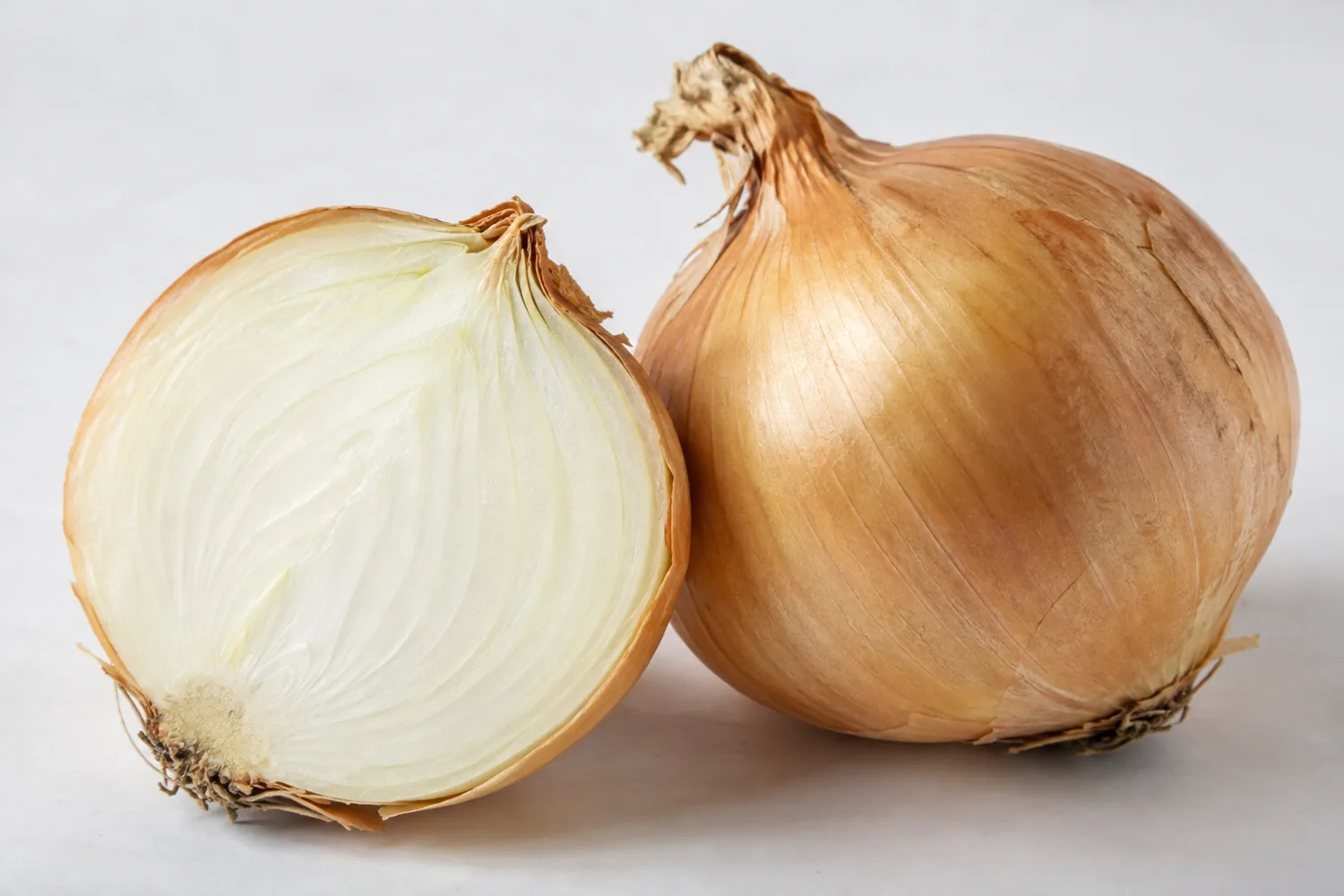
Large yellow onion cross section
For a fresh-bulb contract, request a named type or approved equivalent, skin and flesh color, diameter grade, firmness, neck and root condition, curing state, defect allowance, and a representative size distribution. For a processed cut, the peeled onion's color, cut dimensions, stem and root residue, free-flowing condition, and taste are closer to the point of use. We can review those frozen parameters with a purchasing team. We would confirm the requested Spanish type against available raw material before claiming the frozen pieces came from it.
One useful receiving check is to examine the whole lot rather than a photograph of its largest bulb. Take bulbs from several positions in the pack, record diameter and trimmed mass, and cut a few to look for doubles, soft centers, or damage. Taste evaluation should use a consistent preparation, since a thin raw slice and a deeply cooked sample do not express the same pungency. That simple sampling discipline prevents a broad trade name from concealing variation that later appears as uneven rings, waste, or a stronger finished dish.
If the original request came from a recipe measured in onions rather than kilograms, weigh the reference preparation before rewriting the bill of materials. Record the peeled weight of several typical bulbs and the amount actually added to the pan. Then repeat the finished dish at that as-used weight with the candidate onion. Counting bulbs is convenient in a small kitchen but becomes unreliable when diameter grades change. A weight-based formulation is easier to scale and audit, while the bulb-size requirement can remain separately in place for recipes that display whole rings or long slices. This small conversion also makes a fair comparison between fresh onions and purchased frozen cuts possible.
How does it compare with ordinary yellow and sweet onions?
Spanish onion, yellow onion, and sweet onion are overlapping descriptions in ordinary trade speech. "Yellow" tells you skin color, but yellow onions range from milder to more pungent and from fresh-market to longer storage types. "Sweet" is a flavor and marketing description that may be attached to specific varieties or regional programs. "Spanish" usually suggests a large mild onion, yet variety references show that Spanish and Sweet Spanish descriptions can be separated. Treating the three words as exclusive product categories will create false certainty when a grower's label or a country's retail vocabulary differs from your own.
| Term in a request | Useful expectation | What still needs confirmation |
|---|---|---|
| Spanish or Spanish-style onion | Often a large yellow or white bulb with a relatively mild raw bite | Named type, actual diameter distribution, origin, pungency, storage condition |
| Standard yellow onion | Yellow skin and broad cooking use; intensity varies by lot | Variety, size grade, solids, cooked flavor, trim yield |
| Sweet onion | Mild raw eating quality is often the intended feature | Exact program or variety, short or long storage behavior, cooked performance |
The table is a translation aid, not a grading standard. The Idaho–Eastern Oregon onion industry publishes diameter grades for yellow onions, showing why the size term can be specified directly: medium, jumbo, colossal, and super colossal refer to different diameter ranges. Those trade ranges are useful reference points, but they do not mean every supplier uses the same grade names. Put the numerical diameter distribution and tolerance on the purchasing document where it affects the product. When the finished format is diced onion, specify the cut instead of paying for a size grade that disappears during cutting.
Flavor comparison is more complicated than saying one onion has more sugar. Perceived sweetness also depends on pungent sulfur compounds, water, maturity, and preparation. A raw sample can seem gentle because its sharpness is low; a cooked sample can become sweet as heat softens pungency and changes the balance of flavors. Both conclusions are recipe dependent. If the formula uses onion as a background aromatic, prepare a fixed-weight cooked trial in the actual fat, temperature, and time used in production. If onion is served raw, run a separate raw sensory check at the intended slice thickness. Do not infer one result from the other.
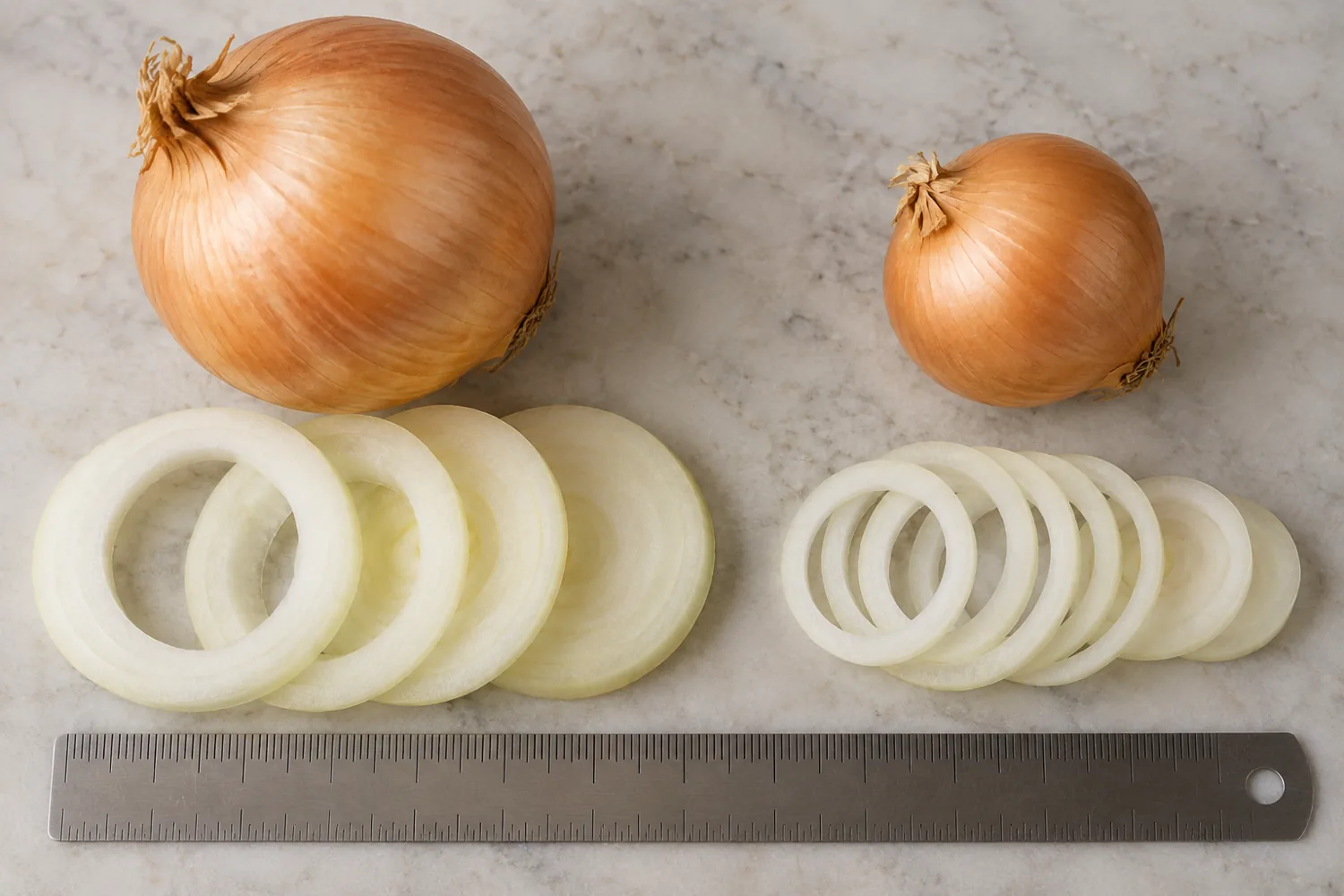
Large and standard onion rings
Storage claims also require care. Some mild sweet onions have relatively short keeping life, but the University of Delaware examples show different storage descriptions among Spanish-related cultivars. Ask for the specific lot's curing and storage plan rather than assuming every Spanish-style bulb behaves like a short-keeping sweet onion. For a frozen ingredient program, the commercial storage question changes: confirm the raw-material window, the freezing schedule, the pack, and the frozen inventory available for repeat orders. This can give production a more predictable cut input, provided the sensory and texture results fit the application.
Use a common reference onion during approval. We suggest weighing the candidate and reference at the same as-used mass, preparing both by the same method, and recording aroma, initial bite, aftertaste, cooked sweetness, color, and water release. Ask panelists to describe what they perceive before telling them which sample is called Spanish. A name can bias a tasting panel toward the result it expects. A controlled comparison can reveal whether the distinction matters in the final meal or only on the procurement form.
When does bulb size affect usable yield?
Bulb diameter matters when the shape survives processing. Large, sound onions can produce broad rings or long slices with fewer small pieces. A foodservice kitchen cutting substantial numbers of onions may also spend less labor peeling a given mass of large bulbs, although this must be checked against the lot's actual skin, neck, root, and defect condition. A single striking jumbo bulb is not evidence of better commercial yield. What matters is the distribution in the delivered lot and the mass of acceptable material after the particular cutting operation.
For rings, define both the bulb diameter and the ring size that counts as acceptable. A large bulb with a double center, heavy skin, or soft layers may create less saleable ring material than a more uniform smaller bulb. A thin ring can break during handling; a thick ring may sit above a burger or fail a frying line's target. Slice thickness and the allowed fraction of broken or small rings therefore belong with the diameter requirement. Check the cutter and the pack handling in the same trial, because a hand-cut sample can overstate what a production line delivers.
For dice, much of the diameter advantage disappears. The cutter converts different bulbs into pieces of a target size, and the economic question becomes peeled yield, defects, cut regularity, and labor. We would record incoming mass, peel/root/top trim, rejected internal defects, and acceptable dice after cutting. This gives a usable-yield figure for the exact lot and cutter. It also shows whether a named large-bulb type earns its price in a sauce or ready meal. Do not borrow a yield percentage from another crop or plant; a different peeling system and defect tolerance can change the answer.
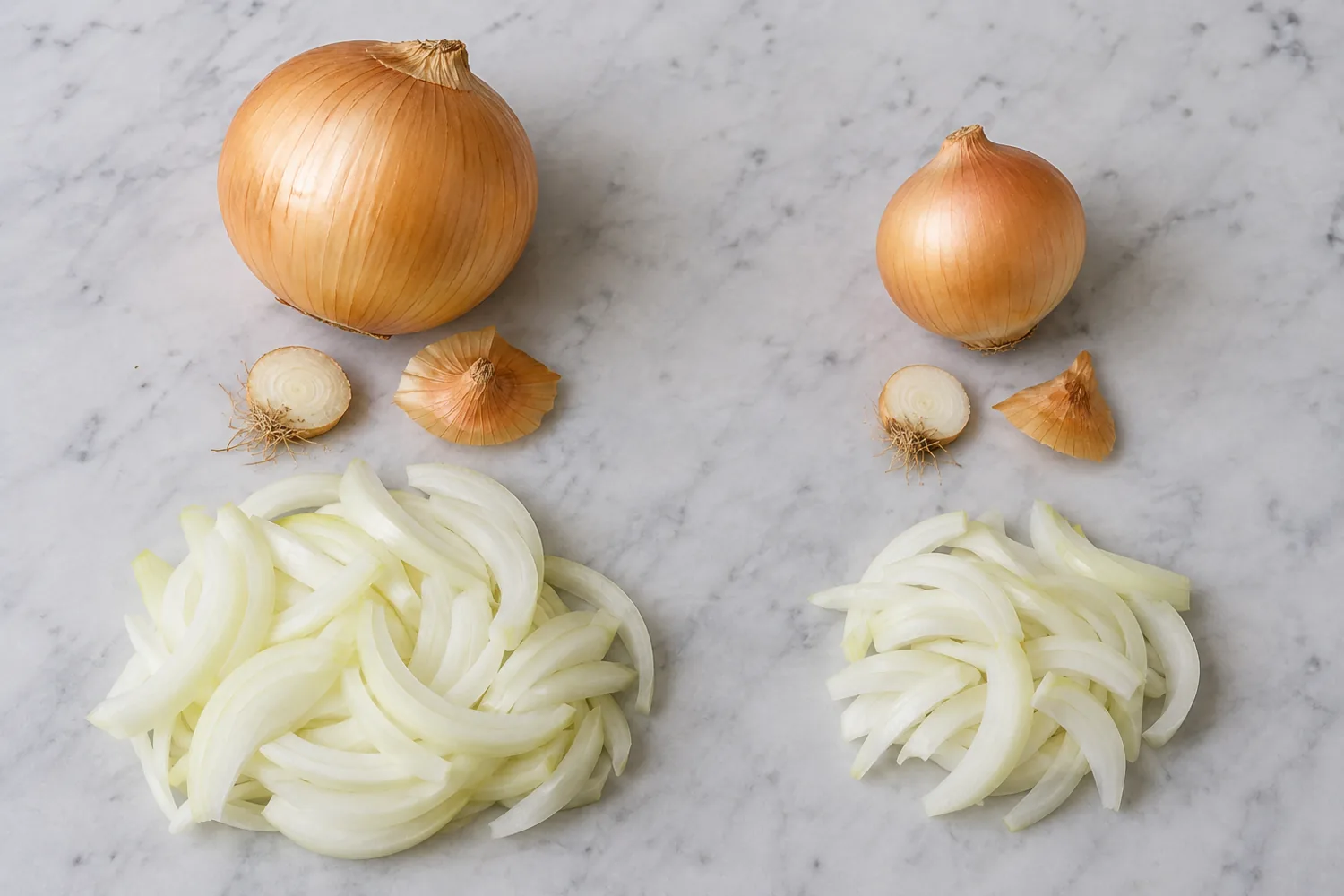
Onion bulb trim and slices
Water is part of the yield discussion. A cut onion can carry surface moisture, and a frozen piece can release liquid when thawed or cooked. Net purchased weight alone does not describe the onion solids and flavor delivered to a soup kettle or sauté line. Compare drained weight or cooked reduction where those measures affect the formulation. A large fresh onion with high water and a smaller, firmer onion may have different mass balances even when both feel mild raw. An as-received weight, a trimmed weight, and a cooked result make the comparison accountable.
Packing and handling can erase a theoretical yield advantage as well. A fresh bulb must travel through receiving, storage, peeling, cutting, and waste removal. Frozen dice shift much of that preparation upstream, but they add frozen storage and portioning requirements. For a factory choosing between fresh bulbs and IQF onion, map the entire path: labor hours, trim disposal, line downtime, cold storage, freezer stability, and finished-product performance. The best choice is the one that meets the recipe and operating target at a known usable cost, not necessarily the largest onion in a catalog.
When an RFQ arrives with only "large Spanish onion," we ask what the size is meant to achieve. If the answer is "wide rings for a cooked sandwich," diameter and slice integrity deserve a pilot. If the answer is "less chopping work in a sauce," an approved frozen dice may serve the operation more directly. The distinction changes the sample plan before a supplier spends time quoting the wrong format.
Will frozen slices or dice preserve the desired role?
Freezing changes the expectation for texture. Onion cell structure softens during freezing and subsequent cooking, so a frozen cut is a sensible candidate for soups, sauces, sautéed dishes, ready meals, and fillings where the onion is heated. It will not reproduce the crisp snap of a fresh raw Spanish-onion ring in a salad or sandwich. That does not make the frozen ingredient inferior; it gives it a different job. Write the job into the specification and evaluate the cut after the same heat and hold steps used in the final food.

Frozen red and white onion dice with caliper
GreenLand-food's frozen onion range includes diced onion, strips, slices, rings, chopped onion, and whole peeled onion, subject to the confirmed order. The product page lists several diced dimensions, including 5 × 5 mm through 20 × 20 mm, and different strip widths. Those are available discussion points, not a promise that a Spanish cultivar underlies each cut. We confirm raw onion type and color separately. The photograph above shows frozen red and white dice with a caliper; it demonstrates the kind of cut inspection a buyer can perform, not the flavor of a Spanish-style yellow onion.

Frozen red and white onion slices
Slices and dice solve different formulation problems. A slice or strip remains visible after moderate cooking and can give a stir-fry, topping, or ready meal a recognizable onion component. A small dice disperses through soup, sauce, or filling and can build a consistent aromatic base. A larger dice may remain visible longer and release water differently in a pan. Test at the intended inclusion rate and cooking time. The image of frozen onion slices shows a supplied cut form; approval still depends on the actual color, thickness, breakage, and sensory target for the product in development.
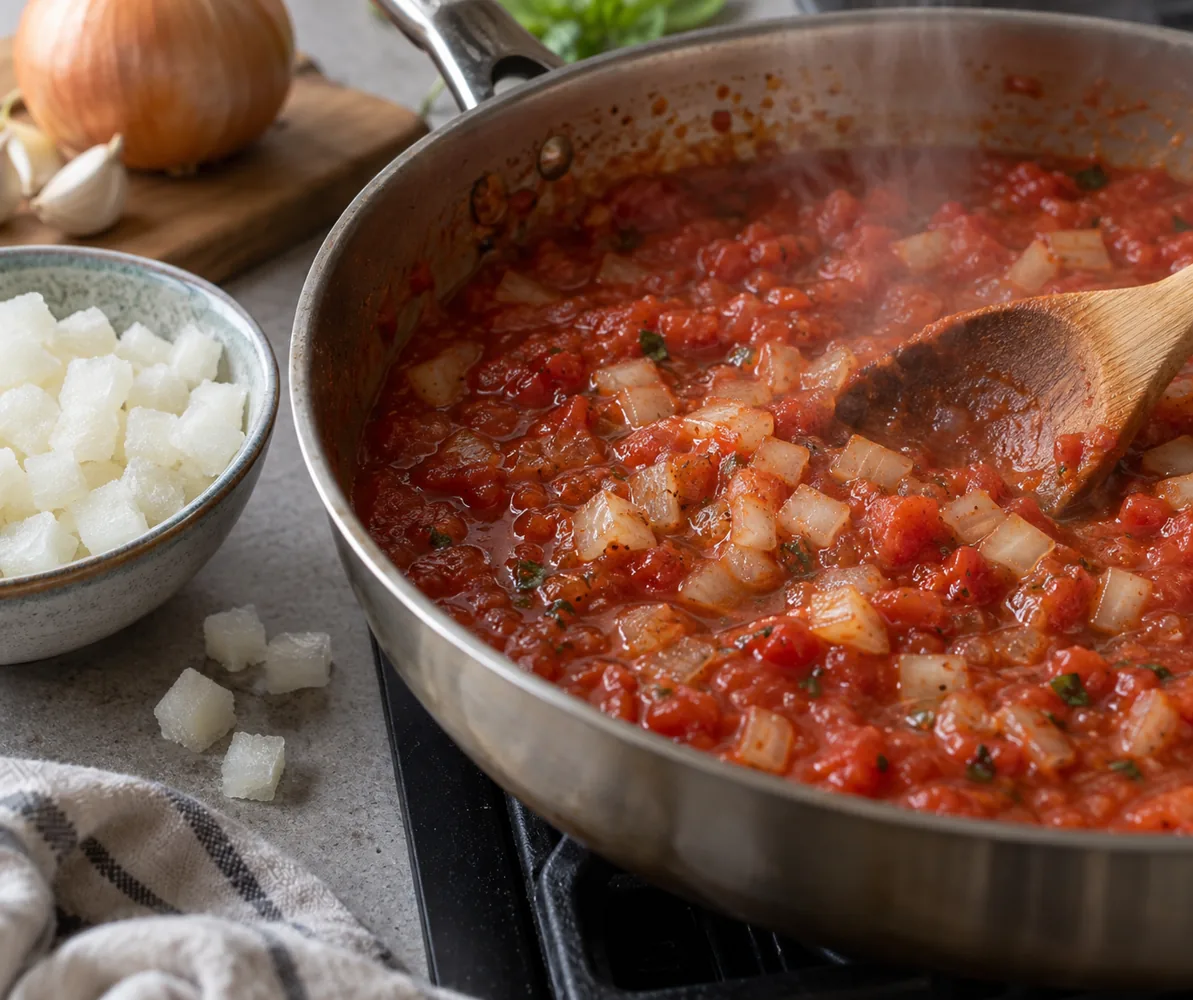
Onion dice in cooked sauce
We recommend a matched application trial rather than comparing cold frozen pieces with a fresh raw sample. Weigh the fresh reference after peeling and cutting, and weigh the frozen candidate as specified. Cook both in the same vessel with the same oil or recipe base. Record time to soften, water release, color, perceived sharpness, sweetness after cooking, and visibility of the onion pieces at the end of the normal hold. A longer simmer may erase differences that remain obvious in a brief sauté. For a chilled or ready-to-eat format, a separate food-safety and texture assessment is required; the cooked-trial result cannot answer that use case.
Frozen handling also belongs in the trial. Check whether the pieces remain free flowing, whether clumps affect dosing, and whether the pack can be opened and portioned in the production environment. Confirm storage temperature and the logistics plan for the destination. If a recipe needs thin, intact rings, ask how slice thickness and ring breakage are controlled from cutting through packing and transport. For small dice, ask about fines and oversize pieces. These are measurable aspects of the finished format, whereas "Spanish onion" remains an imprecise upstream description.
There is a sourcing caveat that should be visible to a buyer: GreenLand-food supplies frozen onions in several colors and formats, but the current product page does not establish a standing Spanish-onion cultivar program. We can review a request for that type against raw-material availability, MOQ, and production feasibility. Until a lot and specification are confirmed, the honest product description is the frozen onion cut and its approved attributes. A sourcing team can still achieve the target flavor through a sample comparison without assuming a cultivar that was never verified.
What should a Spanish-onion RFQ specify?
Start with the finished dish and the incoming form. For a fresh ring program, name the minimum and preferred bulb diameter, skin and flesh color, intended ring thickness, breakage tolerance, raw flavor target, and pack. For a frozen cooked ingredient, name whether the request is dice, slices, strips, rings, or whole peeled onion; give cut dimensions, color, expected cooking method, and the sensory reference that the supplier should match. If a particular Spanish cultivar or origin is mandatory, state it explicitly and request confirmation of availability. If the name is only a shorthand for mildness and size, say so. That small clarification widens the chance of finding a technically suitable lot while keeping the comparison honest.
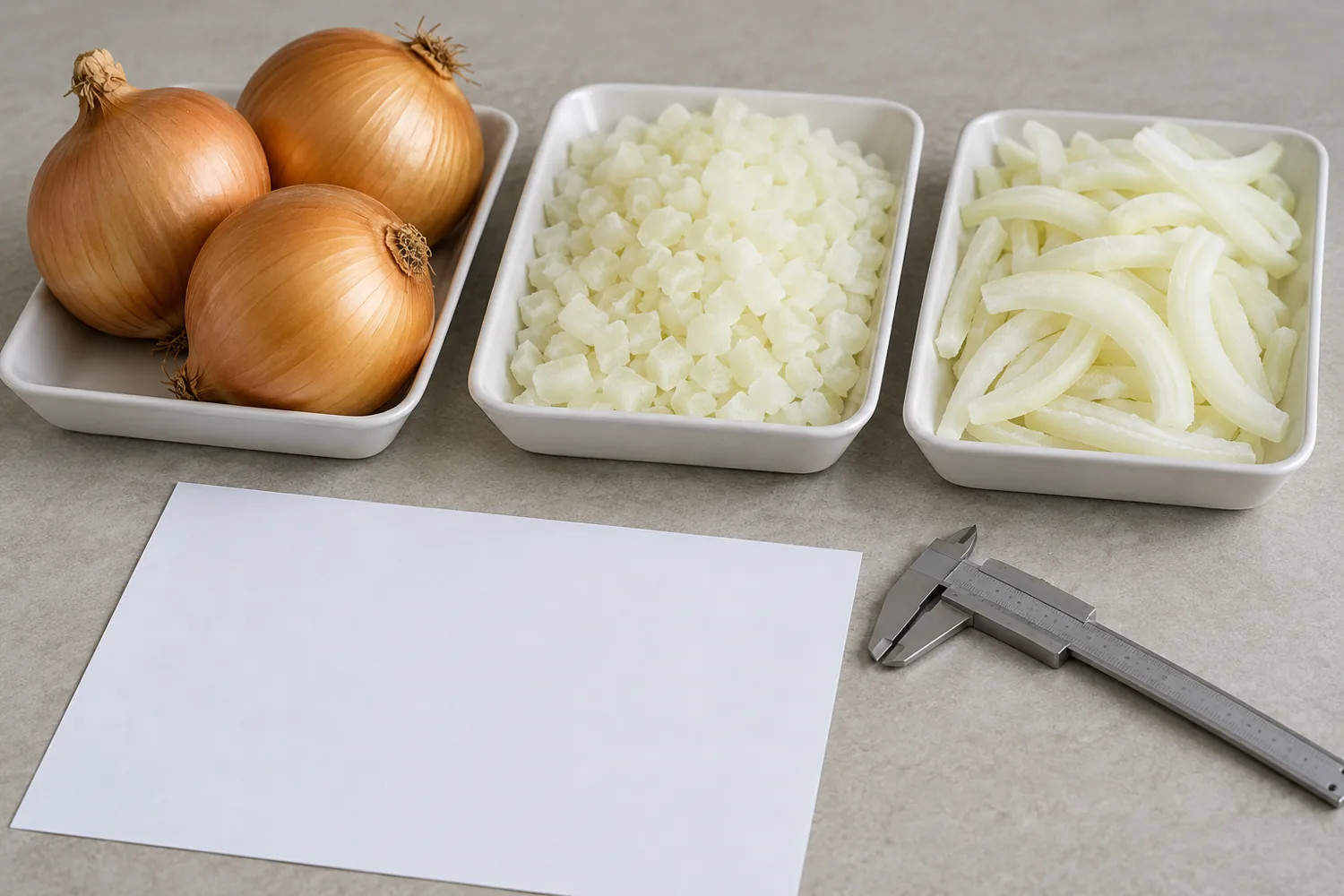
Onion form sampling trays
An RFQ example for a ready-meal sauce could read: "IQF yellow onion dice, 10 × 10 mm target, natural yellow/white flesh, typical clean onion odor, no off flavor, free-flowing after frozen storage, low visible peel and root residue, packed in 10 kg cartons; intended for a cooked tomato sauce at our reference inclusion rate. Supply a representative lot sample and confirm raw onion type, actual cut tolerance, packing, MOQ, lead time, origin, and required microbiological and residue documents for our destination market." The quoted dimensions are an example of a measurable request, not an approved specification for every buyer. The actual acceptable tolerance must be agreed after the line trial.
For a sliced application, substitute ring or slice diameter and thickness, intact-piece expectation, and the cooking endpoint. For raw service, specify fresh onion rather than assuming frozen slices will keep a fresh bite. If multiple facilities use the ingredient, document the reference preparation so every site judges samples the same way. We also suggest stating whether a change in onion type, crop origin, or cut requires reapproval. That control matters when a recipe depends on a narrow flavor or visible piece shape.
Commercial fields complete the request. Give expected order and annual volume, pack size, private-label or foodservice requirements, destination, shipment window, and documents needed for the buyer's market. Ask for a lot-linked specification and a sample that represents the planned production rather than an attractive nonrepresentative piece. We confirm processing, packing, traceability, applicable documents, and cold-chain arrangements against the order. The frozen onion supply page lists available forms, while our onion classification guide and boiler onion guide cover adjacent questions about onion types and small bulbs.
Build an approval record that survives staff changes. Photograph the approved fresh bulb or frozen cut beside a scale reference, note the sample lot, and retain a short description of both raw aroma and cooked performance. Record the recipe dose and cooking method used during the test. If purchasing later receives a different color, more visible peel, or noticeably smaller pieces, quality staff can compare that delivery with an agreed reference rather than reinterpret an old email. This is especially useful when the same onion enters several products: one line may tolerate a broad size range while another relies on visible slices. A single generic approval would obscure that difference. The record should also say who can authorize a substitution when the requested Spanish type is unavailable and which finished-food check must be repeated before release.
A final approval should be a signed product description and a retained reference sample, not a verbal agreement that an onion "tastes Spanish." That description protects the chef's intended result, lets quality teams check the delivered cut and flavor, and gives purchasing a clear basis for comparing prices across suppliers. When the next crop or frozen lot arrives, the same criteria can be tested again before it enters the finished recipe.
Source frozen onion with GreenLand-food
GreenLand-food is a professional frozen onion supplier and manufacturer in China, providing factory-direct wholesale supply for importers, food manufacturers, foodservice distributors, and private-label programs.
Send the product form, specification, packing, quantity, application, destination, private-label needs, and requested documents. We will confirm availability and the suitable order plan.