


Passion Fruit Seed Coproducts: Residual Pulp Can Change Drying Load Without Improving Oil Quality
Oct 09, 2026
Leave a message
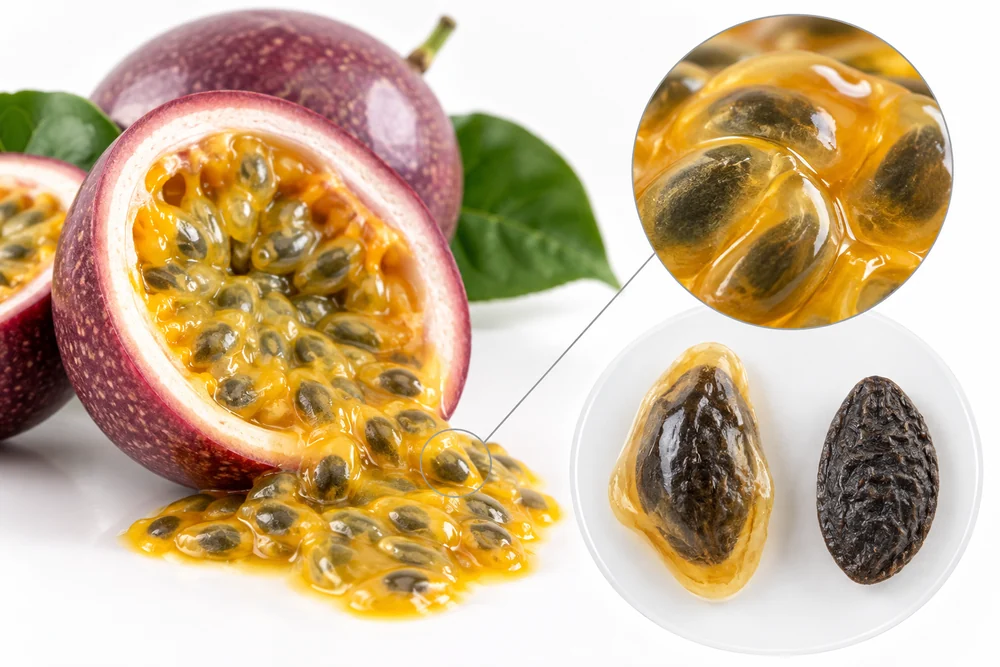
Separate seed recovery from puree preparation
The physical distinction begins at the screen or separator. Passion-fruit pulp contains juice-bearing material around numerous seeds. A seeded puree may intentionally retain seeds, whereas a seedless puree removes them for the intended eating or drinking experience. In either case the commercial ingredient specification concerns the puree supplied to the buyer. A seed stream set aside after a separate juice or puree operation is a coproduct whose composition depends on the upstream separation. Some seeds may carry visible pulp; others may retain a thin adherent film; the proportion can vary with fruit, equipment, residence time and how the process is adjusted. Calling all of these streams simply "passion-fruit seeds" erases the feed difference that the drying study investigated.
For the oil processor, the incoming unit should be described as recovered wet seeds plus attached material, not as a nominal weight of clean dry seed. Surface pulp can contribute water, soluble solids, color and organic matter, yet it may not contribute the same recoverable seed oil. Conversely, an aggressive attempt to remove it may lose seeds or affect their physical condition. The purchaser needs the material origin, method of collection, holding history and receiving condition before a cleaning comparison has meaning. These are suggested investigation fields, not claims that every passion-fruit processor uses the same line or that a particular GreenLand lot has such a coproduct.
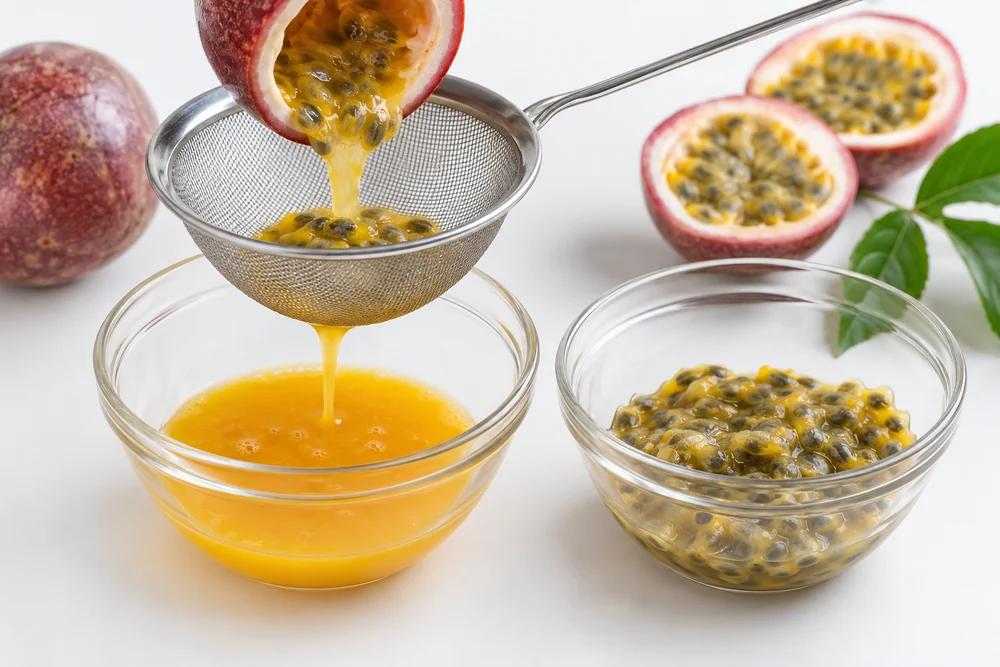
The puree ingredient and a seed coproduct are different streams.
Imagine, illustratively, a fruit processor asking GreenLand how residual pulp on a recovered passion-fruit seed stream affects downstream qualification. This is a hypothetical buyer scenario, not a past customer discussion or test case. We would first clarify whether the proposed purchase is GreenLand's frozen fruit or puree for an application, or whether the processor is discussing seeds recovered in its own plant. We would then ask what the processor actually calls "clean": a visible-pulp limit, a measured solids fraction, a drain condition, or a target dry-matter basis. Those definitions lead to different sampling and claims. We cannot infer the performance of the latter stream from an ingredient product page.
It is tempting to treat deseeding in puree manufacture as the same operation as seed cleaning for oil. It is not. The puree buyer may care about mouthfeel, sieve performance, flavor and the permitted residual seed count. The oil processor cares about the yield and stability of a dry seed feed and the quality of extracted oil. A separation method that produces an attractive puree can leave seeds with substantial attached pulp. A cleaning method tuned to make seeds easier to dry could, in turn, remove recoverable fruit material that the puree operation values. Each line needs its own endpoint, and the supplier should not be asked to certify a downstream oil result without a validated arrangement for that operation.
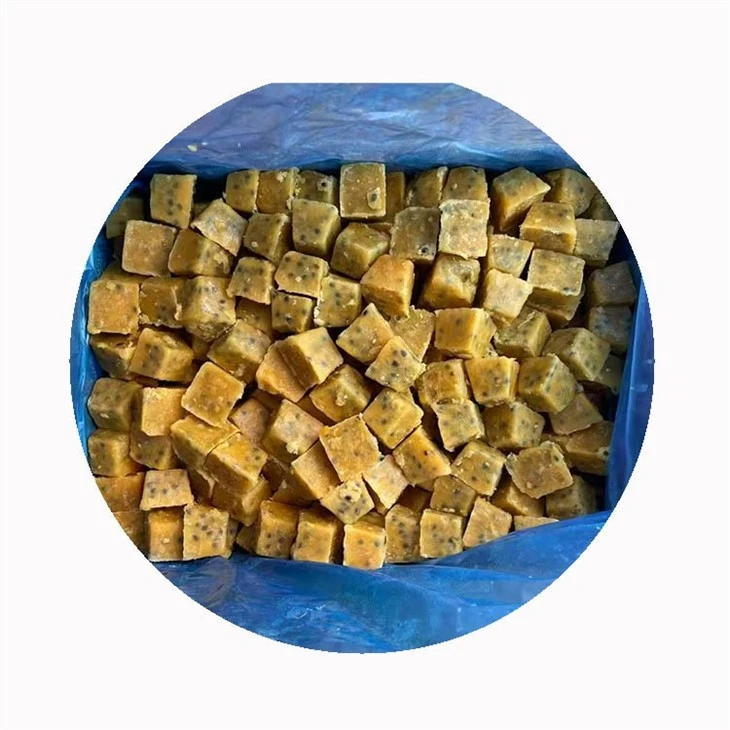
Passion-fruit pulp cubes visibly retain seeds and some fruit tissue around them.
The distinction also matters for traceability and acceptance. A useful incoming record identifies fruit origin or lot, the exact stage where seeds were separated, storage temperature and time before further treatment, the quantity of visibly attached pulp and how a representative sample was taken. If two suppliers deliver nominally equal tonnes of "wet passion-fruit seed," those tonnes may contain different amounts of seed dry matter. Paying, drying or assessing extraction yield by wet incoming weight alone can reward the wrong variable. Before discussing price or capacity, agree whether the commercial unit is raw recovered seed, cleaned wet seed or cleaned dry seed. That agreement prevents a processing comparison from becoming a dispute about the denominator.
Cleaning changed process demand in the original experiment
The original research compared seed material with and without a particular pulp-waste purification treatment. The treated material dried in less than half the control drying time under the authors' experimental conditions, and they reported a proportional increase in oil extraction yield of about 7.7 percent. Those numbers describe their material, route and yield definition. They do not provide a general operating target for another plant, a dryer-capacity promise for frozen fruit seeds, or a validated specification for all passion-fruit varieties. The useful insight is narrower and stronger: attached pulp was a process variable large enough to affect how that experimental seed feed behaved.
Drying load is not captured by moisture percentage alone. A sticky pulp layer can slow the release of water from a seed bed, alter how evenly particles spread, and change airflow through a tray or bed. It can also cause clusters that take longer to break apart or inspect. Those are plausible engineering mechanisms for a plant trial to investigate; they are not all measurements reported in the cited paper. The study's result tells a buyer to test cleanliness and drying together, rather than assuming seed dry matter is the only variable. A plant should observe the actual residence-time distribution, end-point variation and handling losses for its equipment.
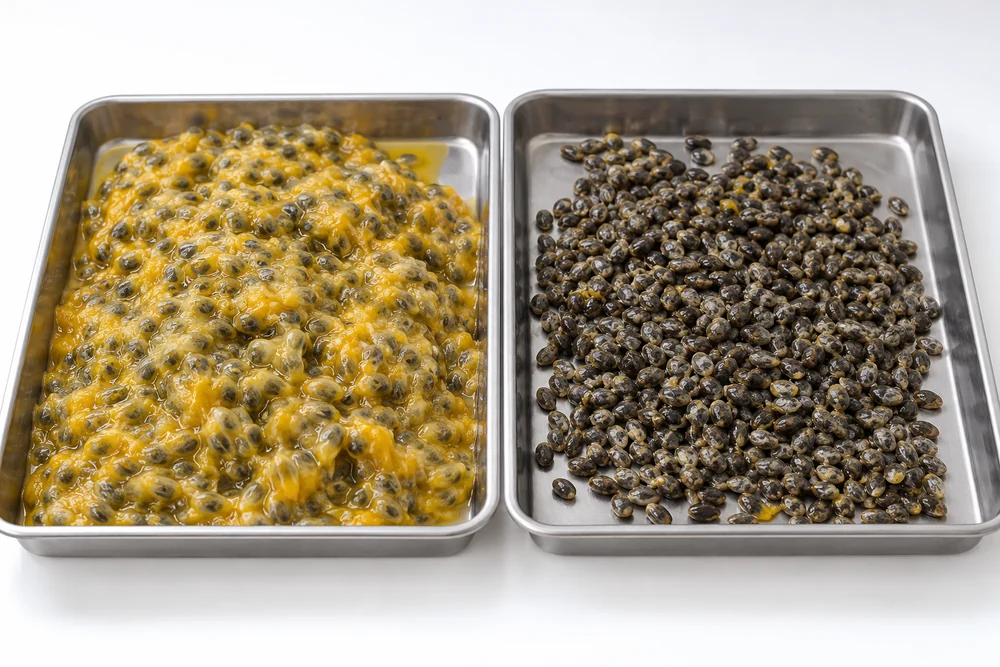
Attached pulp can change the feed entering a dryer.
The particular purification route used in a paper should never be copied into a food operation merely because it improved an experimental endpoint. Time, temperature, wash chemistry, material contact, water quality and residues would need independent food-safety and regulatory review for the intended jurisdiction and product. A processor might choose a different, validated physical route, or decide the oil recovery economics do not warrant any additional cleaning. The publication supports a question and a test design, not a turnkey standard operating procedure. Even the apparently simple phrase "wash the seeds" needs a plant-level decision on what washes away, how much seed is lost and how the wash stream is controlled.
We would compare two representative sublots from the same incoming seed stream before using the paper's direction as a purchasing assumption. One follows the processor's current, validated preparation; the other follows a proposed, independently approved cleaning route. Dry them to equivalent and measured endpoint criteria, rather than running both for an arbitrary equal time and calling one cleaner. Record the mass entering and leaving each step, moisture by a consistent method, energy or dryer occupancy if relevant, visual clumping and any seeds lost with removed pulp. Replicates matter because a single tray may reflect a local wet pocket rather than a typical stream. This is a trial plan, not a claim that these specific measurements were all endpoints in the original study.
The claimed proportional oil-yield increase also needs a careful read. "Yield" can refer to oil mass divided by wet recovered stream, dry cleaned seed, dry seed kernel, or material entering a press after losses. A gain under one denominator can partly reflect the removal of non-oil pulp from the denominator. Another part may reflect better seed preparation or extraction. Without a clear basis, the number cannot be compared to a supplier quotation or another published paper. The buyer should request both absolute oil mass and the complete starting mass balance, then calculate each agreed yield definition. This lets engineering and procurement see whether a faster dryer and a changed proportion actually create a useful net recovery.
Other seed pressing research examines material preparation and oil outcomes under a different route. It reinforces why extraction technique, feed moisture and analytical conditions must be written beside every yield figure. It does not confirm that the purification comparison will produce the same change with an expeller, a different cultivar or a different seed source. Before extending a published result, a processor should identify precisely which stage it wants to improve: receiving, cleaning, drying, press throughput, extraction recovery or oil acceptance. A gain at one stage can be offset by losses or quality costs elsewhere.
A cleaner feed is not necessarily a better oil
Oil quality is a set of measured attributes under defined methods, not an automatic consequence of a visually cleaner seed. The original study evaluated physicochemical oil measures after its seed treatment. Its headline conclusion was that the purification did not deliver a general improvement in oil quality, despite process and proportional-yield changes. The full results should be read with more care than a one-line summary: at least one oxidation-related comparison did differ, so it would be misleading to say every measured attribute was identical. It would be equally misleading to turn that difference into a universal shelf-life prediction for oil made under a new process. Test design, storage, extraction and analytical method bound the interpretation.
For procurement, separate three questions. Did the cleaning step reduce the non-seed material entering the dryer? Did it increase oil mass recovered from an equivalent amount of seed dry matter at the chosen extraction conditions? Did it make the oil meet the purchaser's specified quality criteria? A "yes" to the first does not answer the second or third. A faster dryer can improve scheduling and lower an operational burden while the oil remains essentially similar on the attributes a buyer requires. Alternatively, a route might improve throughput but create new residue, oxidation or sensory questions. These possibilities are reasons to measure, not assumptions about this experiment's unreported outcomes.
An oil specification should name its endpoints and methods before samples are submitted. Depending on intended use and jurisdiction, a processor may examine moisture and impurities, acidity or free fatty acid measures, peroxide and secondary oxidation markers, fatty-acid profile, color, odor, contaminants, residues and microbiological aspects of upstream handling. That list is a design menu, not a claim that the cited study measured every item or that each is universally required. Testing should match the actual food, cosmetic or other intended market, approved processing aids and the customer's specification. Do not use the word "quality" as a substitute for that agreement.
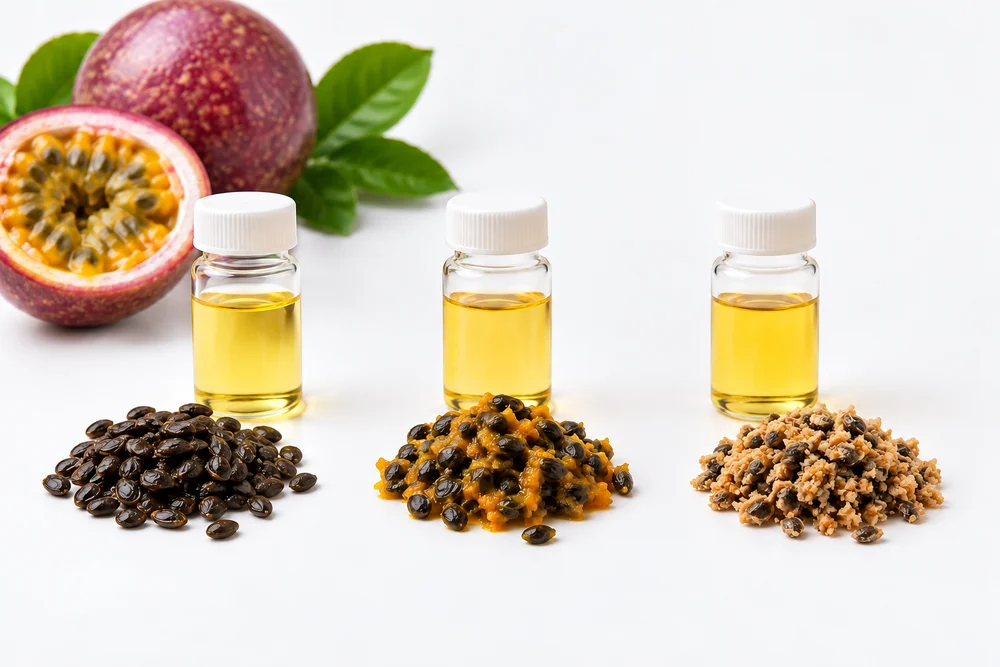
Oil needs its own quality measurements after seed preparation.
Sample history can obscure the effect of cleaning. If one oil was pressed immediately after drying and another sat warm or exposed to air, differences may reflect holding as well as seed preparation. If one seed lot came from a different fruit maturity or source, it is not a paired cleaning comparison. If the same oil is analyzed by different laboratories or methods, a small difference may be analytical rather than material. A credible qualification uses traceable paired lots, controlled extraction and storage, replicate samples and appropriate test methods. The buyer can then tell whether the proposed change improves the endpoint that matters in its market instead of selecting the most attractive number from unrelated publications.
Published expeller research and other seed-oil characterization work supply useful context about preparing a seed material and testing a resulting oil. Their process configurations and raw materials differ. Their results should inform a test list, not be averaged into a promised GreenLand oil profile. Likewise, an interesting fatty-acid profile from one paper does not prove every recovered-seed stream will have the same flavor, oxidation behavior or commercial shelf life. Oil made from a frozen ingredient side stream would require its own evidence, and the current GreenLand product pages do not advertise such an oil.
This distinction can change the purchase decision even when the oil passes all tests. If the intended buyer only needs a stable, specification-compliant oil, faster drying may improve operational economics without justifying a premium quality claim. If a formulation needs a particular aroma, color or oxidation profile, the processor must qualify that property directly and may find cleaning alone does not provide it. For an ingredient procurement team, the right conclusion is conditional: a cleaner feed may be easier to handle; whether the oil is better depends on the defined metric and paired measurement. Avoid making "clean" a marketing proxy for everything the downstream product needs to deliver.
Track the coproduct mass before comparing yields
A defensible trial begins with a material ledger. Weigh the incoming wet seed-and-pulp stream, take a representative moisture and composition sample, weigh removed pulp or wash solids, collect and characterize any seed loss in that removed fraction, then weigh retained wet seed and its dry matter after drying. Finally record feed to extraction, recovered oil and remaining cake. The ledger need not be complicated, but every flow must use the same lot identifier and a clear wet or dry basis. If the only recorded numbers are a bag weight before cleaning and oil volume after pressing, the apparent yield can hide both non-oil material removal and actual seed loss.
An illustrative arithmetic example shows why the basis matters; these values are hypothetical and are not the paper's results. Suppose one hundred kilograms of recovered wet material contains seeds, adherent pulp and water. A cleaning step removes a visible fraction before drying, so the cleaned feed weighs less. If the same oil mass is divided by that smaller cleaned-feed mass, the displayed percentage rises even when no additional oil was recovered from the original lot. Conversely, if cleaning loses seeds, the percentage per kilogram of remaining feed may look favorable while total oil from the original hundred kilograms falls. The buyer needs absolute oil mass per original lot as well as yield per seed dry matter.
Water complicates comparison again. Drying reduces mass without removing the same kind of material as pulp separation. A raw wet-feed figure, an oven-dry figure and an as-fed press figure are not interchangeable. The sampling method and moisture test should be documented for each stream. If seeds retain a sticky film, taking a handful from the top of a container may understate wet clumps at the bottom. Mix or stratify the sampling plan to fit the actual container and process, with the analyst recording where and when material was taken. These are practical controls for interpreting a trial, not universal formulas for every factory.
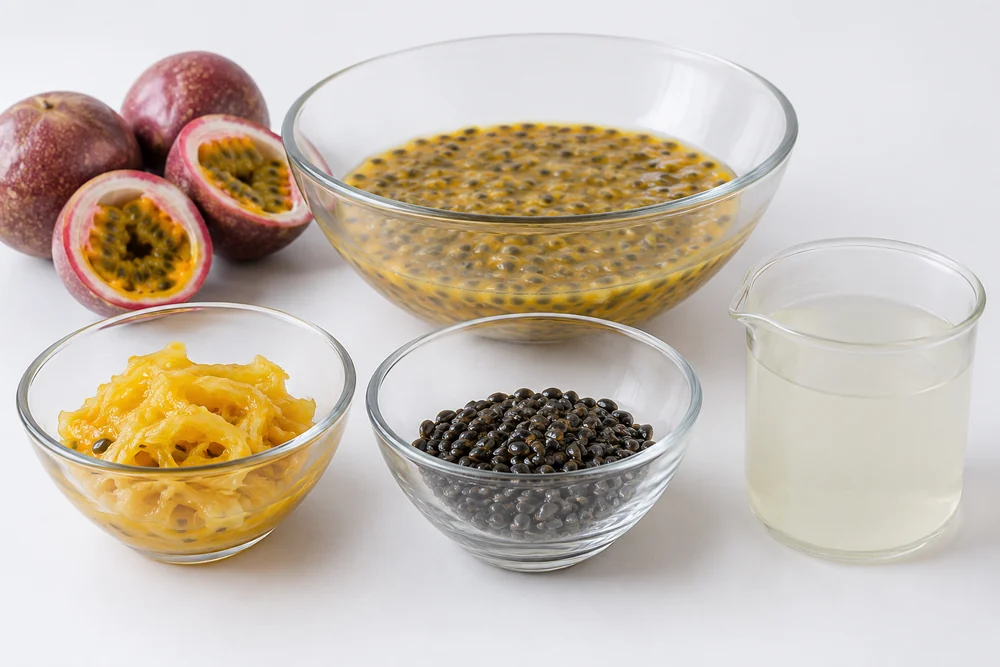
Measure every removed and retained fraction before comparing yield.
Two operators may also define "seed recovered" differently. One may count every dark particle left after screening, including broken fragments and attached pulp; another may count only intact cleaned seeds. State the inclusions and exclusions before comparing lots or quotes. A useful photograph of the feed can document appearance, but visual evidence cannot replace dry-matter measurement and a defined tolerance. For an oil recovery project, report seed cleanliness as a measurable property alongside the extraction result, so a buyer can distinguish a cleaner supply from a more efficient extraction system. If pulp is diverted to another saleable stream, include that recovery and its quality requirements separately rather than silently treating it as waste.
Cost accounting should follow the same boundaries. Cleaning may consume water, labor, capacity and disposal or wastewater treatment; faster drying may release dryer capacity and lower energy use. Pressing may require additional conditioning, filtration or refining. The correct economic comparison is a full route per original feed lot and per accepted oil unit, with realistic reject and rework assumptions. A price per tonne of uncharacterized wet seed is weak evidence of value. Procurement can ask the processor for a paired trial report showing incoming mass, removed material, dry cleaned seed, oil output, tested quality and route cost. If one field is missing, avoid converting the remaining result into a guaranteed commercial saving.
An independent seed-oil study on a different material and extraction route helps illustrate the diversity of experimental designs, but its numerical results are not a substitute for the mass ledger here. Literature can tell a team what kinds of variables to measure. It cannot decide the yield basis of an unpublished plant feed or reconcile missing inventory. The most useful meeting between R&D, operations and purchasing is often the one where all three agree on the denominator and the destination of each fraction before anyone calculates a percentage.
Qualify the intended recovery operation separately
Qualification should begin with the intended product and regulatory context. The customer should identify whether the seed oil would be a food ingredient, a cosmetic input or another material, which processing aids are permitted, and what specification must be met at release. Then assess the actual seed stream's hygiene, holding, transport and separation history. A route acceptable for a research comparison may be unsuitable or uneconomic for that application. The paper's treatment settings are evidence about that experiment; they are not a recommended food plant method. The processor's quality and engineering teams must validate any proposed cleaning and drying route with the controls applicable to their own operation.
For a pilot, keep the trial deliberately stage-specific. Sample several representative recovered-seed lots, not just the cleanest bag. Document fruit source and production day, degree of pulp attachment, time before processing, cleaning route, mass loss, moisture profile, drying uniformity, extraction settings and oil tests. Hold control and trial samples under comparable conditions. If the intended process uses a different dryer or press from the papers, evaluate that equipment directly. A single laboratory drying curve cannot prove factory throughput, and a small bottle of acceptable oil cannot prove a stable long-term supply. Those are scale and variability questions, not criticisms of the study.
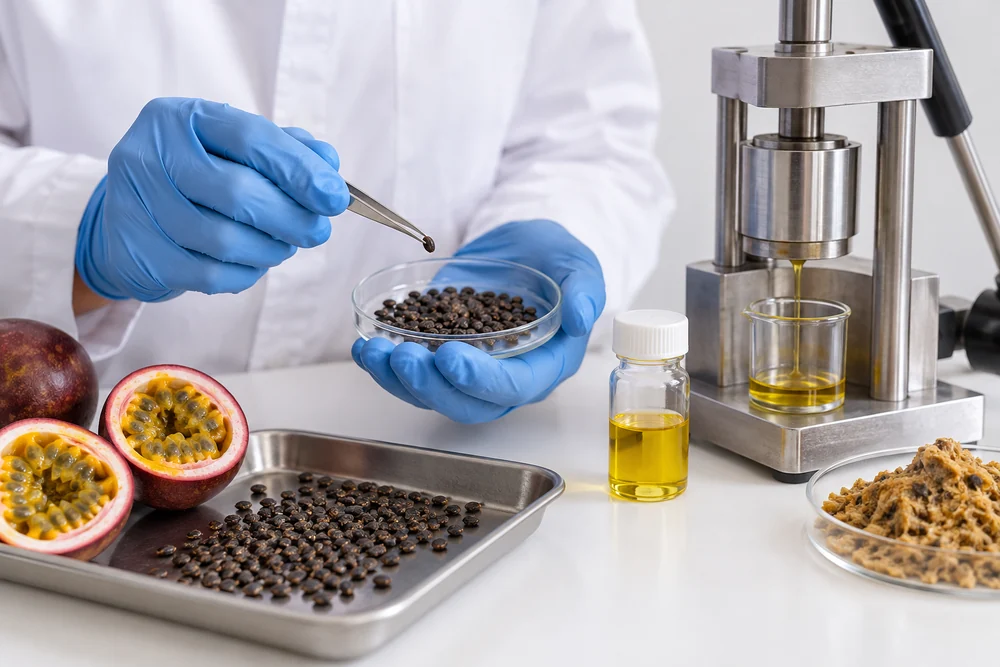
A processor must test its actual recovery route and oil endpoints.
Set pass criteria before reviewing results. For example, a buyer could require a reproducible dry-matter recovery, a defined limit on attached pulp, oil that meets its measured specification, and a documented disposition for removed material. Set those thresholds from the intended product and demonstrated process capability. Some teams may find that extra cleaning is unnecessary once the feed is characterized; others may find dryer handling is the bottleneck. If oil quality does not improve, that is still valuable information: it directs attention to process capacity rather than an unsupported premium-quality story. Record both favorable and unfavorable outcomes so future purchases use the real variance.
At GreenLand, our useful role in the illustrative processor conversation is to define the fruit ingredient actually requested and the questions that need a downstream trial. We can discuss the available frozen passion-fruit forms, including how a seeded or seedless form fits a beverage, dairy or dessert application. A seed-oil recovery proposal needs a separate verified operation and specification; the frozen-fruit listing documents fruit ingredients only. If a processor proposes recovering seeds from its own operation, the engineering, safety and analytical evidence belongs to that proposed operation. Its intended end use and specifications should be shared before any sourcing recommendation is made.
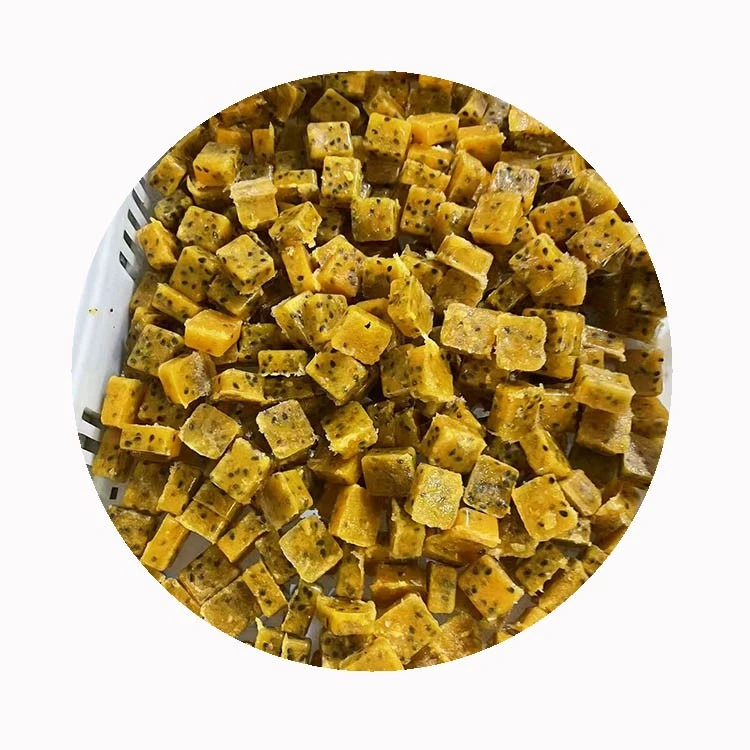
Assess the seed and residual-pulp balance in the ingredient form intended for the recipe.
The answer to the buyer's question is therefore operational rather than cosmetic: residual pulp can make recovered seeds a different drying feed, and removing it can change measured process demand in a particular experiment. Oil quality is a separate release decision, and a proportional extraction yield is meaningful only with its starting material and denominator. Send GreenLand the intended passion-fruit ingredient form, application and required seeded or seedless specification; if a downstream seed recovery project is involved, also provide the two routes being compared, the complete mass basis and the oil tests required for that market. We can then discuss the relevant fruit supply without turning one study into a promise about an unverified coproduct.
Plan frozen passion fruit supply with GreenLand-food
For frozen passion fruit, tell us the intended product form, application, pack, and inspection priorities. GreenLand-food is a China-based frozen-food supplier and manufacturer. We can discuss factory-direct wholesale supply around the specification you need to evaluate.