


Frozen Berry Recall Risks: What UK Buyers Should Check for Hepatitis A and Traceability
Aug 27, 2026
Leave a message
Buyer guide · Updated August 26, 2026
A buyer-readiness guide that separates monitoring priorities from confirmed incidents and turns traceability into a timed, lot-level recall capability.
Quick answer: UK buyers should treat hepatitis A and norovirus as relevant frozen-berry supply-chain hazards, especially for ready-to-eat and no-cook use. A government monitoring priority is not a positive result, recall or import ban. Use it to review intended use, supplier preventive controls, component-level lot genealogy, testing limitations and timed one-step-back/one-step-forward traceability before approving or releasing berry lots.
Four checks that prevent the wrong response
- Identify the event type: monitoring programme, survey finding, incident investigation, withdrawal/recall or legal restriction.
- State whether the berry is supplied as ready to eat, used without cooking, or subject to a validated further process.
- Trace every blend component by origin, supplier, facility, production lot and finished-product lot.
- Test recall readiness with a timed quantity reconciliation. A list of records is not the same as a functioning traceability system.
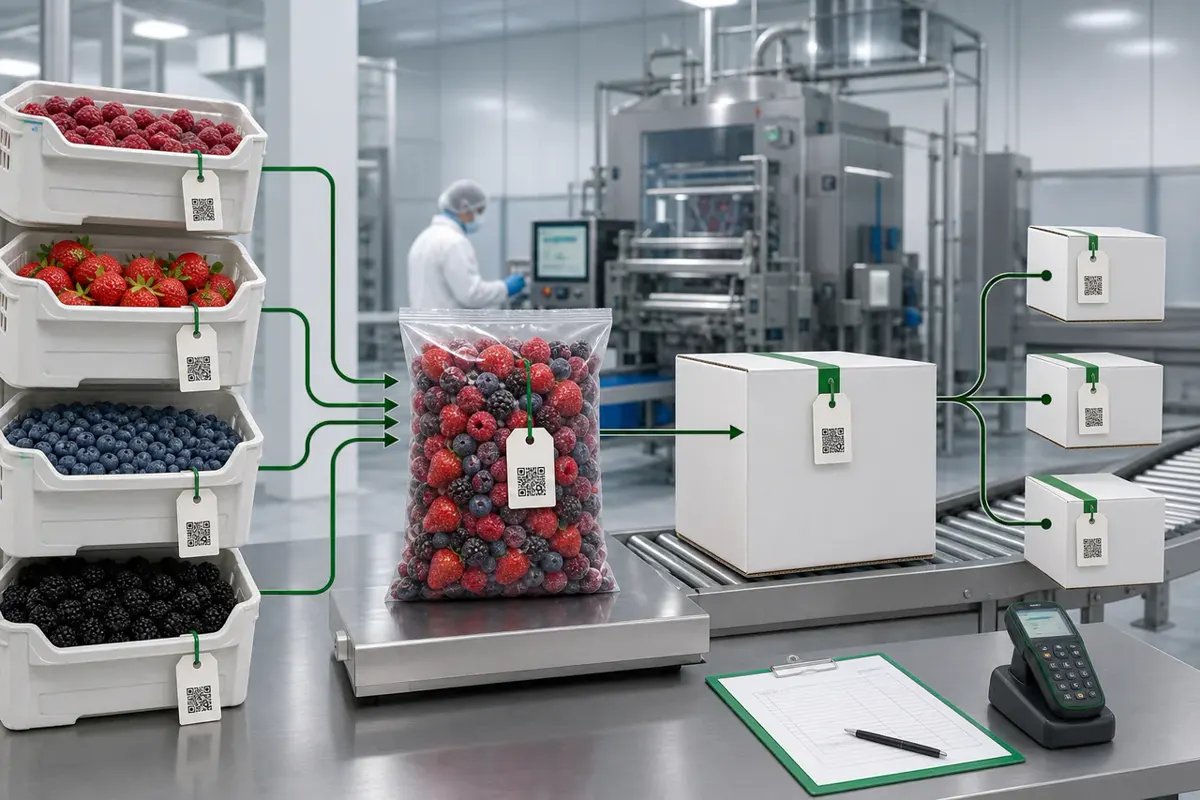
The useful unit of recall readiness is the component lot, not only the finished blend or outer carton.
The 2026/27 UK monitoring plan is a sampling priority
The UK National Monitoring Plan for imported foods 2026/27 lists frozen raspberries and other frozen small fruit and berries as medium-priority categories for norovirus and hepatitis A sampling. It also lists frozen sweetcorn in the same viral-hazard priority group.
That wording means authorities have prioritised sampling and intelligence gathering. It does not say that a named lot tested positive. It does not announce a recall. It does not prohibit every product in the category. A buyer who turns the table into "UK bans frozen berries" creates misinformation and may disrupt unaffected supply.
Monitoring still matters. It shows that regulators consider imported frozen products and enteric viruses worthy of targeted attention. Buyers can use the signal to check whether their supplier approval, intended-use statement, verification plan and traceability file are strong enough. The right response is more precise control, not a dramatic category claim.
The Food Standards Agency's 2026/27 research programme also refers to targeted work on imported berries. Again, planned or active surveillance is not a positive finding. When citing public monitoring in an internal risk review, include a "what this source does not say" field so sampling priorities cannot later be copied as incident facts.

Each supplied lot should connect origin, harvest or production data, testing and customer dispatch records.
Separate five types of public information
| Public information | What it means | Buyer response |
|---|---|---|
| Monitoring priority | A product-hazard combination selected for official sampling attention | Review risk assessment, supplier controls and verification scope |
| Survey result | Findings from a defined set of samples and period | Read sample frame and product/origin details before changing approval |
| Incident investigation | Authorities are investigating cases, food links or a supply route | Check scope, hold potentially matching lots and monitor updates |
| Withdrawal or recall | Specified food is removed from sale or recalled from consumers | Match product and lot; stop distribution and execute the recall plan |
| Import restriction | A legal control applies to defined product-origin combinations | Check current law, certification, border route and shipment documents |
Do not use the action for one row as the action for another. A buyer may enhance sampling after a monitoring priority, but should not issue a recall without affected product. Conversely, if a recall matches the buyer's lot, "it was only a survey topic last month" is irrelevant. The current event and scope control.
Keep the source, publication date, retrieval date and scope in the incident file. Government pages can be updated. Third-party articles may simplify the language or omit product boundaries, so use the official notice for disposition decisions.
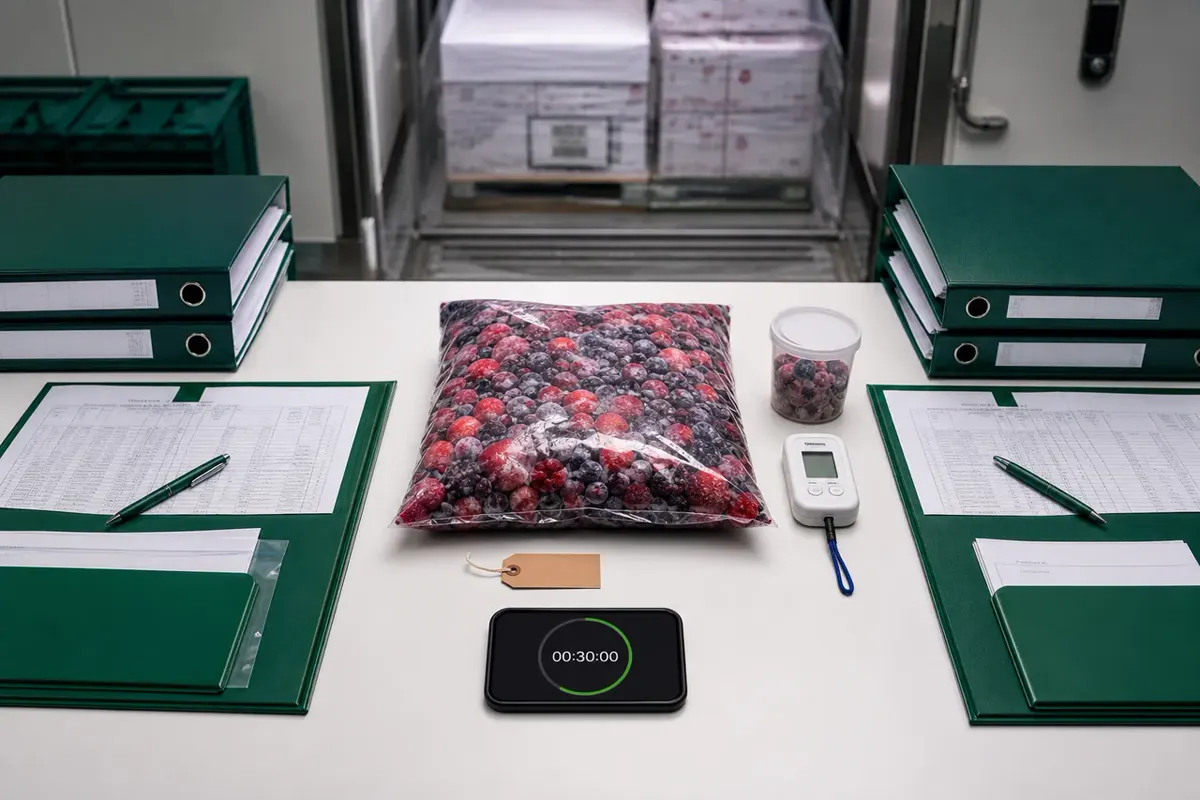
Readable, durable codes allow teams to move from a complaint or alert to affected stock quickly.
Why hepatitis A and norovirus require supply-chain controls
Hepatitis A virus and norovirus can enter berry supply chains through contaminated water, infected food handlers, sanitation failures or other pre- and post-harvest routes. Freezing preserves product quality but should not be treated as a validated viral kill step. The absence of visible spoilage does not resolve viral contamination.
Frozen berries are commercially important because they are often consumed without another process capable of reducing the hazard: smoothies, overnight oats, yogurt toppings, desserts and retail snacking. Industrial use can also be no-cook when fruit is folded into a product after heat treatment. A specification saying "for processing" is too vague to establish risk control.
Testing has limitations. Contamination can be uneven, the infectious dose can be low, and analytical recovery from food matrices is challenging. A negative lot result supports a broader system but should not be described as proof that every berry is virus-free. Supplier preventive controls, hygiene, water management, traceability and intended-use management remain essential.
The FDA's enteric-virus prevention strategy for berries is not UK law, but it is useful international context: control must address the supply chain, not merely end-product testing. UK buyers should anchor legal decisions in UK requirements while using sound technical evidence from credible authorities.
Classify intended use before approving the lot
Ready-to-eat or no-cook use
If the product may be consumed without a validated kill step, the supplier and buyer should agree that use explicitly. Review farm and worker hygiene, water controls, processing sanitation, environmental risks, viral hazard analysis, traceability, change management and verification. Product labelling and customer instructions must not contradict the approved use.
Further processing with a validated control
Document the exact downstream process and who owns its validation. "Cook before use" is incomplete if the customer makes smoothies or adds berries after heating. Time, temperature, product geometry, load and process monitoring matter. The supply contract should prevent diversion to no-cook channels without review.
Unknown or mixed use
When the buyer cannot control downstream use, apply the more conservative approved-use assumption. A distributor selling the same carton to bakeries, cafés and smoothie shops should not rely on one customer's cooking process. Separate SKUs or customer restrictions may be needed.
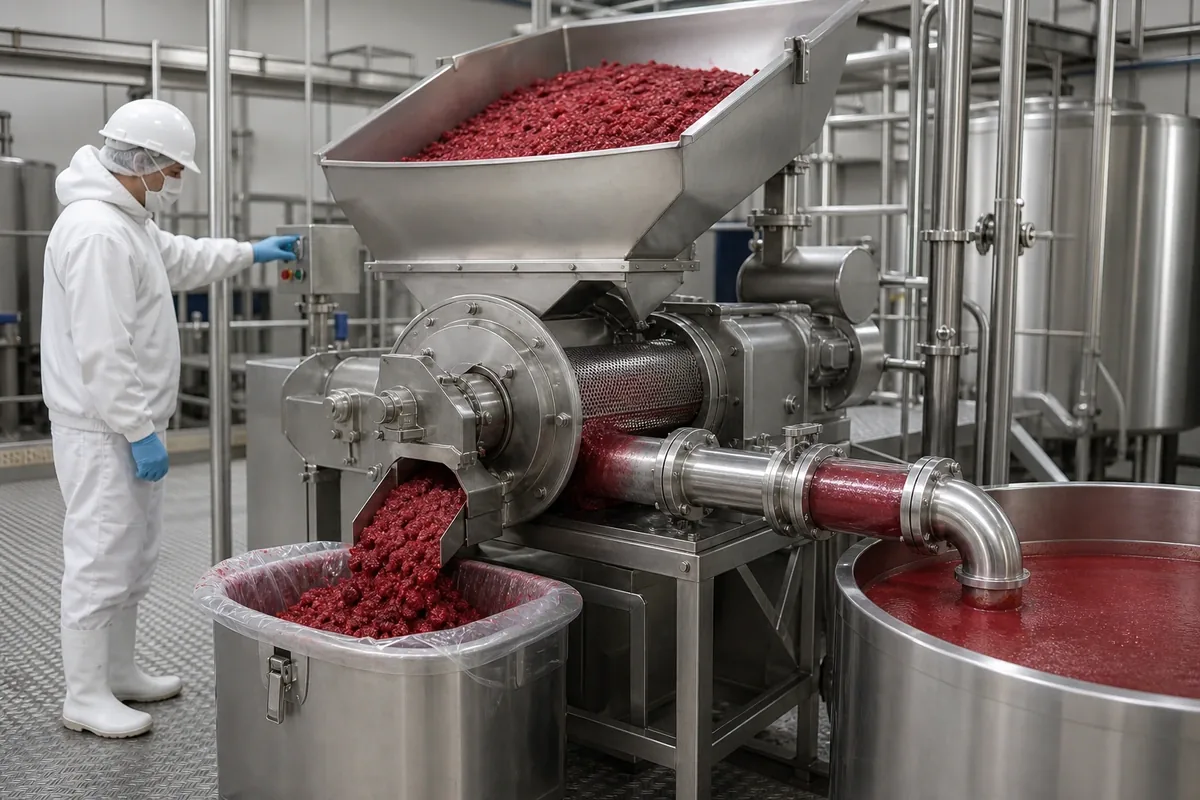
A realistic drill measures identification, quarantine, quantity reconciliation, contacts and decision records.
The supplier evidence file
| Evidence group | Questions for the supplier | Examples |
|---|---|---|
| Product and use | Which species, form, origin and intended use are approved? | Signed specification, ingredient statement, RTE/further-process declaration |
| Source controls | How are farms, pickers, water and raw fruit approved and monitored? | Farm list, water assessment, hygiene programme, supplier verification |
| Facility controls | How are sanitation, employee illness, line segregation and rework controlled? | HACCP plan, sanitation records, illness policy, rework procedure |
| Verification | Which viral or microbiological checks are used, with what limitations? | Risk-based sampling plan, method, laboratory scope, trend review |
| Traceability | Can every inbound component be linked to every finished and shipped lot? | Lot genealogy, production record, mass balance and distribution list |
| Incident readiness | How are holds, withdrawals, recalls and authority/customer notifications managed? | Recall plan, contacts, mock recall, CAPA and effectiveness evidence |
Review the evidence for the exact facility. A group policy or certification for another plant cannot confirm controls at the named production site. Check certificate scope, audit date, major findings and corrective-action closure. Certification supports supplier approval but does not replace your product- and use-specific assessment.
For supporting company information, see Solution / Factory Audit & Inspection Support.
Ask how origin and raw-material suppliers change. A new growing area, co-packer or berry component can alter the hazard and traceability profile. Require advance notification for changes that affect the approved risk assessment. The first shipment after a material change may need enhanced verification.

Product approval and recall readiness should stay linked through consistent lot and dispatch records.
Trace a blend at component level
Mixed berries are not one traceability input. The finished lot may contain raspberry, strawberry, blueberry and blackberry components from different origins and production dates. The genealogy should show the quantity of each inbound lot consumed, any rework added, finished bags and cartons produced, waste or yield loss, pallets, customers and remaining stock.
A UK outbreak report published in 2026 described investigation of a frozen mixed-berry product linked through a manufacturer and multiple fruit origins. The case illustrates why a finished brand or carton code may not be enough for root-cause and scope work. A component can connect several finished lots or markets.
Use a controlled lot-code hierarchy. The pallet, carton, inner bag and production record should connect without manual guesswork. If retail or foodservice packs use a customer code, retain the cross-reference to the supplier batch. When relabelling or repacking occurs in the UK, preserve the original source lot in the transformation record.
Rework needs explicit control. If unused mixed berries return to later batches, the system must carry all component origins forward. An unlimited rework loop can expand recall scope across many production days. Define rework age, quantity limits and traceability rules.

A drill is complete only when physical, system and customer quantities reconcile with documented exceptions.
Run a timed one-step-back and one-step-forward exercise
- Select one finished mixed-berry lot without warning the record owner in advance.
- Identify every inbound berry component, supplier, origin, facility and source lot.
- Retrieve production, blending, rework, packing, QA release and cold-chain records.
- Calculate theoretical output from inbound quantities and compare with finished, waste, samples and remaining stock.
- Identify every pallet, warehouse position, shipment and customer that received the lot.
- Test whether contacts and quantities can be exported in a usable recall format.
- Record elapsed time, missing data, unexplained variance and system workarounds.
- Correct gaps, repeat the drill and define the next test frequency.
Set the target time according to your risk and customer requirements. The point is not to celebrate a fast first lookup while quantity reconciliation takes two days. The exercise is complete only when source, production, stock and distribution quantities can be explained.
The basic UK traceability principle is one step back and one step forward. The GOV.UK supplier and traceability guidance summarizes record responsibilities. A robust buyer system goes further by preserving internal transformations so the legal one-step records can be converted into an accurate lot scope.
Why frozen sweetcorn appears in the same monitoring table
The monitoring plan's inclusion of frozen sweetcorn alongside frozen berries is a useful boundary reminder. The sampling priority is hazard- and product-based, not a declaration that "berries are uniquely unsafe." Frozen vegetables can also be consumed without a kill step or may have relevant pre-harvest and handling risks.
Do not use sweetcorn evidence to approve a berry supplier or vice versa. The products have different agricultural, processing and application profiles. Use the table to ask a general control question: which frozen products in our portfolio are eaten without further cooking, and do our hazard analyses and supplier files reflect that use?
Pause, test, release and recall-readiness decisions
Pause
Hold lots when a public incident may match the product or supply route, when intended use is unclear, when component genealogy is incomplete, or when material preventive-control evidence is missing. Block physical and system release, identify in-transit and customer stock, and preserve samples.
Test or investigate
Testing can support an investigation when the sample plan, method and laboratory are suitable. It should answer a defined question and sit beside supplier-control evidence. Repeatedly sampling until a negative appears is not a defensible disposition method. For virus questions, involve competent laboratories and public-health or regulatory specialists.
Release
Release when the approved product and use, supplier controls, lot genealogy, documents and any required verification are complete. Record conditions, such as validated further processing or channel restriction, and make them visible to downstream customers.
Recall readiness
Maintain current incident contacts, authority and customer notification procedures, decision roles, draft communications, inventory controls and reconciliation templates. If a matching recall occurs, the team should not be designing its lot-code query while product continues to ship.
For cold-chain and shipping details, see FDA Import Alerts and Frozen Berry Recalls: What U.S. Buyers Should Recheck.
Common UK buyer errors
- Reporting a monitoring priority as a positive test, recall or ban.
- Assuming "frozen" means pathogen-free or ready to eat.
- Accepting "for processing" without a validated downstream process.
- Approving a blend from the finished-lot code but not tracing its components.
- Treating one negative result as proof for a heterogeneous lot.
- Keeping records that cannot reconcile quantity or be exported quickly.
- Using a certification logo instead of reviewing site, product and corrective-action scope.
How GreenLand-food supports berry traceability questions
Worked scope exercise: one raspberry lot inside three blends
A UK distributor receives a public-health notification concerning a frozen raspberry lot used by a European manufacturer. The distributor does not buy raspberry-only cartons from that facility, but it buys three private-label blends. Sales initially concludes that the notification is irrelevant because the product names differ. The component genealogy shows otherwise.
The manufacturer's raspberry lot R-17 entered Blend A on two production days, Blend B on one day and a rework pool later used in Blend C. Each finished blend has its own retailer code. The distributor's item master links only the retailer codes to customers, while the supplier's production record carries the component link. Both systems are needed to define scope.
The team pauses all finished lots connected to R-17. It reconciles 8,000 kilograms of inbound raspberries against 7,620 kilograms in finished blends, 110 kilograms retained or sampled, 190 kilograms recorded process loss and 80 kilograms still in controlled rework. The balance closes. Distribution records identify stock at the distributor, two retailers and one foodservice customer.
Intended use changes the urgency but not the traceability boundary. Blend A is sold for smoothies, Blend B is used in a validated cooked preparation, and Blend C has mixed downstream uses. The buyer preserves all lots within scope while specialists determine the appropriate product action. It does not silently release Blend B on the strength of the word "cooked"; it obtains the actual process validation and customer confirmation.
The exercise finishes within two hours, but one customer file lacks current emergency contacts. That is recorded as a recall-readiness failure even though lot tracing succeeded. The distributor updates contacts, creates a component-lot lookup in its system and limits rework carryover. The next mock recall tests a different component and an after-hours scenario.
The case illustrates why private-label product name and finished-lot search are insufficient. A single component can converge into several blends and then diverge across customers. Traceability needs both directions and quantity reconciliation.
Communicate risk without overstating certainty
Draft communications from confirmed facts: authority or supplier source, affected product and lot, current hold or recall status, customer action and next update time. Separate "potentially connected" from "confirmed affected." Early precision builds more trust than a sweeping reassurance that must later be withdrawn.
Do not say "virus-free," "fully safe" or "cleared" on the basis of a negative result. State what was tested, by which method, on which sample and how that evidence informed the decision. Do not promise that cooking controls the hazard unless the process is validated and actually applied to the product.
When no match is found, document the scope test and tell customers only what they need: your facility, supplier, product or lot does not match the stated event based on named evidence, and monitoring continues. Avoid attacking the affected supplier or making claims about causes before authorities and the firm complete investigation.
Verification frequency and trigger management
Set routine and event-driven reviews. Routine checks can include annual traceability drills, supplier-control updates, water and hygiene evidence, certification scope and trend review. Event triggers include a new origin, farm group, co-packer, process, RTE claim, adverse test, outbreak intelligence, recall or significant audit finding.
A supplier with strong historical performance still needs review after a material change. A new negative laboratory result does not erase poor traceability. Conversely, an isolated monitoring priority should not automatically force permanent intensive testing of every lot. Match verification to the identified uncertainty.
Track corrective actions through effectiveness. If the mock recall took six hours because one code map was manual, confirm the new automated link works on a later lot. If component quantities did not reconcile, investigate yield and rework records before accepting a new template. Closing a task in software is not evidence that the system improved.
Use retained samples with a defined purpose and storage plan. Record lot, date, quantity, temperature, seal and disposal. A retained sample can support investigation, but its result cannot automatically represent all distributed units. Decide in advance who may open it and how chain of custody will be protected.
Include warehouses and repackers in the drill. A supplier can produce perfect genealogy while a UK relabelling operation creates a new code with no source link. Third-party cold stores should be able to locate blocked pallets and prevent dispatch. Test weekend and after-hours contacts because food incidents rarely respect office schedules.
Reconcile customer returns and destruction. Traceability does not end when a recall notice is sent. Record quantities acknowledged, recovered, consumed, held, destroyed or unresolved. Investigate the gap. Effectiveness checks should focus on whether consignees received and acted on the instruction, not merely whether the email left the outbox.
Review insurance, contracts and decision authority before an event. The operations team needs to know who can stop shipment, who contacts authorities and customers, who approves public wording and who authorises disposal. Commercial liability can be addressed later; the immediate control must not wait for an executive who is unavailable.
After closure, hold a no-blame technical review. Compare first signal, scope time, customer response, recovered quantity and corrective-action completion with targets. Update specifications, supplier approval and system fields. A recall exercise has value only when it changes the controls that failed.
Retest the revised system on a different berry, facility and customer route so the improvement is not limited to the original example.
We start with the exact berry, origin, facility, pack, intended use and destination. We coordinate the product, process and lot records available from the matched production partner. We do not describe monitoring as a recall, and we do not claim freezing alone controls hepatitis A or norovirus.
Buyers can review our frozen fruit range, our traceability framework, and the full catalog. Include RTE or further-process status, pack, annual volume and required traceability response time in your enquiry.
Frequently asked questions
Does the UK 2026/27 monitoring plan mean frozen raspberries have tested positive for hepatitis A?
No. The plan identifies imported-product sampling priorities. It is not, by itself, a positive test result, recall or ban. Review separate official incident or recall notices for findings, and use the monitoring priority to strengthen risk-based supplier verification.
Is a negative hepatitis A test enough to release a frozen berry lot?
Not automatically. The decision should consider representative sampling, method and laboratory competence, the test result, supplier preventive controls, intended use, lot traceability and any regulatory or customer requirement. Viral contamination can be heterogeneous, so testing does not replace supply-chain controls.
Test the traceability chain before an incident
Send the berry mix, origins, intended use, pack, destination and traceability requirements you are reviewing. We will coordinate an order-specific supplier evidence discussion.