


When Are Golden Kiwis in Season? Crop Timing and Frozen Supply
Sep 23, 2026
Leave a message
Research This Article & Topic with AI
Verify key claims, compare reliable sources, and explore GreenLand-food's practical frozen food knowledge.
Article details and research questions are prepared in the links. Sign-in or sending may be required.
Golden Kiwi Season Depends on Growing Region
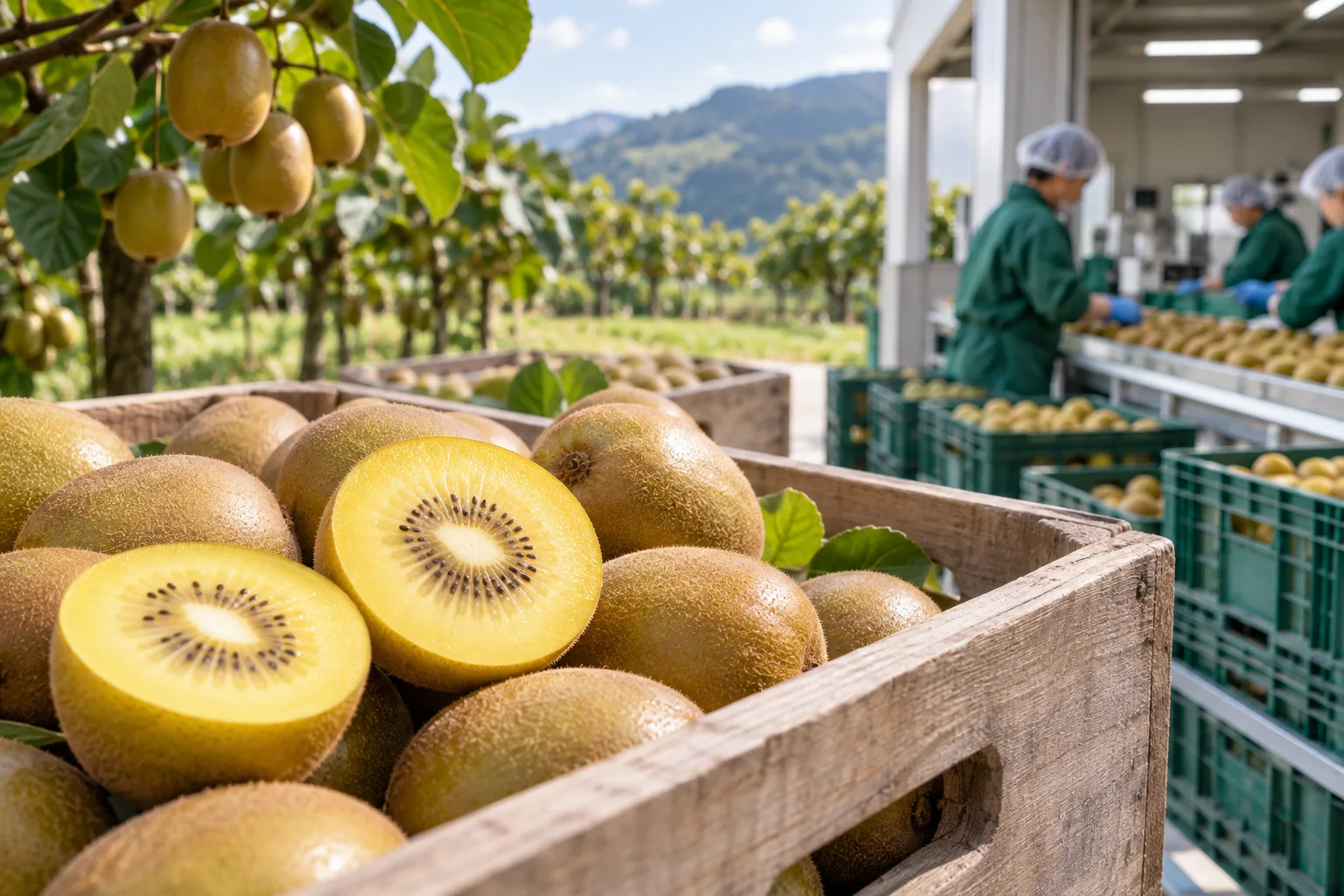
Kiwifruit vines respond to local winter chilling, spring growth, flowering, summer heat, and autumn maturation. Southern Hemisphere orchards pass through those stages roughly six months opposite Northern Hemisphere orchards. That is why New Zealand fruit can enter international markets as the European crop is winding down, while Italian or other northern fruit can take over when New Zealand packing is no longer at its peak.
Latitude is only the beginning. Coastal influence, elevation, frost exposure, orchard aspect, soil, irrigation, canopy management, and cultivar all affect the date at which fruit reaches harvest maturity. Two orchards in the same country may not pick on the same week. A large marketer may deliberately combine districts and cultivars to extend its packing season.
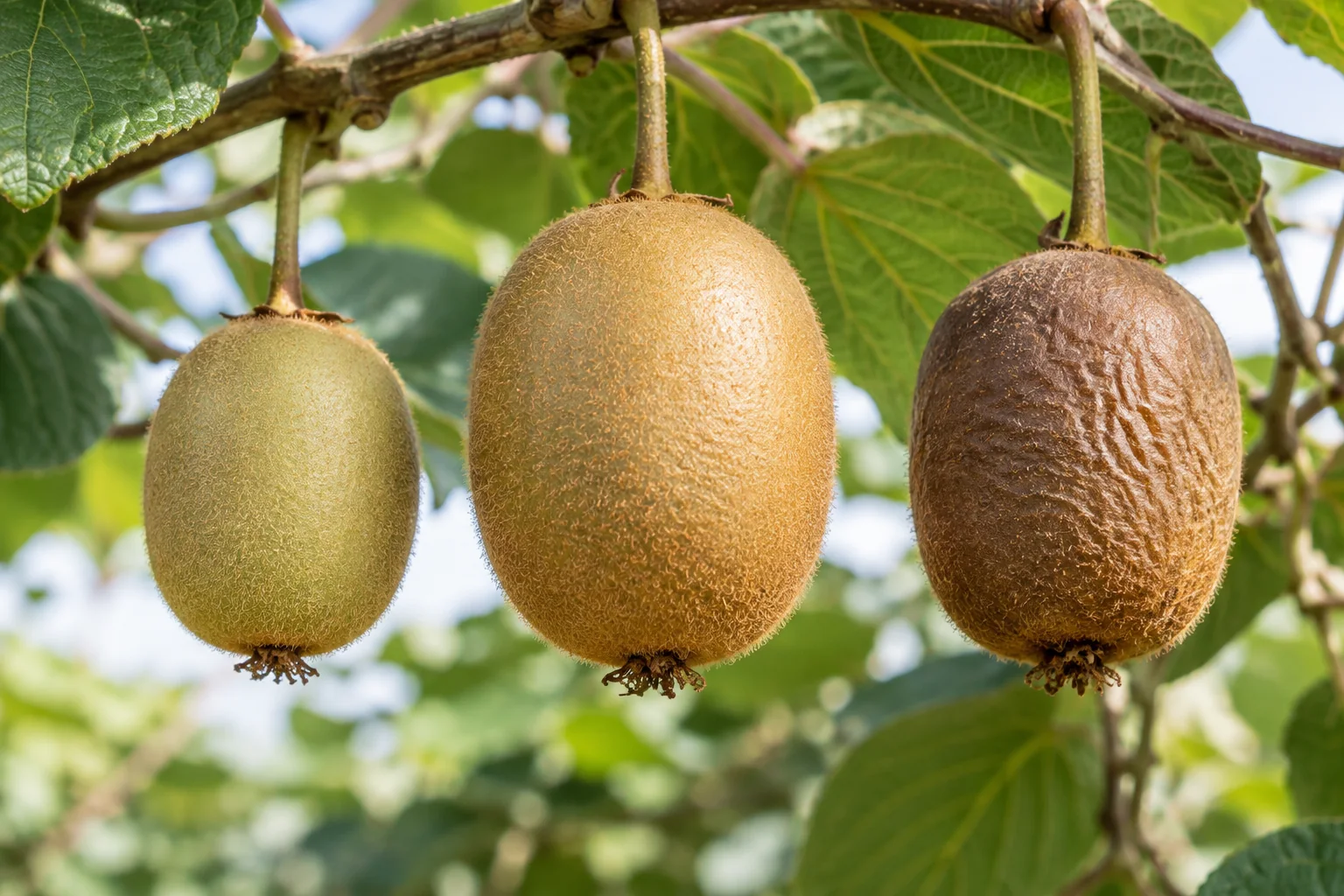
A botanical maturity comparison of three golden kiwifruit on the vine: undersized firm fruit, harvest-ready fruit, and overripe soft fruit, with accurate vine and leaf details and no labels.
Golden kiwi is harvested firm, before it reaches the soft eating stage. Growers and packers use maturity indicators rather than waiting for fruit to feel ready to eat on the vine. Soluble solids, dry matter, flesh color development, firmness, and seed maturity may all inform release decisions under the applicable program. Fruit picked too early can struggle to develop the expected sweetness and aroma; fruit left too late can lose storage potential.
For that reason, a calendar graphic should be read as a sourcing map, not a quality guarantee. A statement such as "March to May" describes a likely harvest concentration for one origin. It does not tell the buyer whether fruit is a gold cultivar, whether it meets the required dry matter, how long it has been stored, or whether it is suitable for slicing, pureeing, or freezing.
We separate three questions when discussing seasonality: when the selected origin normally harvests, when the proposed processor converts fruit into frozen form, and when inventory can be shipped. The third window can be much longer than the first two, but only if enough suitable material was booked and frozen during the crop period.
| Supply stage | What the date describes | What a buyer still needs to verify |
|---|---|---|
| Orchard harvest | Fruit is being picked in a named origin | Cultivar, maturity clearance, crop condition and processing allocation |
| Fresh-market season | Packed fruit is being stored, shipped and ripened for sale | Pack date, firmness, remaining storage life and arrival timing |
| Frozen processing window | Fruit is peeled, cut or pureed and frozen | Format, run schedule, grade, yield and reserved quantity |
| Frozen shipment window | Finished frozen lots can be released from inventory | Lot, shelf life, pack, documents and cold-chain plan |
Weather can move every stage of that sequence. A warm spring may advance flowering, while frost, rain during bloom, summer heat, or a cool finish can reduce yield or delay maturity. A published "normal" season should therefore be checked against current crop reports before a contract is timed. This is particularly important for a short promotional program: a two-week movement in harvest may be manageable for annual industrial use but serious for a fixed retail launch.
Buyer language should also distinguish gold flesh from marketing color names. Some quotations use "yellow kiwi," "gold kiwi," and a cultivar name as if they were exact synonyms. They may describe different genetic material and different commercial rights. If cultivar identity is essential, request documentary confirmation. If performance is what matters, define flesh-color range, flavor, firmness, and process yield so that the specification can be evaluated without relying on an ambiguous name.
New Zealand Harvest and Fresh-Market Availability
New Zealand is strongly associated with commercial gold kiwifruit. The main harvest starts in late summer or early autumn, often from March, then moves through districts and varieties during the following weeks. The New Zealand Kiwifruit Growers industry book explains the crop cycle and the coordinated work behind orchard production, harvest, packing, storage, and export. It is a better planning reference than a single retail arrival date.
Fresh fruit does not appear in every destination as soon as picking begins. It must be harvested under the relevant maturity system, delivered to the packhouse, graded, packed, cooled, cleared, loaded, shipped, and then moved through import and ripening channels. Air freight can shorten the route for small premium programs, but most commercial volumes travel by sea. The consumer-facing season consequently lags behind orchard harvest.
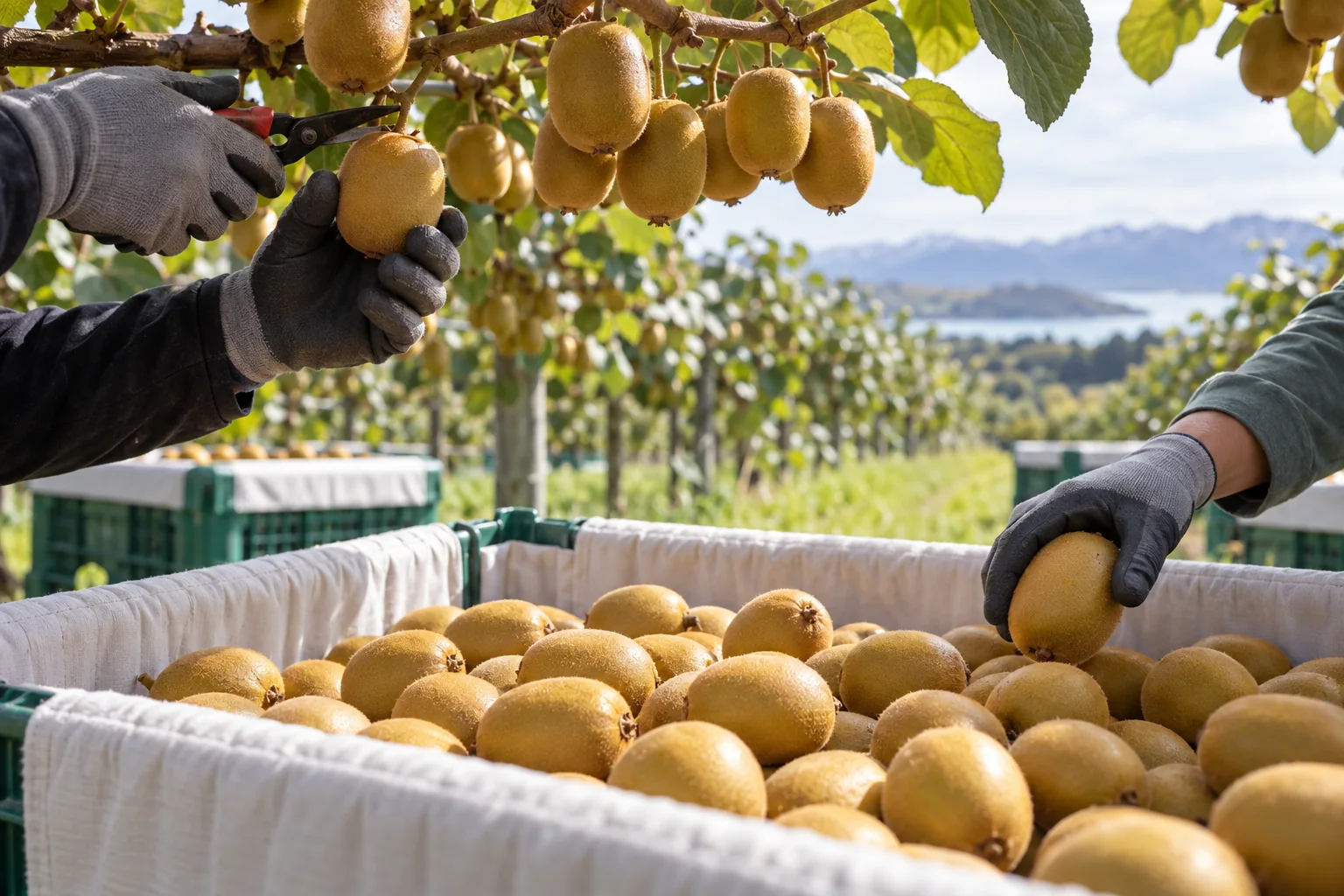
A New Zealand golden kiwifruit orchard at harvest with workers' hands clipping firm fruit into padded field bins, no faces, logos or implied GreenLand facility.
Once packed, suitable fruit may remain in refrigerated or controlled-atmosphere storage. This extends the marketing window and lets suppliers release fruit according to demand. Storage is not neutral, however. Firmness declines, starch and acids evolve, aroma changes, and fruit becomes more vulnerable to handling damage as time passes. A late-season tray can still be sound, yet it may behave differently from an early-season tray in cutting or foodservice preparation.
The broad fresh-market window often runs through much of the middle of the calendar year, and branded programs may offer New Zealand gold fruit into the southern spring. Exact end dates change with crop size, fruit condition, shipping plans, and destination. A buyer who needs a firm slicing grade should therefore ask about pack date and remaining storage potential, not merely accept "New Zealand origin" as a specification.
Processing fruit follows its own schedule. Some fruit may be directed to freezing near harvest when color, flavor, and availability fit the planned product. Other lots may become available as packing programs sort for size or appearance. Processors still need edible sound fruit; processing is not a safe outlet for decayed or uncontrolled material. The usable conversion window depends on the processor's intake standards and capacity.
Sizing and cosmetic grading can also affect what reaches a processor. Fruit outside a fresh retail count may still be sound and suitable for peeling or pureeing, provided it meets the processing specification. That does not make it "waste fruit." Industrial buyers need controls for decay, foreign material, maturity, residues, and traceability just as fresh buyers do; the difference is that shape or skin appearance may matter less after preparation.
When comparing early and late New Zealand offers, ask whether the quotation refers to fruit not yet harvested, fruit in packhouse inventory, or an already frozen lot. Each carries a different risk. A pre-crop program depends on forecast and eventual yield. Stored fresh fruit depends on remaining condition. Frozen inventory can be inspected by lot, but replacement may be limited once the processing run is over. The purchasing decision should reflect which risk the application can tolerate.
Northern Hemisphere Crops Extend the Calendar
Northern Hemisphere kiwifruit generally matures later in the calendar year. Italy is a major European origin, and commercial harvest commonly occurs in autumn. Greece, France, Portugal, Spain, China, Korea, Japan, and the United States also have kiwifruit production, although their cultivar mix, gold volume, market role, and export reach differ. "Northern Hemisphere kiwi" is therefore too broad to serve as a purchase specification.
A northern crop can bridge the period after the main New Zealand selling season, but the handoff is not perfectly seamless. One program may finish stored southern fruit before another has enough mature northern fruit packed and shipped. Variety licenses, import access, residue programs, and customer approvals can further narrow the practical origin choices. Procurement should identify acceptable countries and varieties in advance instead of assuming that any gold kiwi can replace another.
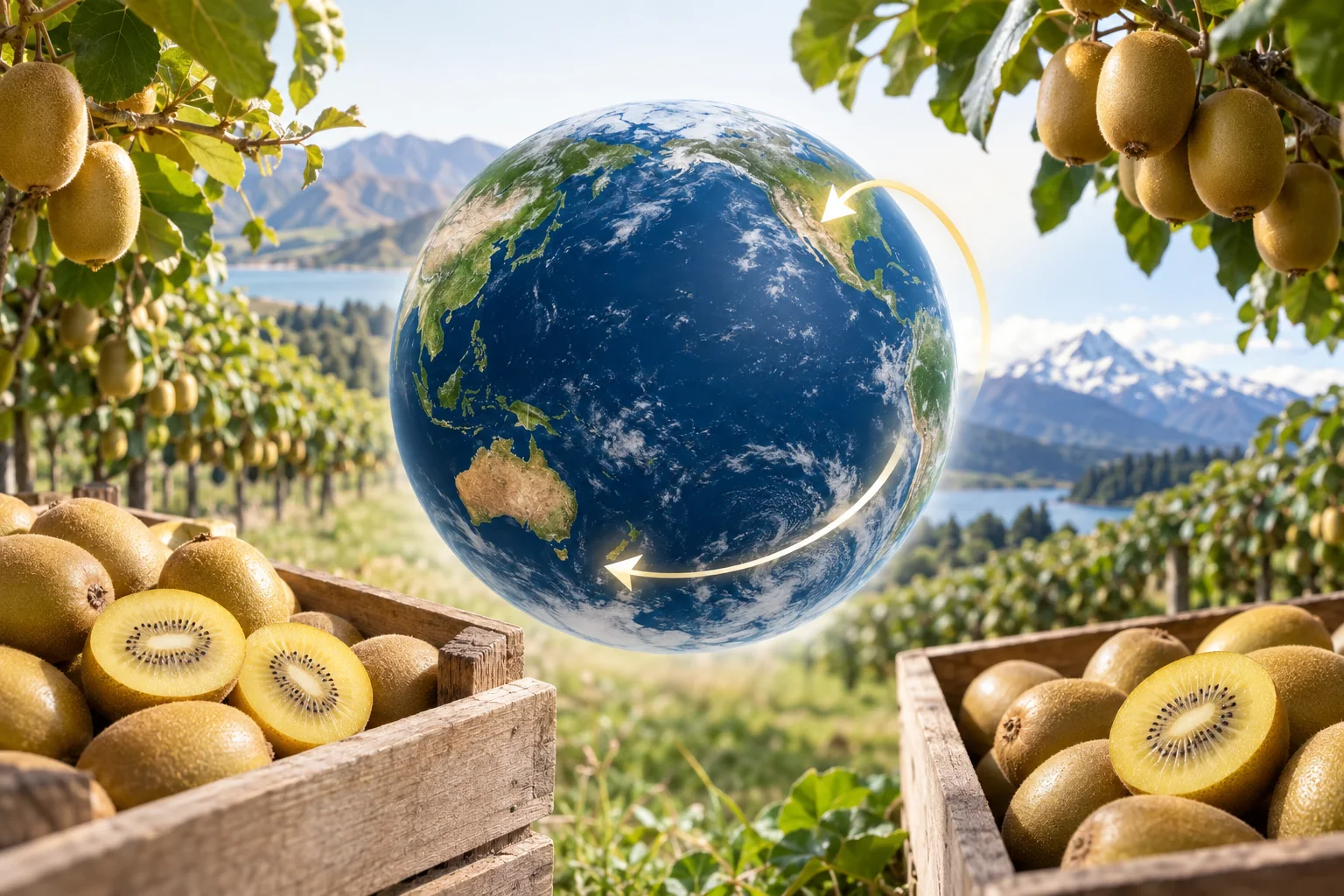
A geographic editorial illustration showing southern-hemisphere and northern-hemisphere golden kiwi harvest handoff across a world globe using orchard imagery and subtle arrows, no text.
The Zespri update on its Northern Hemisphere season illustrates the commercial purpose of this counter-season supply: fruit grown closer to northern customers can support availability when the New Zealand season is not supplying the whole market. It also shows why crop announcements need a year. Volume, participating countries, and timing can change from season to season.
For processors, the northern harvest may provide a second annual opportunity to contract raw material or refresh frozen inventory. Whether it is economical depends on local processing capacity, fruit price, usable yield, cold-chain cost, and the exact finished format. Fresh export fruit, processing grade, peeled whole fruit, slices, dice, and puree do not share the same cost structure.
Origin can also alter the sensory profile. Cultivar has a major influence, but growing conditions and harvest maturity contribute to sweetness, acidity, color, and aroma. A beverage formula calibrated to one crop may need a small adjustment when another origin enters. That is manageable if the buyer has an approved range and retains reference samples; it becomes a surprise if "gold kiwi" was the only requirement recorded.
Harvest Window Is Not the Same as Supply Window
Harvest window means the period when fruit is removed from the vine. Fresh supply window adds packing, storage, transit, and ripening. Frozen supply window adds processing and inventory management. Mixing these terms leads to weak forecasts. A buyer may hear that gold kiwi is harvested for only several weeks and wrongly conclude that the ingredient is unavailable for the rest of the year; another may see fruit at retail for months and wrongly assume that new processing can be scheduled at any time.
Fresh-storage systems slow biological change but do not stop it. Fruit is living tissue after harvest. It respires, softens, loses water, and responds to ethylene. Controlled atmosphere and temperature management can extend usable life, yet every lot has a finite condition window. Late storage fruit may be excellent for immediate eating while being too soft for a long distribution route or a precise fresh-cut program.
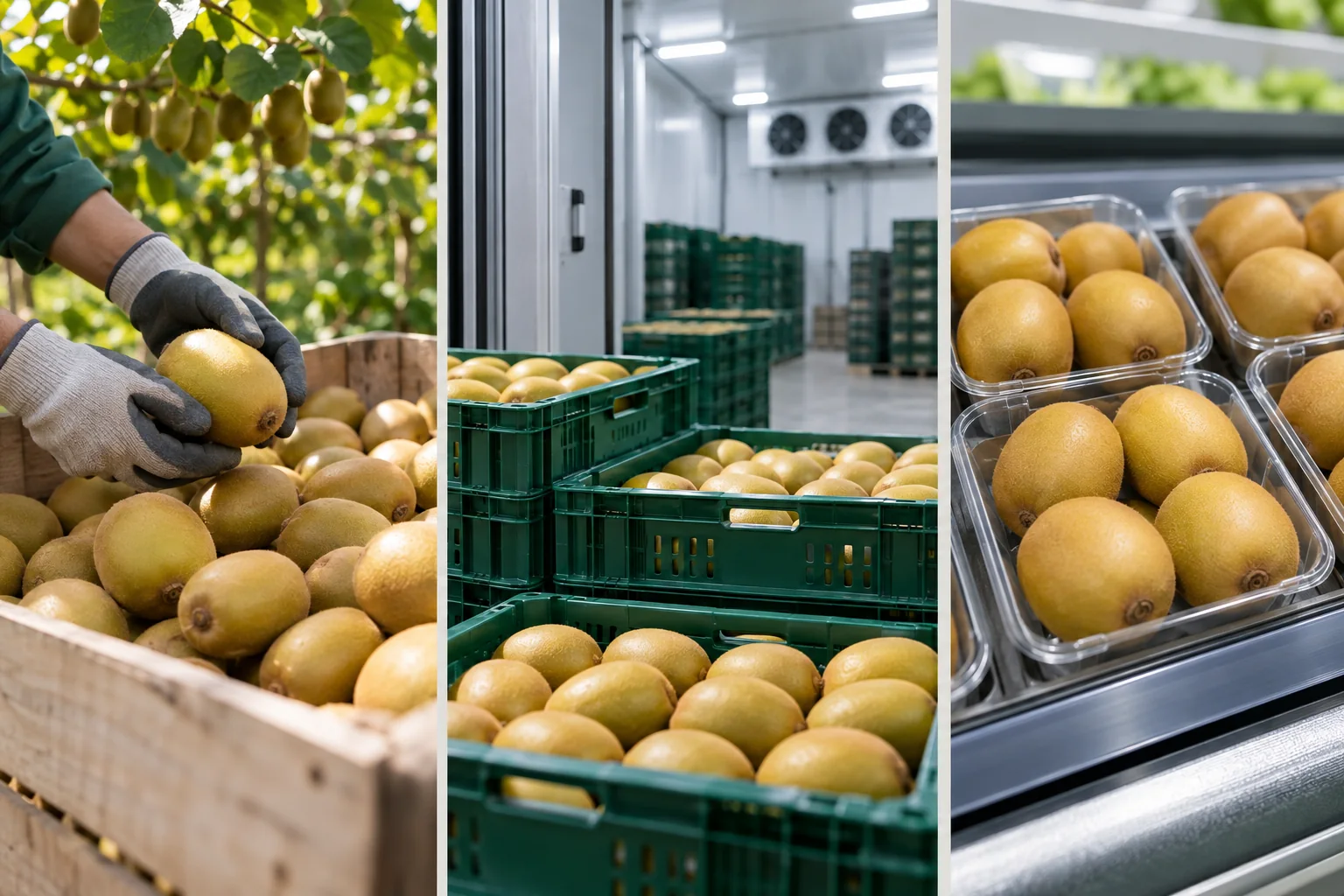
A cold-storage sequence showing firm golden kiwifruit moving from harvest bin to refrigerated packhouse storage and retail tray, with realistic fruit condition and no fabricated metrics.
Frozen kiwi changes the problem. Once sound prepared fruit is rapidly frozen and kept at the required temperature, the commercial focus moves from ripening to frozen inventory, pack integrity, temperature history, and remaining shelf life. Texture after thawing will not match fresh fruit because ice crystals disrupt cells. For smoothies, puree, sauces, fillings, and many beverage applications, that softened texture may be acceptable or even helpful.
Supply claims should name the form. "Available year-round" may be reasonable for contracted frozen slices held in stock, but it should not be generalized to every cut, certification, pack, or origin. A special dice, private-label bag, organic grade, or narrow size tolerance may require production during the crop window. If the buyer waits until the fresh season has passed, the only remaining inventory may not match the specification.
We therefore ask for the required delivery months as well as the expected annual volume. A rolling schedule makes it possible to reserve stock, plan replenishment, and identify the months where a crop transition or long transit creates risk. Seasonality becomes a manageable inventory question rather than a last-minute search for fruit.
How Frozen Kiwi Supports Year-Round Processing
Frozen kiwi supports year-round production by converting a seasonal fruit into stable, portionable inventory. The most common options include peeled whole fruit, slices, dice, and puree. Each form has a different yield and labor profile. Whole peeled kiwi offers flexibility but still requires cutting or pulping. Slices help with visual applications and measured loading. Dice can reduce preparation time. Puree is easiest to pump and blend but no longer provides intact fruit identity.
The freezing kiwi guide explains the form and texture tradeoff behind year-round supply.
The GreenLand frozen kiwi range includes formats that buyers can review for industrial and foodservice use, including frozen kiwi slices. Product pages show a category, not a standing guarantee that every cut and pack is immediately available. We still confirm the current crop, format, packing, minimum order, destination, and documents for the proposed shipment.

IQF whole peeled kiwi showing frozen surface condition.
Freezing preserves the selected state; it does not improve immature fruit. Gold kiwi intended for freezing needs developed color and flavor, acceptable soundness, and controlled preparation. Peeling, cutting, exposure to oxygen, pre-treatment if used, freezing rate, glazing or anti-clumping practice, and package barrier all influence the final result. A buyer should request a sample in the actual form because whole fruit and thin slices do not thaw in the same way.
For beverage processing, frozen kiwi can be added while partly frozen when the equipment and recipe allow it, helping control product temperature. For desserts and yogurt inclusions, thaw drip and piece definition matter more. For decorative applications, frozen kiwi is usually a poor substitute for firm fresh slices because thawed tissue softens and releases liquid. Matching the form to the application is more important than making a general fresh-versus-frozen judgment.
Annual planning should use first-in, first-out inventory with lot traceability and a realistic safety stock. Holding too little leaves the plant exposed to crop or freight interruptions. Holding excessive stock ties up cold storage and may push material beyond the buyer's preferred remaining shelf life. The target is enough contracted inventory to bridge the next qualified production window, with review points before demand or crop assumptions become outdated.
Quality Changes Buyers Should Expect Across Crop Transitions
A crop transition can change sweetness, acid balance, flesh color, firmness, aroma, piece size distribution, and thaw behavior. These changes do not necessarily indicate a defect. Fruit is agricultural material, and an agreed specification normally allows a controlled range. The buyer's job is to decide which attributes affect the finished product strongly enough to require approval or recipe adjustment.
Color deserves special attention in golden kiwi. The target may range from green-gold to a deeper yellow depending on cultivar and maturity. Photographing samples under different lighting is unreliable. Use a consistent light source, neutral background, thaw time, and cut surface. If color is critical to a pale beverage or dessert, agree on a physical reference or instrumental range and state when it is measured.

Frozen peeled kiwi with cut views showing flesh and seed distribution.
Acidity and soluble solids influence flavor, but neither alone predicts eating quality. A sweeter crop may still taste flat if acid is low; a high-acid lot may be refreshing in a sugared beverage but too sharp for a plain puree. Test the fruit in the actual formula. A smoothie with banana, a dairy base, and a clear drink reveal different aspects of the same kiwi lot.
Texture variation is especially visible after thawing. Slice thickness, fruit firmness before freezing, freezing rate, temperature fluctuation, and thaw method all affect drip and breakage. Compare lots after a fixed thaw protocol and gentle handling. If the plant blends the fruit completely, a small difference in slice integrity may be irrelevant; if the product shows pieces through a clear cup, it may be decisive.
We recommend retaining an approved sample or documented sensory profile across the transition. When the next crop arrives, compare it with the reference, record the meaningful differences, and decide whether the lot is acceptable as is, needs a formula adjustment, or requires customer approval. This is more reliable than asking the supplier to promise that natural fruit will look identical forever.
Building an Annual Golden Kiwi Sourcing Plan
Start with a twelve-month demand forecast by product form, not a single annual tonnage. Separate whole peeled fruit, slices, dice, and puree because one format cannot always cover a shortage in another. Add trial, launch, promotion, and safety-stock volumes. Then work backward from the required delivery dates through ocean or inland transit, order preparation, freezing, and the likely harvest window.
Create an origin and crop policy. Record approved gold cultivars or the performance range they must meet, acceptable origins, whether origin changes require customer notification, and which documents are mandatory. If the finished label names an origin or variety, the commercial team must know before contracting. A flexible origin policy can reduce gaps, but only if regulatory, sensory, and customer requirements genuinely allow it.
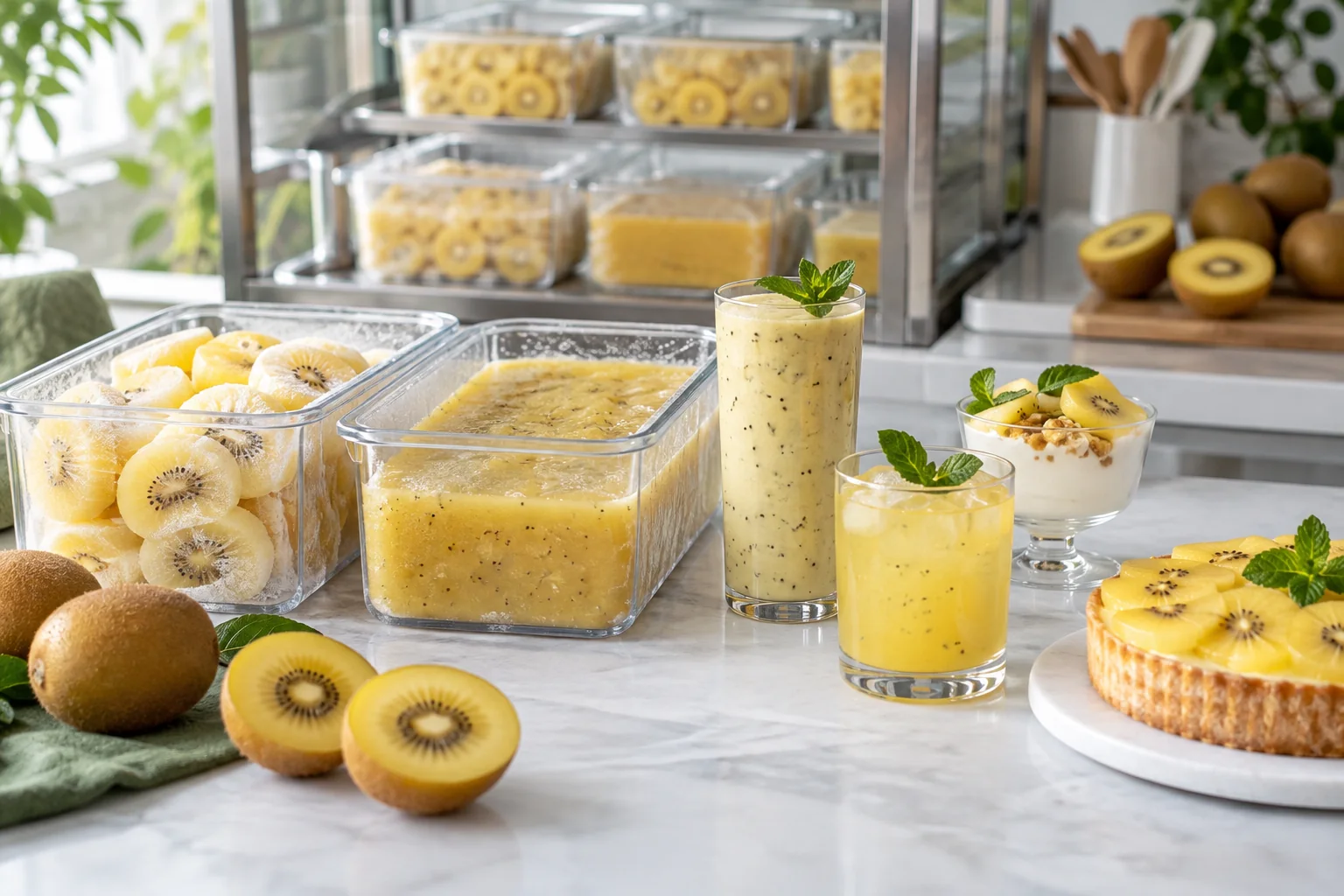
A beverage and dessert production plan using portioned frozen kiwi slices and puree across different months, shown as a professional ingredient scheduling scene without text or calendar numbers.
The product specification should cover format, cut tolerance, ripeness or color, defects, foreign material, microbiological limits, pack weight, storage, shelf life, and traceability. For slices, define diameter and thickness tolerances plus broken-piece limits. For whole peeled fruit, define size range and peel-removal expectations. For puree, viscosity, screen, seed presence, Brix, and acidity may be more relevant.
Build checkpoints into the calendar. Before the anticipated crop, confirm forecast and specification. During production, review a representative sample and provisional lot information. After freezing, confirm packed quantity and expected shipment schedule. Before a crop transition, compare the incoming lot with the retained standard. The purpose is not to remove all agricultural variation; it is to find variation while there is still time to respond.
Commercial details complete the plan: minimum order, carton or bulk pack, pallet pattern, private-label lead time, loading port, destination, Incoterm, certificate scope, and inspection needs. Keep requested delivery dates separate from estimated departure dates. Frozen stock can cover the calendar only if logistics and documents move with it.
Use a monthly stock model rather than a rough annual average. The opening balance plus confirmed arrivals should cover forecast consumption, planned promotions, expected yield loss, and a safety allowance. Mark the last month in which another compatible crop or production run could reasonably replenish the item. That date is the real decision point: once it passes, a shortfall may require a specification change instead of a routine reorder.
The same model should track shelf life at arrival, not only manufacturing date. A buyer receiving material after a long sea route needs enough remaining life for storage, production, and its own finished-goods cycle. Agree on the minimum remaining shelf life in the contract and check it against the proposed lot before loading. This avoids the false comfort of having enough tonnes on paper when part of the inventory cannot support the planned production calendar.
Finally, define a contingency path. It may be a second approved origin, a second cut that the line can reduce to puree, a larger pre-season reservation, or a formula that tolerates a controlled range of color and acidity. A contingency should be qualified before it is needed. Emergency substitutions made during a stockout are more likely to create label, sensory, or process problems than a planned and tested alternative.
Golden kiwi season is therefore a chain of windows. Orchard harvest creates the raw material, storage extends fresh sales, opposite hemispheres reduce calendar gaps, and frozen inventory supports processing after fresh fruit has moved on. A buyer who distinguishes those windows can plan a stable annual program without pretending that every month offers the same crop, price, or product condition.
Source frozen kiwi with GreenLand-food
GreenLand-food is a frozen-food supplier and manufacturer supporting factory-direct wholesale programs. We match the requested product form and coordinate the commercial details. Tell us your kiwi form, annual volume, destination, packing and production calendar. We will review frozen kiwi supply options for your program.