


When Is Pineapple in Season?
Sep 07, 2026
Leave a message
Attach an origin and a date to every season claim
In a US seasonal shopping context, pineapple is commonly associated with spring and summer; that is not a universal harvest calendar. For commercial purchasing, connect the origin's harvest window to processing dates, shipment timing and usable stock. Frozen pineapple can extend the period in which a crop is supplied, but available inventory and arrival dates still need confirmation for the actual order. For a frozen order, distinguish existing released inventory from a future production plan. Work backwards from the date usable stock is needed, including packing, shipment and receiving steps, and confirm which crop or lots support the offer.
A regional harvest peak and year-round retail availability can both be true; keep the location attached to the claim.
Frozen stock separates use from harvest timing, but the exact cut, production lot and available quantity still need confirmation.
Calculate inventory cover from suitable, unallocated stock and plan around the date the ingredient is usable at destination.
There is no single worldwide pineapple season
A season answer needs a location. Pineapple grown in one hemisphere does not follow the same calendar as every other origin, and neighboring production areas can have different harvest patterns. A consumer looking for a favorable local buying period and an importer booking frozen containers are asking related but different questions.
USDA's seasonal produce guide lists pineapple under spring and summer. That is useful shopping context for its audience. It should not be turned into a statement that pineapple is unavailable outside those months or that every exporting country harvests at the same time. Retail availability includes imported supply and distribution decisions as well as the local calendar.
For a procurement plan, write the relevant origin beside every season claim. Then identify whether the dates refer to harvest, processing, export packing or market arrival. An offer described only as "new season pineapple" is incomplete. Ask which crop and production period it means, what product is being reserved and when that product can realistically reach the destination.
Read a season claim with its location attached
Regional examples show why a global peak-month table can mislead. Okinawa's ingredient guide describes a summer-centered pineapple harvest and a wider availability period associated with different varieties. Australian Pineapples describes year-round Australian availability. Neither statement is a forecast of every 2026 shipment from those regions.
| Context | What the published guidance supports | What still needs order-specific checking |
|---|---|---|
| US seasonal shopping guide | Spring and summer are highlighted | The actual fruit's origin and current retail quality |
| Okinawa local production | A local summer harvest context with varietal staggering | The variety, current crop and available commercial volume |
| Australian industry supply | Pineapple can be available through the year | Regional production, product form and dispatch dates |
| Frozen export order | Stock can be supplied beyond its harvest date | Production lot, inventory allocation and shipment schedule |
Use these examples to interpret a season claim, not to predict current price or availability without a quotation. Weather, field scheduling, demand and logistics can change what is available to a particular buyer. A short email confirming crop period and available stock is more useful for booking than a polished calendar that has no connection to the offered lot.

Why production can be staggered
Pineapple does not behave like a single short-lived orchard harvest that must all reach the market in one week. Production scheduling, growing areas and varieties can spread harvesting over time. That helps explain why year-round market supply can coexist with regional periods of stronger availability. It does not mean supply is unlimited or equally convenient in every month.
Ask whether the supplier is offering current processed stock, product from an upcoming production run or a plan dependent on a future crop. Each has a different level of scheduling certainty. A stock offer can be checked against existing lot details, while a future production plan needs milestones and a way to communicate changes.
Do not infer the fresh fruit's origin solely from the country where a frozen product is packed or sold. If origin is material to the purchasing program, state that requirement and confirm the relevant documentation. The same applies to variety. A broad product name may cover more than one source arrangement, and the buyer should resolve that before using the season information in a customer commitment.
Harvest season and buying season are different dates
The harvest date is only one point in a supply chain. A frozen order also involves preparation, freezing, packing, quality release, booking, loading, transit and destination handling. A product harvested during a local peak may arrive well after that peak. Conversely, stock produced earlier may be available for shipment while the current fresh crop is between busy periods.
Build the discussion around the date the ingredient is needed in production, not just the month it leaves the supplier. Include receiving time and a reasonable allowance for the buyer's own checks. A container arriving at port on the day a factory needs to start a run is not the same as usable stock available at the line.
For a fresh program, the route and fruit condition are especially relevant because the product continues to change during distribution. For a frozen program, lot age, remaining shelf life and cold-chain records become more prominent. Neither route should be assessed from harvest season alone. The purchasing decision is whether the correct product can arrive in acceptable condition with enough time and shelf life for its planned use.
Maturity still matters during a busy crop window
A peak supply period does not automatically make every pineapple suitable for every application. Variety, harvest maturity, defects and preparation still determine the ingredient's value. Pineapple does not gain a new supply of sugar after harvest simply because it is left on a counter. UF/IFAS pineapple guidance provides the crop context for selecting fruit at appropriate maturity.
For a processor, define the quality required in the finished cut: color, flavor, core residue, eye removal, cut size and any analytical checks relevant to the recipe. A fruit that looks attractive as a whole may produce unacceptable fibrous pieces after cutting. A busy harvest window should make these checks more important, not less visible behind a promise of abundant supply.
Evaluate a representative sample from the offered production, where available. Do not rely indefinitely on a sample from a previous crop. If the supply lot changes, check whether the approved specification and application result still hold. A repeated menu needs a stable ingredient outcome even when the agricultural source moves through its normal variations.
How frozen pineapple carries a crop beyond harvest
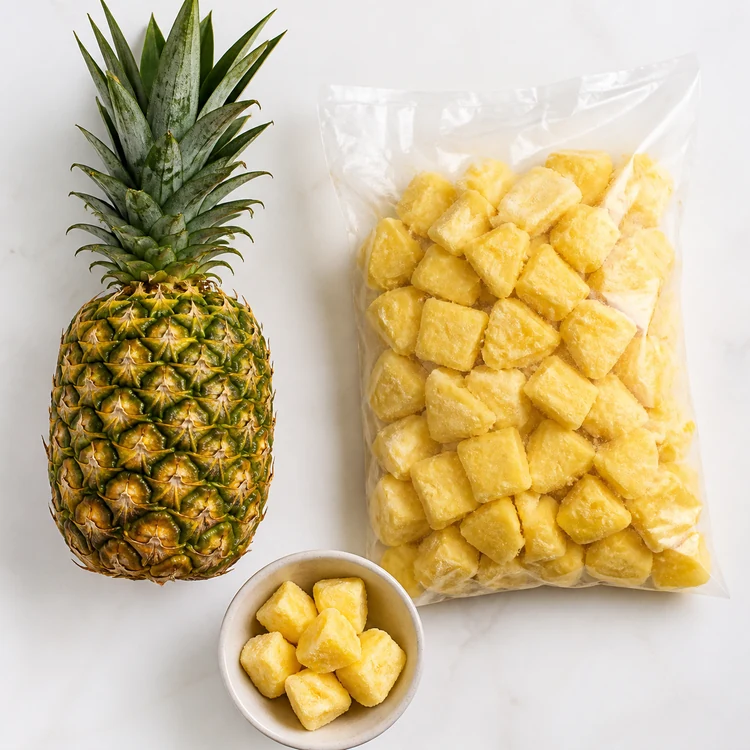
Freezing allows prepared pineapple to be stored and distributed after the fresh harvest period, provided the product is produced, packed and held under the required conditions. This separates the consumer's use date from the harvest date. It does not create new inventory, correct poor raw fruit or guarantee that a requested cut is always available.
For ingredient format details, see How to Freeze Fresh Pineapple: Chunks, Rings and Puree.
We supply frozen pineapple formats for different applications and confirm the available cut and packing against the order. A buyer should ask which lots can be allocated, when they were produced and how their remaining shelf life fits the intended sales or production period. The specification and storage instructions remain part of that decision.
| Fresh-market question | Frozen-supply equivalent |
|---|---|
| When is the local fruit being harvested? | Which crop and production lots support this offer? |
| Will ripe fruit be available next week? | Is the required cut already packed or still scheduled? |
| How quickly must the fruit be used? | What remaining shelf life and handling conditions apply? |
| Can another origin cover a gap? | Can an approved alternative lot or format cover the requirement? |
Frozen supply is most useful when it is planned as inventory with defined specifications, rather than treated as an unlimited substitute that can be ordered at the last moment.
Build a purchasing calendar backwards
Start with the week the ingredient must be usable at the destination. Work backwards through the actual stages of the order, using confirmed estimates rather than a generic lead-time promise. Keep the assumptions visible so the plan can be revised when a booking or production date changes.
- Set the production need. Identify the recipe, quantity and first required use date. Include the receiving site's storage capacity and any customer shelf-life requirement.
- Allow for destination handling. Include arrival procedures, inland transport and the buyer's inspection or release process. Distinguish port arrival from warehouse availability.
- Confirm the shipment plan. Obtain the proposed loading window and the current logistics basis. Keep estimated dates separate from confirmed milestones.
- Confirm product readiness. Establish whether the order uses existing released stock or requires production and packing. Include artwork approval when private-label packing is involved.
- Connect to crop supply. Ask which harvest or production period supports the plan and what could change the available quantity or format.
- Agree updates and alternatives. Define when a delay should be reported and which substitutions require approval before shipment.
A simple calendar with these dependencies is easier to manage than a single promised date. It also shows where an early purchasing decision creates value: approving a cut and pack before the production window can be more useful than merely asking whether pineapple is "in season."
A backward calendar can be shown without pretending that one lead time fits every trade route. Let week zero be the week the buyer needs released stock in its warehouse. Place the confirmed destination handling interval before that, then the current transport estimate, then the loading window and product-readiness requirement. If the order uses custom retail packing, place artwork approval before the packing milestone. Each interval comes from the actual order participants.
Now test a delay scenario. If a proposed loading slips by one week, identify which production runs would lose coverage and whether existing acceptable inventory covers them. If it does, the buyer may only need an updated arrival plan. If it does not, an approved alternative or a revised production schedule becomes necessary. The calendar turns an abstract concern about pineapple season into a decision about a defined quantity and date.
Keep a difference between estimates and commitments. A provisional crop or logistics estimate can support planning, but it should not be shown to a downstream customer as a confirmed delivery. Record when the estimate was last reviewed and what event will make it firmer. That makes later updates straightforward and avoids treating a seasonal overview as an order guarantee.

Specify the format before reserving volume
Pineapple cubes, irregular chunks, pieces and other forms do not necessarily share the same availability. Cut geometry affects processing, yield, packing and application performance. A supplier may have pineapple stock without having the exact format a customer's line needs. Reserve a defined product rather than a generic tonnage of fruit.
For frozen pineapple cubes, confirm the nominal dimensions and acceptable variation. For irregular pieces, agree a size range and the limits on very small fragments. State whether core residue, eye remnants or unusually fibrous pieces are acceptance issues. A dimension alone does not describe the full eating or processing quality.
Packing also changes the schedule. Bulk cartons, foodservice inner bags and retail packs involve different preparation and approval tasks. Private-label artwork and destination declarations should be settled early enough to fit the production plan. Do not assume a standard stock item can become a custom retail program without additional coordination. We review the product, quantity and packing together before confirming the order schedule.
Compare crop offers on usable output
A low seasonal price is not automatically the lowest recipe cost. Compare the ingredient after the preparation or thawing steps required by the application. Whole fresh fruit includes crown, peel, core and cutting work; prepared frozen fruit includes a different set of handling and performance considerations. The comparison basis must be explicit.
Suppose one fresh-fruit trial gives 50 kg of acceptable chunks from 100 kg purchased, while a prepared frozen trial gives 95 kg acceptable after the buyer's defined process from 100 kg purchased. These are illustrative measured outcomes, not standard yield promises. Divide each purchase cost by its usable output, then add the relevant labor, energy and waste handling costs. The result may differ substantially from the incoming price comparison.
Also consider whether the product passes the final application test. A cheaper lot that requires more trimming or creates unacceptable texture after reheating can cost more in rejected meals. Keep yield, recipe acceptance and commercial terms together. A season calendar tells you when to investigate an offer; a measured application comparison tells you whether the offer is useful.

Watch the risks around a supply gap
Define the gap in operational terms: how many production days would be uncovered if the next shipment arrived late? The answer depends on usable stock, expected consumption and incoming orders that are actually confirmed. Inventory that is already allocated to another customer or too old for the program should not be counted as available cover.
Create an approved alternative before it is urgently needed. That may be another acceptable cut, a different pack format or another qualified lot. Test the alternative in the recipe and confirm any changes to portioning, labeling or process settings. A last-minute substitution made only because it is also pineapple can create a production problem that is harder to solve than the original shortage.
Avoid assuming a future crop will compensate for every current delay. Crop readiness and logistics are different risks, and both need current information. Ask for updates tied to meaningful milestones such as production completion, quality release and loading. A brief, specific status report helps the buyer decide whether to adjust production or use an approved reserve.
Inventory cover should use available, suitable stock. Suppose a program consumes an illustrative 500 kg per week and the warehouse holds 3,000 kg. The simple calculation suggests six weeks of stock. If 1,000 kg is already committed elsewhere and 500 kg does not meet this customer's remaining-shelf-life requirement, only 1,500 kg is available to this program: three weeks of cover. The physical pallet count has not changed, but the purchasing decision has.
Apply the same logic to incoming shipments. Count an order according to its realistic readiness and arrival status, and avoid counting the same stock twice because both purchasing and sales have listed it. A clear allocation record helps prevent a seasonal rush from producing promises that exceed usable supply.
When a crop transition is expected, decide how much of the existing lot should remain as a reference and how the new lot will be released. Test the new product early enough that a quality question can be resolved before the old stock is exhausted. This is particularly useful when a customer's recipe is sensitive to cut distribution, flavor or liquid release. Waiting until the final pallet is opened leaves little room for a controlled response.
Manage inventory through a change of crop
Keep incoming and existing lots identifiable. Use a rotation method that respects remaining shelf life and customer requirements rather than automatically choosing whichever pallet is easiest to reach. If a new lot is introduced into production, retain the transition date and the recipes or customers affected. This makes later quality questions easier to investigate.
Check the new lot against the approved reference before using it across the whole program. Look at color, cut distribution, flavor and performance after the actual cooking, thawing or blending stage. Small agricultural differences may be acceptable, but they should be assessed against the agreed specification. Do not silently adjust every recipe and lose the record of what changed.
For a distributor, align the stock plan with downstream customer use. A foodservice customer may accept a format that a retail packing program cannot. Keep allocations clear so one attractive incoming lot is not promised to several different programs simultaneously. Inventory planning is most reliable when quantity, quality and customer suitability are tracked together.
What to send for a seasonal supply plan
Send the required pineapple form, cut size or range, expected quantity by period and destination. Add the packing format, private-label requirements and the date the stock must be ready for use. If the program requires a specific origin, variety or minimum remaining shelf life at arrival, state that at the start.
We review the requested IQF pineapple chunks or another confirmed format against the application and available supply plan. MOQ, lead time, production allocation and loading arrangements are confirmed for the order. A forecast helps planning, but it should be distinguished from a placed order and from stock that has already been reserved.
Include the documents needed for the product and destination, such as the specification, appropriate lot information and shipping requirements. Agree how changes will be communicated. If volume, packing or delivery timing moves, the product allocation may also need review. A useful seasonal plan is a working agreement connecting the crop, the packed ingredient and the buyer's production schedule.

Questions about year-round availability
What should a new-season offer identify?
Ask for the origin or crop basis relevant to the program, production period, exact cut and packing, available quantity and proposed readiness date. New season alone does not distinguish released stock from a future production plan.
Can all stock in the freezer count toward inventory cover?
Only stock suitable and available for the specific program should count. Exclude quantities already allocated elsewhere or unable to meet the customer's remaining-shelf-life or specification requirements. Calculate cover using expected consumption and realistic incoming-order status.
Source frozen pineapple with GreenLand-food
GreenLand-food is a professional frozen pineapple supplier and manufacturer in China, providing factory-direct wholesale supply for importers, food manufacturers, foodservice distributors and private-label programs.
Tell us the product form, required specification, packing and quantity, along with the application, destination and delivery timing. Include seed or cut preferences where relevant, private-label requirements and the documents your team needs. We will review the sample, MOQ, lead time and loading arrangement for the proposed order.