


Enoki Beef Rolls: Strand Length, Meat Wrap and Complete Heating
Oct 20, 2026
Leave a message

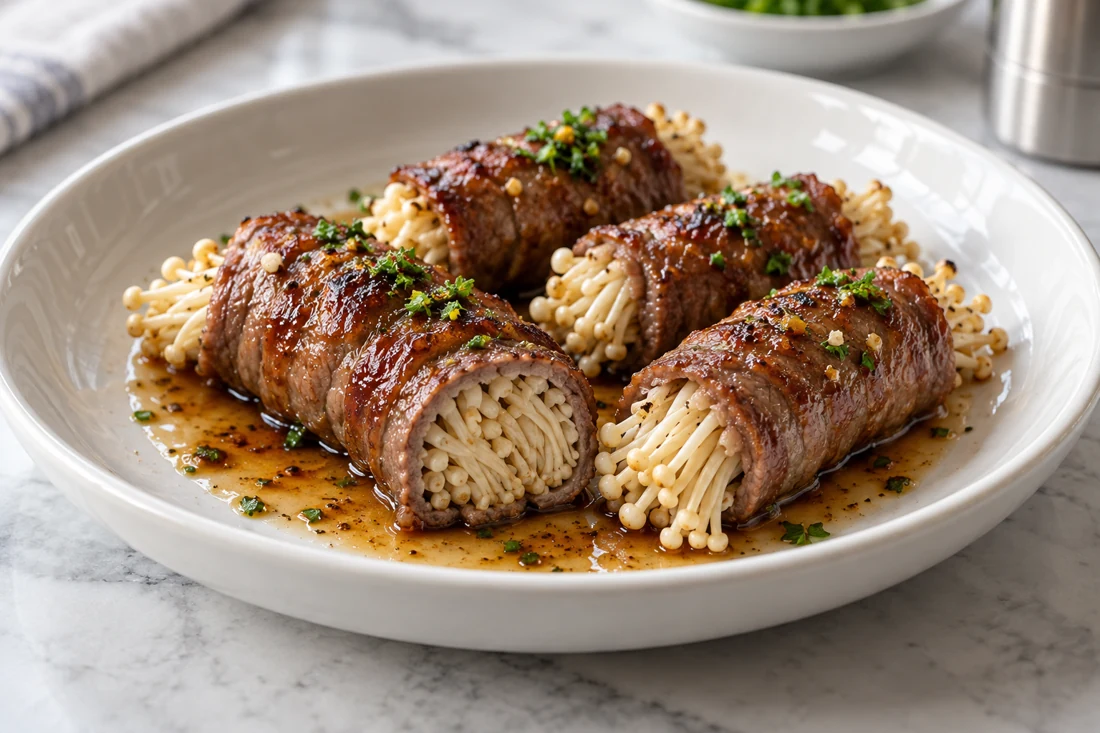
Choose strand length around the served bite
The desired enoki length begins with the way the roll will be eaten. A small appetizer served with chopsticks has different requirements from a knife-and-fork main course or a reheated lunch tray. Fine stems can project attractively from the beef, but a long tangled end may pull the filling out when the diner bites. Evaluate a normal serving with its intended utensils rather than judging only an uncooked arrangement on a board.
Define total mushroom length and the amount that projects beyond the wrap. Those dimensions are related but are not interchangeable. A wider beef slice can cover more of the same strand, while a narrow strip leaves longer ends exposed. If the menu needs caps visible at both ends, the assembler may arrange two smaller bunches in opposite directions. That changes the amount of mushroom at the center and should be assessed as a distinct assembly.

The supplied form needs a separate check of length, base removal and processing state.
Trim the growing base according to the approved ingredient standard. A compact base should not remain simply because it makes the bundle easier to handle. Firm connected material, substrate and damaged ends need a defined acceptance rule. Some connection between clean stems may help assembly, but the buyer should examine the thickest area after trimming. A neat external shape can conceal a dense end that affects both bite and heating.
Fresh chilled enoki and a supplied frozen format may separate differently. Frozen long stems can tangle, fracture or retain the shape imposed by the pack. The actual preparation instructions and documented processing state must be considered before assembly. Do not assume that a fresh recipe's handling sequence is suitable for a frozen ingredient. If the planned operation uses a controlled thaw, assess the resulting drained form rather than a photograph of the frozen bag.
Measure the usable portion yield during sample preparation. Record the material removed as base, the short fragments unsuitable for the roll and any caps lost during separation. These are different defects and may require different solutions. Excessive trimming may indicate an unsuitable supplied form, while breakage during rough handling may require a change at the assembly station. Keep enough detail to distinguish the two before blaming the ingredient specification.
The frozen enoki supply page describes the form questions to confirm. Its genuine product photograph shows fine pale stems and small caps; it does not establish a fixed roll length, an approved bundle mass or a finished cooked state. We would match the proposed cut and packing to an actual sample and the buyer's assembly trial before treating it as a repeatable commercial requirement.
Match beef thickness and overlap to the mushroom load
The beef slice needs to wrap the agreed mushroom portion without tearing or forming an unnecessarily thick seam. Slice thickness, width, length and fat distribution all influence that result. A specification that says only thinly sliced beef leaves substantial variation. The assembly trial should identify the slice characteristics that produce the desired bite and can be cooked completely in the operation's established process.
Measure mushroom mass separately from total roll mass. Two rolls can weigh the same while containing different proportions of beef and enoki. A larger meat overlap can hide a smaller filling, and a heavy mushroom bundle can stretch a slice into a fragile wrap. Recording both components makes yield, cost and heating comparisons interpretable. It also helps the assembler recognize whether a variation begins with the beef slice or the mushroom portion.
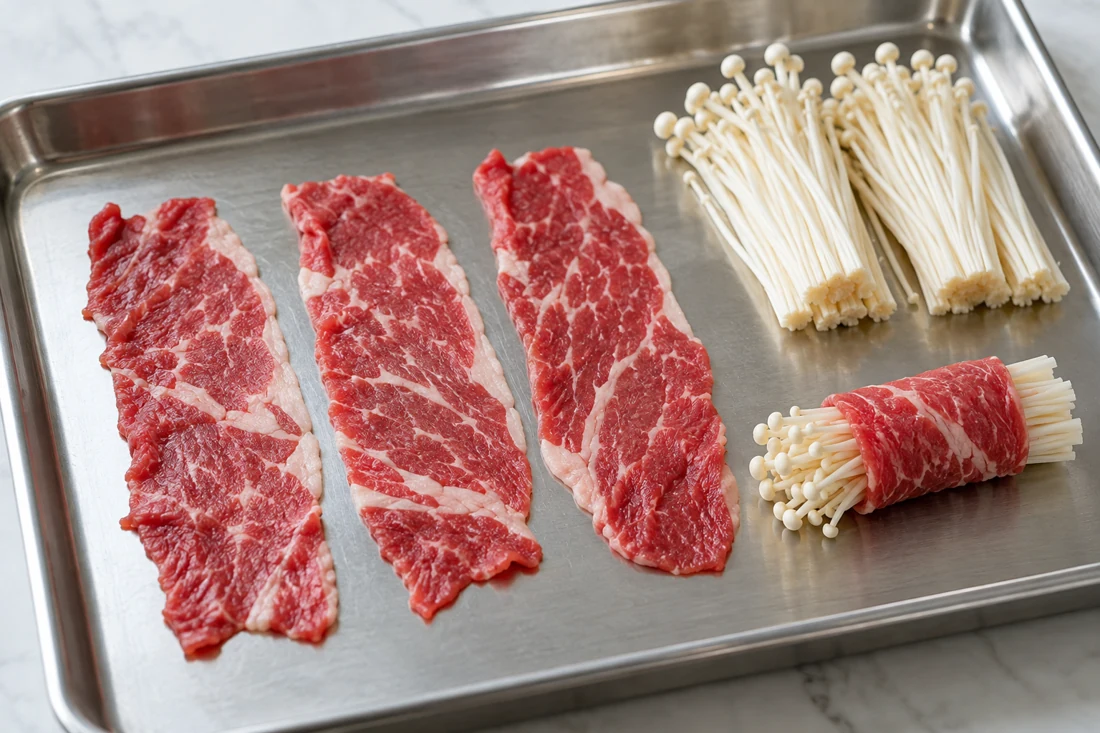
Slice dimensions and overlap determine the thickness around the mushroom load.
A modest overlap can help keep the seam closed during handling. Several turns of beef around the same bundle create a thicker local region and change the eating balance. Where the slice tapers, the operator may compensate by folding or doubling it, producing further variation. Agree how irregular slices are handled and whether they are suitable for the roll. Uncontrolled folds should not become the routine way to use every piece in a pack.
Fat and connective tissue influence the eating result, but appearance alone cannot predict it. A highly marbled slice may release more fat into the pan, while a lean slice can become firm under a cooking process needed to heat the center. Compare the actual supplied beef under the final process rather than choosing solely from the raw photograph. Keep the meat specification and its required safety classification with the assembly record.
Marinade can change handling as well as flavor. A wet slice may slip during rolling or leave liquid that affects browning in a crowded pan. Additional sugar can darken the surface quickly, making color an even weaker guide to complete heating. If marinating is part of the process, define the formulation, refrigerated handling and drain condition. Do not let an operator's improvised extra sauce change both the wrap behavior and the apparent cooking endpoint.
The beef supplier and the finished-food operator should confirm whether the meat is intact, mechanically tenderized, injected, reformed or otherwise processed. Those distinctions may affect applicable cooking controls and labelling. The mushroom supplier cannot establish them from an assembly photograph. The final roll is a combined product, so its safety and quality review must account for the actual meat as well as the enoki ingredient and the way the two are assembled.
Build rolls that stay intact without a dense center
A roll that survives handling is useful only if its center can be cooked and eaten satisfactorily. Compressing a large mushroom bundle tightly can make assembly look neat while increasing its density. The trial should seek a repeatable moderate portion with enough contact to hold the shape and enough consistency to heat predictably. Avoid using extra compression to compensate for an unsuitable beef slice or poorly separated enoki.
Set up a practical portioning method. A small scale can establish the mushroom and beef quantities during development, while an approved visual reference may help trained staff during production. If a scoop, tray position or other aid is used, verify the variation it produces with the actual ingredient. Long tangled strands do not always behave like a free-flowing filling, so a volume measure may conceal a wide mass range.
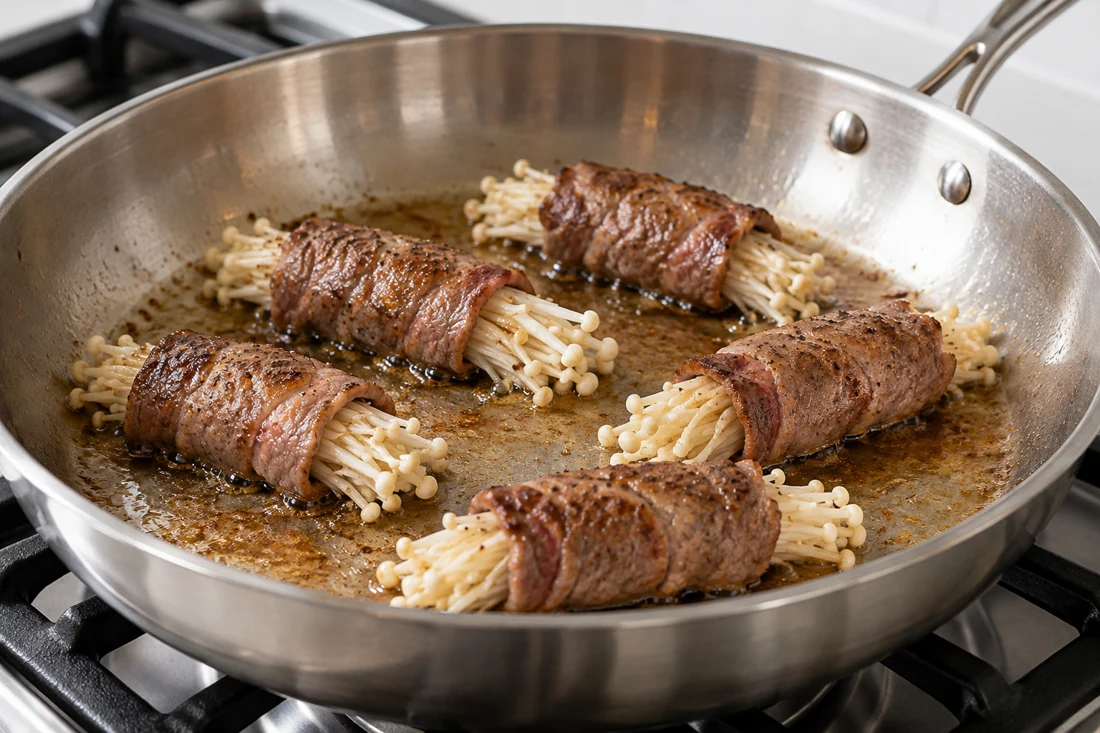
Spacing and seam position belong in the recorded cooking arrangement.
Arrange stems so that the ends are reasonably aligned and the center is not a knot of folded material. A few excessively long strands should not be folded repeatedly into the roll simply to preserve the target weight. That changes local density and bite. Decide whether those strands are trimmed under the approved method or allocated to another suitable use. Keep the commercial loss visible when the chosen form creates extra work.
Place the seam in a defined position for the cooking method, and test whether the roll stays closed as the meat contracts. Seam-side-down placement can be a useful assembly practice, but it does not replace a suitable wrap or complete cooking. Check the roll after turning and transfer as well as at the first contact with the pan. If it opens only when lifted, the tool and handling sequence may need adjustment.
Leave the validated spacing between portions. A pan tightly filled with cold rolls can behave differently from a small test batch, with more released liquid and less exposed cooking surface. Stacked or overlapping rolls can also heat unevenly. Record load, arrangement and turning or covered-heating steps as part of the process. The production method should reflect the busiest realistic service condition rather than a carefully spaced demonstration for a photograph.
Physical integrity has several useful observations: seam opening, escaped mushrooms, cap loss, torn beef and sauce residue left during transfer. Assess them separately after the required cooking. A roll can remain technically intact while losing enough filling to alter the portion. If a toothpick or skewer is proposed, the operation must manage its use and removal appropriately; a concealed sharp fixing should never become an unexamined solution to a weak assembly.
Verify complete heating in the assembled roll
Enoki must be thoroughly cooked, and the beef surrounding it adds another heating requirement. FDA's enoki guidance advises restaurants to cook enoki thoroughly and prevent contamination of foods that will not be cooked. A browned meat surface cannot establish the condition of the mushroom core. Steam, pale stems and an attractive glaze are also inadequate substitutes for the operation's defined cooking controls.
Classify the assembled product under the rules applicable to the operation. The 2026 FDA Food Code, a model for retail and foodservice adoption, specifies 165°F or 74°C for stuffed meat, reached throughout for less than one second. An enoki-filled beef roll should be reviewed as an assembled or stuffed product with the responsible food safety professional and local authority. Do not simply apply an intact-steak exception to a wrapped mushroom center.
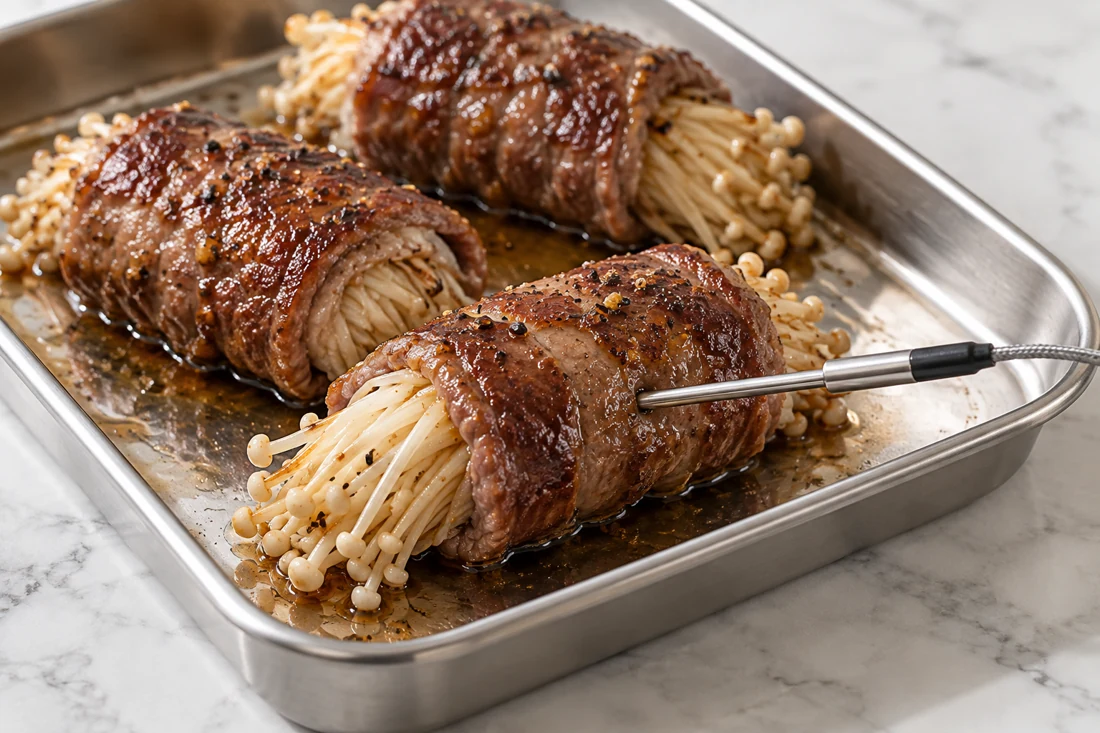
Place a suitable probe at the intended internal location; appearance cannot confirm heating.
The competent technical team should establish the actual cooking process, including any stricter requirement for the product or jurisdiction. Record the roll dimensions, component masses, beef overlap, starting temperature, equipment, load and operating sequence. Validate the locations expected to heat most slowly. The process must address the permitted variation rather than only the average roll. A larger frozen core, extra meat fold or dense bundle may fall outside conditions established for a small chilled sample.
Use a suitable food thermometer and a placement method that reaches the intended internal location. A thin probe can be easier to position in a small roll than a large stem thermometer. Avoid measuring only the hot surface, an exposed mushroom end or the pan beneath it. The USDA thermometer guide explains why correct instrument use and placement matter. Check calibration and follow hygienic probe handling under the operation's procedure.
During development, assess representative rolls from positions that may behave differently within the equipment. The center of a crowded pan, an edge position and the last-loaded area may not follow the same heating history. Routine checks should then confirm the established process conditions and the required endpoint. A single successful reading from an unusually small roll does not establish that every portion in a variable batch received adequate heating.
If the beef becomes too firm before the required internal process is achieved, revisit the design. A smaller mushroom load, more uniform slice, reduced overlap or different validated cooking method may improve the result. Shortening cooking to protect tenderness leaves the central requirement unresolved. Similarly, a frozen assembled roll should not inherit the schedule used for a chilled one. Reassess any change in starting state or dimensions before giving the kitchen new instructions.
Control sauce, chilling and reheating together
Sauce affects flavor, surface browning and the environment around the roll. A light sauce added during a covered cooking stage behaves differently from a thick glaze brushed on afterward. The recipe and thermal process should be developed together so that the intended sauce does not obscure an inadequate heating step or burn before the center is ready. Record the sauce quantity and when it enters the operation.
A marinade or sauce that contacted raw meat or raw enoki requires the appropriate controlled handling and treatment. Keep a clean serving sauce separate unless the operation has an established safe process for the contacted mixture. The same separation applies to trays, tongs and utensils. Finishing a cooked roll on the raw assembly tray can undo careful cooking through recontamination, so the transfer route belongs in the operating procedure.
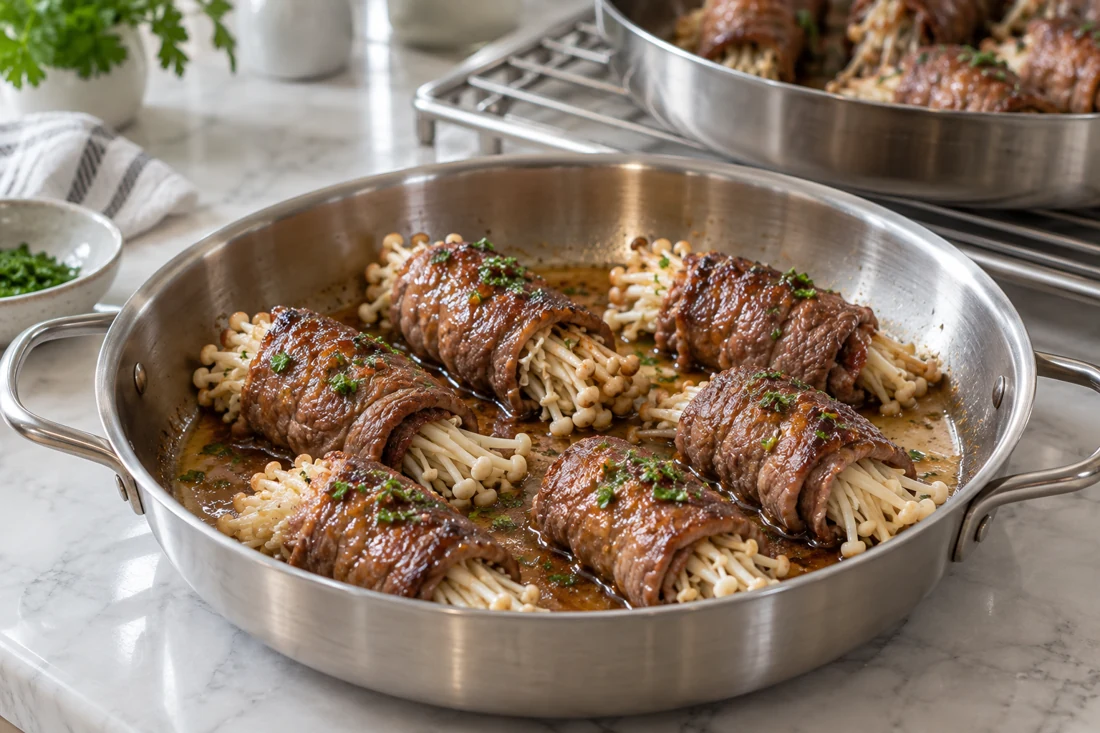
Include sauce depth and pan arrangement in the cooling and reheating assessment.
For immediate service, assess the roll after the normal wait and transfer to the plate. The beef may tighten as it cools, while the sauce can collect around the mushroom ends. Evaluate the whole bite at a realistic serving temperature. A very hot first sample may conceal differences in firmness that become obvious by the time the diner eats. The quality hold limit should come from the actual service route and remain within the operation's safe holding controls.
For a cook-chill or frozen meal route, the responsible operator needs a validated cooling and storage method for the assembled product. Shallow arrangement and spacing can help heat removal, but a photograph of a tray proves no cooling result. Monitor the relevant product locations under a representative load and follow applicable requirements. Piling warm rolls into a deep container changes the conditions substantially and should not be treated as equivalent to the approved shallow arrangement.
Reheating must follow the finished product's established instructions and applicable safety requirements. A microwave can create different heating patterns from a pan or oven, particularly when rolls touch or sit under a thick sauce. The validation should address the stated portion count, container, arrangement and any required standing or redistribution step. A warm sauce around a cool roll is a possible failure, so judge the internal food rather than the surrounding liquid alone.
Compare texture after the entire route. Mushrooms may release liquid into the sauce, the wrap may loosen and the beef may become firmer after additional heating. These changes can make a roll that works at immediate service unsuitable for a prepared meal. Keep the two applications distinct in the specification and sample record. An ingredient or assembly approved for one route should be reassessed before it is marketed for another preparation method.
Compare yield and labor on accepted portions
Commercial yield should describe the portions that the buyer can serve after the required process. Counting every raw assembled roll as an accepted unit hides failures that occur during cooking, transfer or reheating. Record the number made, the number meeting the finished standard and the reasons for rejection. This gives purchasing and operations a shared basis for comparing an ingredient or assembly change.
Track the mushroom and beef inputs separately. For enoki, note trim, unusable short pieces and losses during separation. For beef, note unsuitable slice shapes, tears and excess material removed to meet the wrap standard. Then record cooking loss and any sauce retained with the serving under the defined method. These measures answer different questions; combining them too early makes it hard to identify whether an apparent improvement came from more sauce or more usable food.
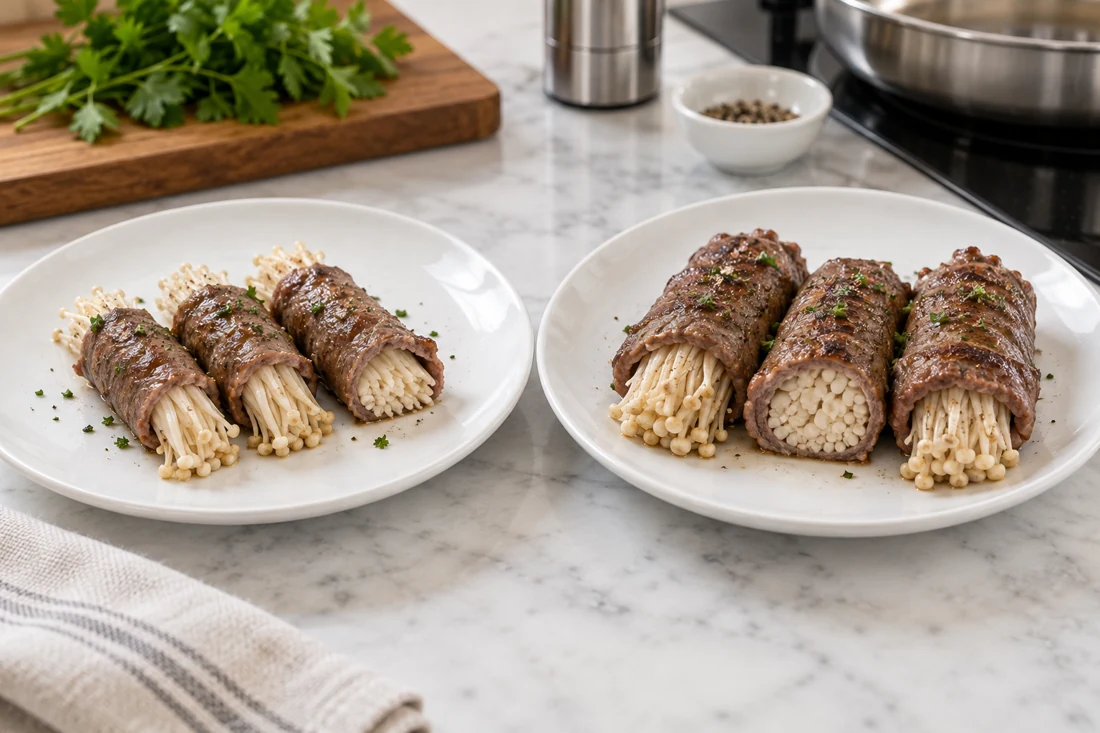
Compare the mushroom and beef proportions as well as total portion size.
A simple illustrative calculation shows the importance of the denominator. If a trial makes one hundred rolls and ninety meet the final standard, the ingredient cost allocated to an accepted roll is total ingredient cost divided by ninety. Dividing by one hundred understates that cost. If the comparison method yields ninety-six accepted rolls from the same nominal count, the difference may matter even when the raw ingredient price is higher. Actual costs and trial results must supply the values.
Measure labor in the tasks the design changes. Separating tangled stems, trimming ends, finding suitable beef slices, wrapping, turning and repairing opened seams all consume time. Record the method and operator conditions so the comparison is fair. A highly experienced person preparing a small demonstration cannot establish the labor rate for a routine shift. Where several operators assemble rolls, assess variation in dimensions and accepted output as well as speed.
The cheapest component combination may not create the lowest served cost. A thinner slice can be economical but tear frequently; a more uniform enoki portion may reduce handling but cost more per purchased kilogram. Those are hypotheses to test. Avoid assuming that a premium-looking raw product improves every finished measure. A useful trial identifies which component changes the buyer's actual bottleneck and whether the improvement survives complete cooking and final service.
Agree the acceptance decision before seeing the results. Define the required internal cooking controls, portion integrity, visible mushroom amount, bite and presentation. Keep safety failures separate from quality rejects and handle all samples appropriately. A roll should not be accepted on appearance while its heating record is unresolved. The resulting cost comparison is then grounded in a product the operation can responsibly sell and the customer is likely to recognize as consistent.
Agree the ingredient and assembly specifications
The final enoki specification should describe the supplied ingredient clearly enough for repeat orders. Include product identity, documented processing state, base removal, stem length, cap retention, allowable breakage and packing. Confirm how the frozen sample is prepared for acceptance and what degree of tangling is manageable. A phrase such as suitable for beef rolls becomes useful only when the buyer's portion and process are linked to it.
The beef specification and assembly standard need their own records. State the applicable meat identity and processing classification, slice dimensions, component weights, permitted overlap and finished roll dimensions. Include the handling method and the validated cooking conditions owned by the finished-food operator. The mushroom supplier should not imply control over a beef process it does not operate, and the buyer should not infer one component's certification from another component's documents.
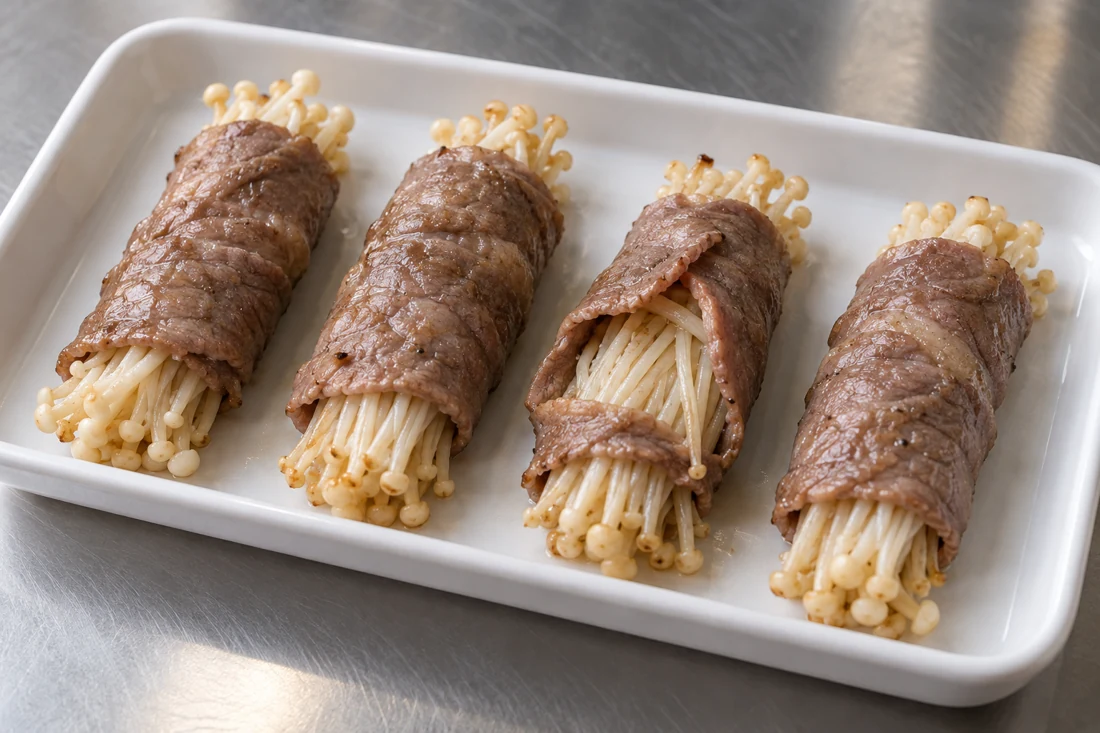
A consistent wrap exposes a repeatable amount of mushroom at each end.
Use tolerances that can be checked in practice. Define how samples are selected from a lot and how length, breakage or portion consistency is assessed. Specify whether a measurement is made frozen, after controlled preparation or after cooking. Differences in sample state can change the result, especially for fine stems. Keep a suitable retained reference or agreed photographic aid alongside the written method, while recognizing that a picture cannot establish texture or microbial safety.
For the finished roll, describe the accepted result after its intended route. Immediate-service, chilled and frozen meal versions may need separate records because their preparation and eating conditions differ. Include the sauce, package and final heating instructions where relevant. A change in wrap thickness, mushroom load or pack arrangement should trigger review of the parts of the process it can affect, rather than being treated as a cosmetic variation.
Traceability should connect the enoki lot, meat lot and other ingredients to the assembled batch and customer destination. Agree relevant microbiological tests, document scope and reporting identities with the responsible suppliers and manufacturer. Check required certificates and claims for the actual product and market. A generic mushroom certificate or an unrelated beef report cannot establish compliance for the assembled food. Retain the records needed to investigate a quality complaint or a product concern.
Send GreenLand-food the intended enoki length, portion mass, beef wrap style, cooking equipment, final service route and destination when requesting an ingredient sample. Include the issue that matters most, such as stems pulling out, dense cores or variable assembly yield. We can use that information to discuss the available enoki form and the appropriate supporting records. Approval should follow the buyer's complete roll trial, with every supplied component and processing responsibility clearly identified.
Related reading
Compare ingredient forms, clumping, breakage and the supplier records needed before an application trial.
Separate fresh, frozen, opened and cooked storage decisions before setting a finished-product shelf life.
Understand the mild flavor and distinctive stem texture when balancing sauce, coating or meat.
Discuss your frozen enoki specification
GreenLand-food is a supplier and manufacturer of frozen enoki mushrooms for wholesale projects. For factory-direct supply, send the destination, volume, packing format and intended cooking application so we can confirm the offered product and supporting order records.