


Red Currants vs Zante Currants: Fresh Berries and Dried Grapes
Oct 19, 2026
Leave a message


The most useful check is the complete ingredient description: fruit identity, fresh or frozen or dried form, and any added ingredients. A dark dried piece labelled currant is not evidence that it came from a red or black currant bush. At GreenLand-food, our redcurrant discussion starts with loose frozen berries and their intended application. Clear naming prevents a kitchen substitution problem from becoming a purchase, storage or labelling problem further down the supply chain.
Read the full ingredient name
The phrase Zante currant identifies a grape product. The University of California, Davis Black Corinth record lists Zante Currant among the synonyms of a Vitis vinifera grape. This is useful botanical evidence when an ingredient name seems ambiguous. Redcurrants belong to Ribes, a different plant group. The two products therefore need to be distinguished at the identity stage, before considering how either one has been prepared or preserved.
In everyday shopping, the context often provides a clue. Tiny dark wrinkled fruit sold for baking are commonly Zante currants; glossy red clusters sold with fresh berries are redcurrants. Context is still a clue rather than a full specification. True Ribes berries can also be dried, and an online photograph may show a serving suggestion rather than the contents of a pack. Read the ingredient statement and supplier description, and obtain clarification whenever the name currants stands alone.
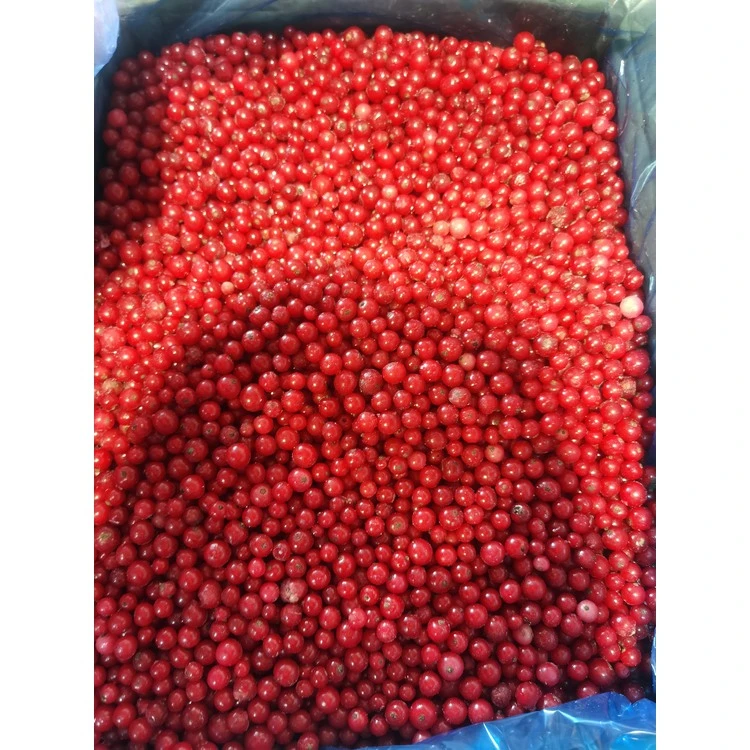
GreenLand product photograph of frozen redcurrants in a lined carton.
Fresh, frozen and dried describe a second dimension of the product. Frozen redcurrants remain berries with substantial water held as ice; thawing changes their texture and releases some of that water as juice. Dried Zante currants have undergone dehydration and have a concentrated, chewy character. Freeze-dried redcurrants are another form again. A buyer who confirms only the fruit name can still order the wrong functional ingredient if the preservation state is omitted from the purchase specification.
Recipes can preserve older regional naming habits. A currant bun or fruitcake may mean dried Zante fruit, while a currant jelly or berry sauce may mean Ribes. Read the method as well as the ingredient list: soaking a small dried inclusion and extracting juice from a berry are different operations. If the recipe remains unclear, identify its intended fruit through a reliable version or the recipe author. Changing the ingredient on a guess can affect the amount of liquid and the finished texture.
For a business, the unambiguous wording belongs wherever the ingredient changes hands. A purchasing description, warehouse item, production sheet and customer-facing label should all refer to the same material. Include the verified fruit identity and form in the product master, then use an approved shorter name only where it cannot cause confusion. Translation deserves particular attention, because a word that clearly means a dried grape in one market can be interpreted as a Ribes berry in another.
The purpose is to choose the right ingredient for the food. Dried Zante currants are an established useful bakery material, while redcurrants offer a different berry character. Once identity and form are clear, a developer can decide whether the existing recipe should keep its original ingredient or whether a new product concept justifies a carefully controlled change.
Recognize a juicy berry and a dried grape
A fresh redcurrant normally has a round, glossy surface through which light can pass. Berries often arrive on a slender cluster stalk, and their flesh is moist with small seeds inside. A frozen redcurrant may be less translucent because of surface frost and its frozen state. These visible details help explain its role in a dish: it can provide a distinct berry pocket, release tart juice, or be crushed into a coloured preparation. The RHS guide describes the familiar cultivated redcurrant and its clustered growth.
Zante currants are small, dark and wrinkled after drying. Their shape is irregular rather than a taut fresh sphere, and they offer a chewy dried-grape texture. A manufacturer's own Zante currant description identifies the Black Corinth grape and common baking uses. That source confirms its product identity; it does not establish that every brand has the same moisture, ingredient additions or processing. Check the actual offered material when those properties affect the recipe.
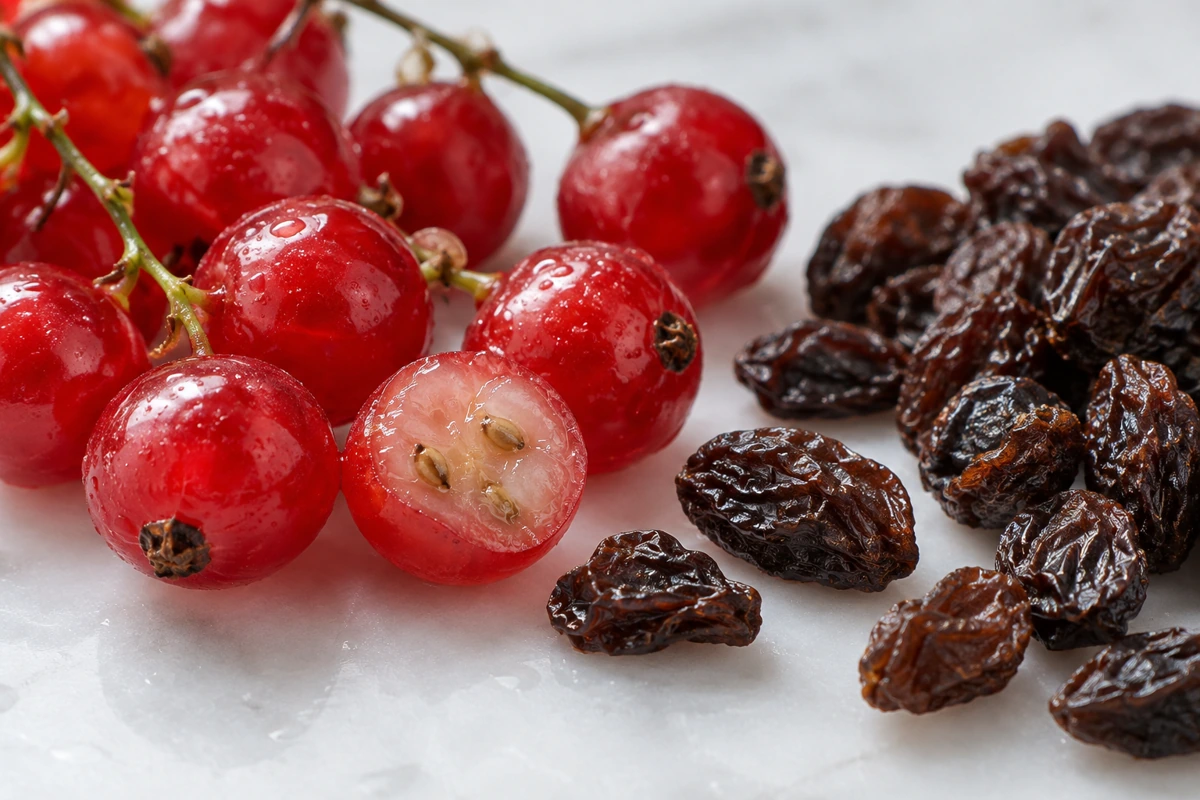
Juicy flesh and a wrinkled dried surface reveal different physical forms. Illustrative scene.
Colour alone is unreliable. Both a dried grape and a dried blackcurrant can be dark, and a photograph can hide differences in size or surface texture. A berry with frost can also look paler than the same berry after thawing. Use the visible inspection to confirm whether the sample is plausible for its declared identity, then resolve uncertainties through the supplier's documentation. A visual check should not become a method for guessing the species of an unknown loose food.
The seed question also needs precise wording. Zante currants are associated with a seedless grape cultivar, while redcurrants naturally contain small seeds. Removing redcurrant stalks does not remove those seeds. A smooth redcurrant preparation usually needs a suitable separation operation, and its specification should state the required texture. Calling loose berries seedless simply because they have no large stone would create a misleading expectation for a drink, filling or dairy preparation.
Consider what the eater will encounter. A small raisin can remain a recognizable chewy inclusion in a bun. A redcurrant can soften and leave a juicy fruit pocket. Both may be desirable, but they are different sensory designs. A developer should examine the cut product and taste it after its normal cooling or holding period. An ingredient photograph cannot show how the surrounding crumb, filling or sauce will respond to that form of fruit.
For receiving staff, use reference images of the approved material in its actual delivered state. A frozen redcurrant reference should show loose berries and relevant physical defects, rather than only a fresh ornamental cluster. A dried-fruit reference should show the accepted size and condition of the dried pieces. Keep the original pack label and lot code with the inspection record. That combination gives the team a practical identity check without asking them to make a botanical decision from colour alone.
Account for water before changing a recipe
Water is the main practical reason that a direct substitution can fail. Fresh or frozen redcurrants bring juice into the food. Dried Zante currants have lost much of their original water during drying and may take up liquid from a recipe or a separate soaking step. An equal mass of the two ingredients therefore does not represent an equal amount of fruit solids or an equal liquid contribution. The recipe has to accommodate the actual material being added.
A soaking step does not turn a Zante currant into a redcurrant. It changes the dried grape's moisture and texture while keeping its identity and flavour. Record whether the recipe uses the soaking liquid, drains it, or includes another liquid afterwards. Each choice changes the mass entering the mix. The same care applies to thawed redcurrants: draining away released juice changes the portion that remains, even though the original bag weight is unchanged.
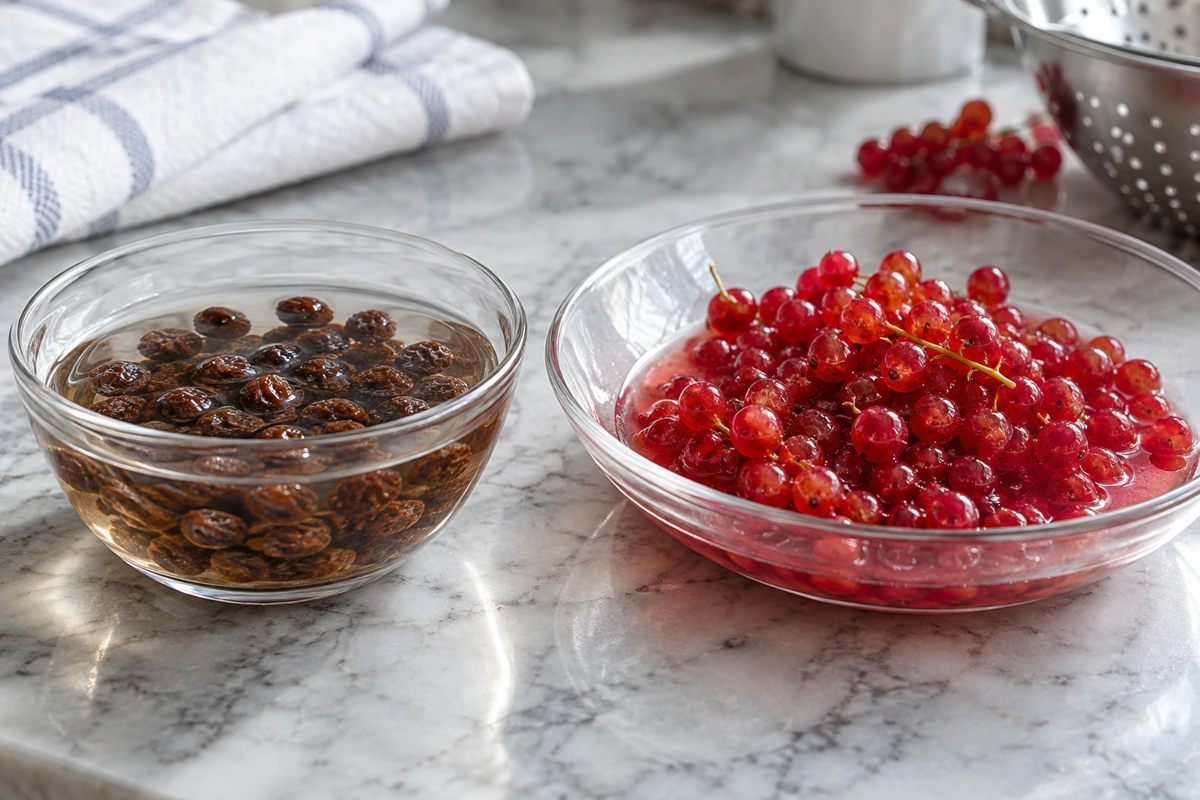
Soaking dried fruit and collecting thaw juice are different changes to the recipe water balance. Illustrative scene.
For a development trial, weigh the ingredient before preparation and record what is added or removed. With dried fruit, note the soaking medium, temperature, time and drained condition. With frozen berries, note the thaw method, fruit condition and whether the released juice is retained. These records need not be elaborate, but the next trial should be able to reproduce them. Otherwise, a texture difference may be attributed to fruit identity when it actually came from an inconsistent preparation step.
Distinguish received weight from prepared weight. If a recipe calls for prepared drained fruit, purchasing a kilogram of the raw ingredient does not necessarily provide a kilogram at that endpoint. If it calls for all the contents of an unsweetened frozen portion, discarding the juice changes the formula. Express the recipe basis in words that the production team can follow. A brief note such as include all released juice can prevent an unintended change more effectively than a long general description of fruit quality.
Water also affects the surrounding food over time. A freshly mixed dough can feel acceptable while its dried inclusions continue to hydrate during holding. A berry filling can release liquid during baking and change the crumb or pastry beneath it. Evaluate the product after the actual waiting, cooking, cooling and storage route. The goal is to learn where moisture moves in that recipe, without assuming that a single moisture number predicts every practical outcome.
At commercial scale, compare cost on the approved finished-food basis. A lower price per kilogram can be misleading if the formulation needs a different addition rate or preparation loss. Include the fruit, any required soaking medium, processing time and acceptable output where these costs materially differ. The decision may still favour either ingredient. What matters is that the calculation compares products that meet the same intended function, rather than treating fresh berries and dried grapes as identical units.
| Ingredient | Physical form | Recipe question |
|---|---|---|
| Fresh or frozen redcurrants | Juicy Ribes berries; frozen fruit softens on thawing | How much juice enters the mixture? |
| Zante currants | Small dried grapes, commonly Black Corinth | Will they be used dry or deliberately soaked? |
| A proposed substitution | A change of identity and moisture state | Does the finished recipe still meet texture and flavour targets? |
Test substitutions in the intended bake
Many familiar recipes using currants were designed for dried fruit. In a bun, scone or cake, small Zante currants can disperse through the dough and create individual chewy points. Redcurrants bring a different effect: tart, softer berry pockets and coloured juice. That change can produce a successful new bake, but it should be treated as recipe development. A purchasing substitution made only because both products say currant can surprise the baker and the customer.
Start by identifying what the original ingredient does. Is it mainly an inclusion, a source of sweetness, a fruit flavour, or part of the product's traditional identity? A dried-fruit loaf may depend on its characteristic chew and distribution. A redcurrant cake may depend on contrast between a sweet crumb and a tart berry. These functions help determine what a replacement must preserve and what can change. Without that decision, the trial can drift toward a different product without anyone explicitly approving the shift.
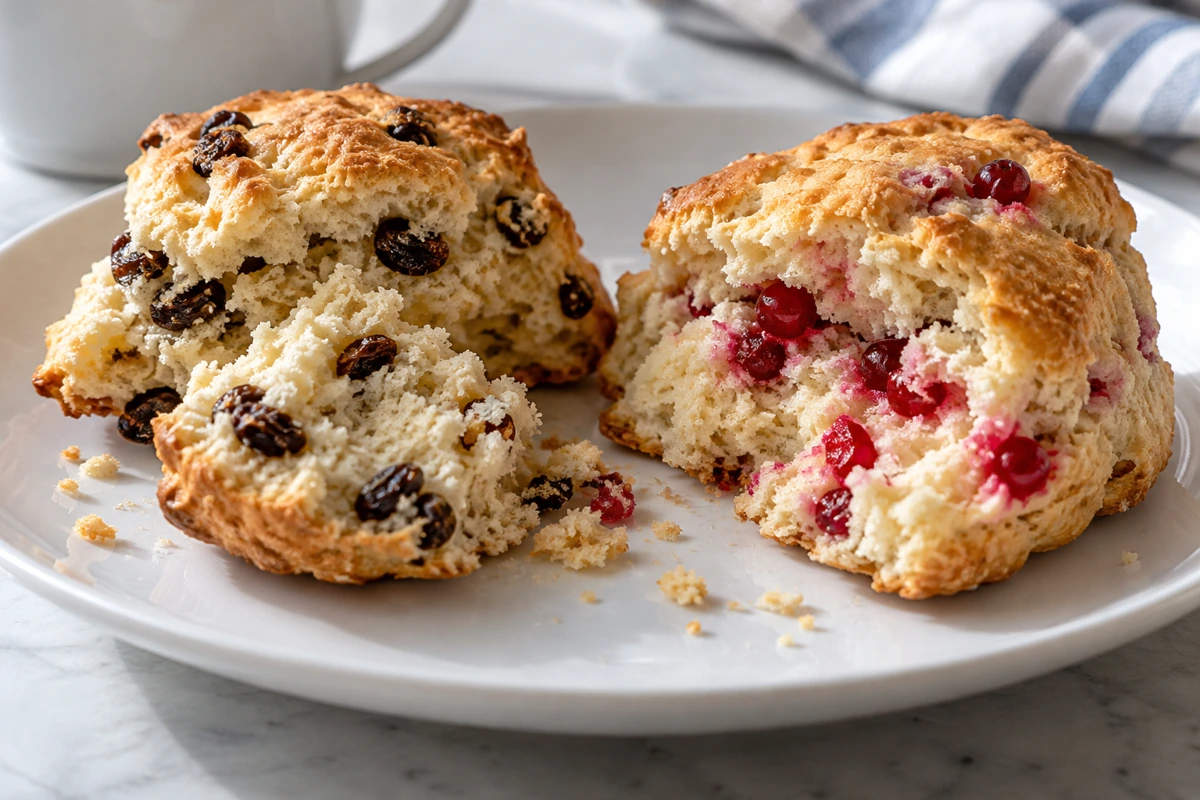
A dried-fruit inclusion and a soft berry pocket contribute different textures to a bake. Illustrative scene.
Use a small recipe test before changing a production batch. Keep the base recipe, mixing procedure, piece weight and pan or tray arrangement recorded. If moving from dried fruit to frozen redcurrants, choose an addition state appropriate to the recipe and account for the juice. If moving the other way, define any hydration step. Avoid making several compensating changes at once, because a good result then becomes difficult to explain or repeat with the next ingredient delivery.
Evaluate the baked interior as well as the surface. Cut comparable portions after the intended cooling period. Look at fruit distribution, moist pockets, crumb structure and colour spread; taste the balance and the fruit texture. Check whether a serving contains the intended amount of fruit rather than a few concentrated clumps. Where the product is sold after a hold or reheating step, include that stage. The condition immediately out of the oven may not be the condition customers experience.
Recipe changes involving sugar or liquid also affect more than flavour. A redcurrant version may need a different balance of sweetness, while a dried-grape version changes the amount and distribution of concentrated fruit solids. Choose adjustments with the complete recipe in mind. For a commercial product, review the revised ingredient declaration and any claims through the appropriate label process. A successful test bake does not authorize carrying over wording that describes a different fruit or composition.
Keep the accepted version as a separate controlled recipe when the difference is substantial. That is often clearer than an instruction allowing either kind of currant at the same weight. The production sheet can then name the exact fruit, form, preparation and dose that were approved. A buyer may maintain both ingredients for different lines, with distinct receiving and storage requirements. The result is a purposeful product range rather than an accidental substitution hidden inside a familiar ingredient name.
Choose fruit for jelly, sauce and drinks
Redcurrants provide juicy tart fruit that can be prepared into juice, pulp or a sauce. Those forms suit different uses: clear liquid for some jellies, screened pulp for a smoother preparation, or whole softened berries when visible fruit is part of the dish. Dried Zante currants contribute dried-grape flavour and solids. Soaking and blending them can create another preparation, but it will not reproduce redcurrant's identity or automatically behave like redcurrant juice in a recipe.
For a jelly, the recipe's fruit and juice description matters. A formula developed around redcurrant extraction cannot be assumed to work with an equal mass of dried grapes and water. The balance of fruit components, acid, sugar and the gelling system changes. Use a tested recipe for preserves intended for home shelf storage, with the specified preparation and processing instructions. A thickened experimental fruit mixture may look convincing while still lacking the evidence needed for an ambient storage claim.
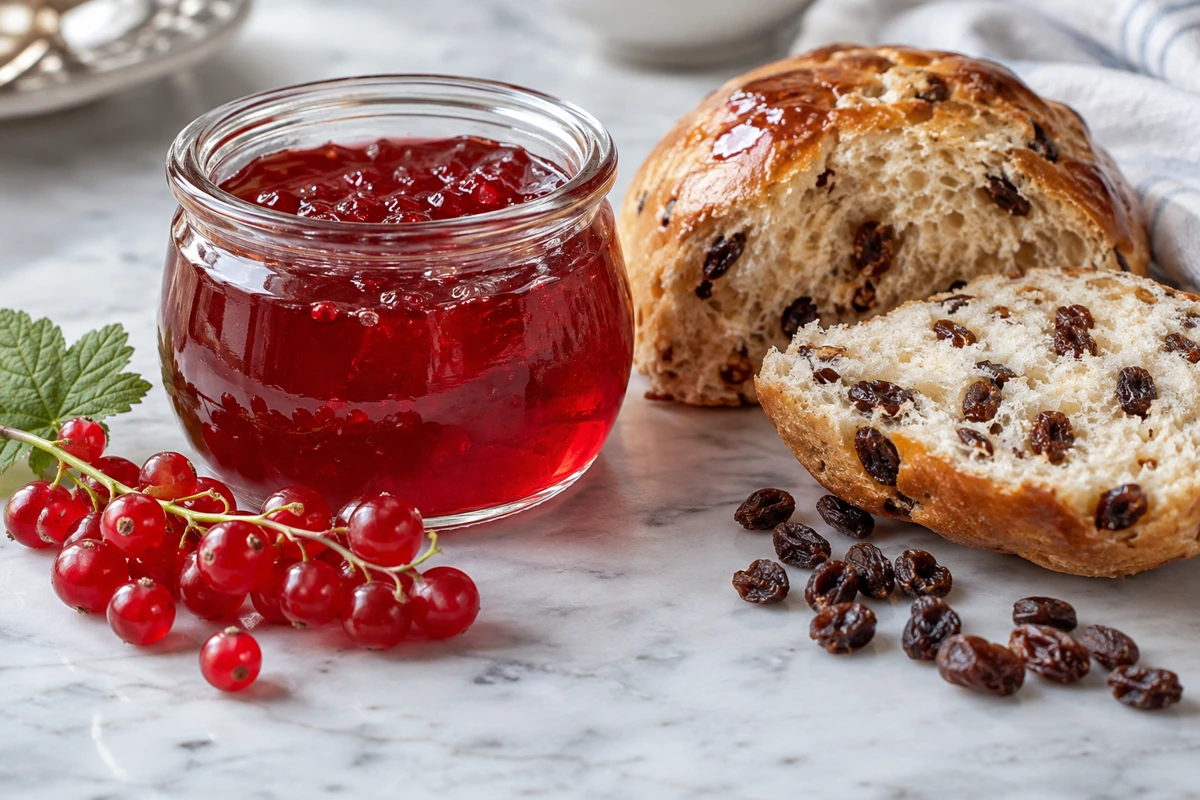
Clear redcurrant jelly and a Zante fruit bun illustrate two distinct culinary roles. Illustrative scene.
In a chilled sauce, the developer has more room to explore flavour and texture, provided the handling and storage process remains appropriate. Redcurrant can offer a bright tart character with a comparatively light aroma. A Zante preparation brings a raisin character that may work with spices or a richer food. Taste each with the intended dish and serving portion. The result should be named honestly, so a customer expecting a redcurrant sauce is not given a dried-grape preparation under the same name.
For drinks, distinguish a smooth fruit base from a visible inclusion. Redcurrant seeds and skin fragments may require screening for a particular mouthfeel or dispenser. Dried grapes need their own preparation if they are to be dispersed or extracted. The amount of water used, material retained and final dilution should be recorded. A cup of dark blended liquid does not tell the buyer how much original fruit it contains or whether it will remain acceptable in the intended beverage.
A syrup or fruit base should be evaluated at its use concentration. A strong neat sample can seem attractive but contribute too much sweetness, acid or sediment after the required dose is calculated. Compare the actual finished drink or dessert, then work backwards to the input specification. Our blackcurrant syrup guide gives an adjacent Ribes example of clear versus pulpy preparation. Its process questions can inform a trial, while its fruit identity remains different from both redcurrant and Zante currant.
When the desired product clearly depends on redcurrant flavour and colour, order redcurrants in the suitable form. When a recipe calls for a small dried grape, source the specified dried ingredient. A substitution should answer a real development need and have its own approval. It should not arise from an abbreviated name on a quotation. Keeping the product purpose visible makes the technical conversation shorter and prevents later attempts to correct an unsuitable ingredient with excessive sugar, water or flavour additions.
Keep fresh, frozen and dried handling separate
Fresh redcurrants, frozen redcurrants and dried Zante currants belong to different handling plans. Fresh berries need appropriate short-term chilled handling. Frozen berries need their specified frozen chain and controlled preparation before use. Dried fruit follows its own packaging and storage instructions. The fact that all three may appear in a bakery does not make their storage interchangeable. Label the item clearly at receipt and place it in the correct storage route before it loses its identity in an internal container.
A sealed dried-fruit pack should be assessed against its supplier's instructions and the condition of the package. Moisture exposure, damage and the behaviour of the fruit after opening matter to its intended use. Do not assume that a product described as dried is sterile or that every dried currant has an unlimited ambient life. The product specification, package and declared storage conditions should govern the warehouse and kitchen procedure. Any additions or treatments also need to match the agreed ingredient description.
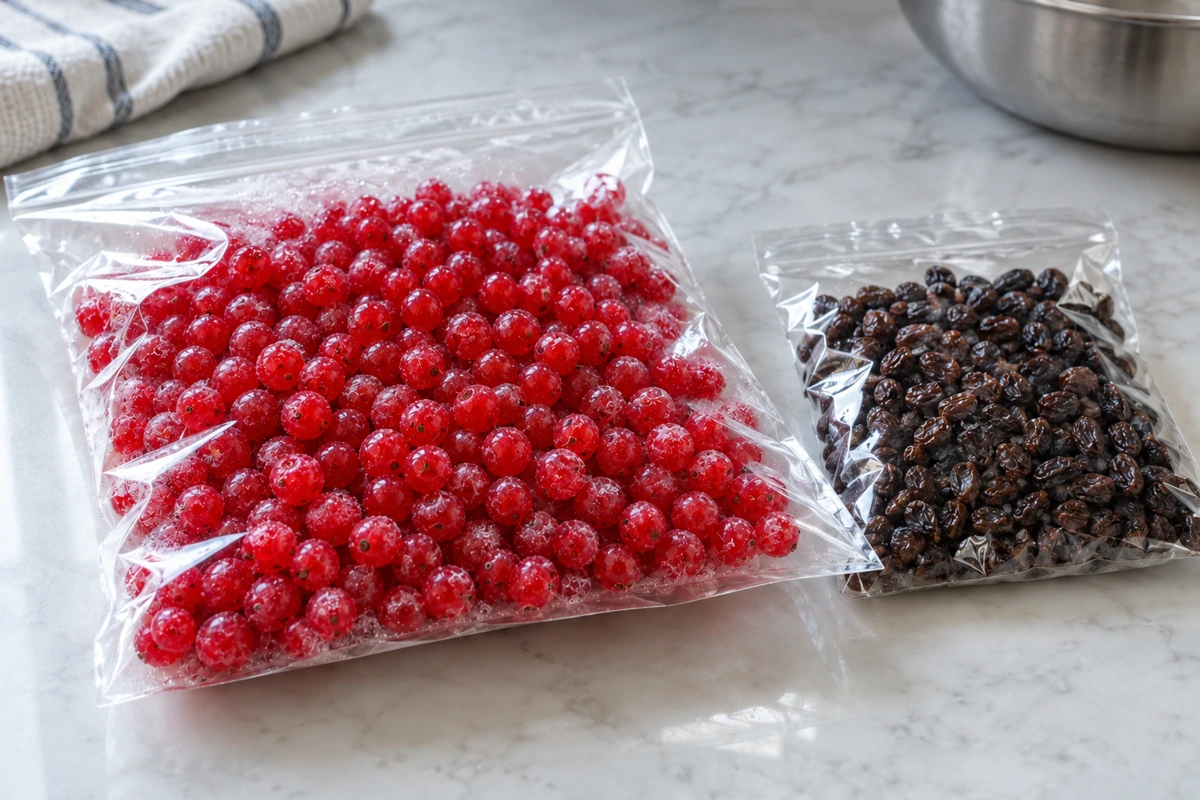
Frozen berries and dried grapes require handling appropriate to their respective forms. Illustrative scene.
Frozen redcurrants need protection during portioning as well as transport. Use a pack size that fits the operation, keep the remaining fruit under the specified conditions, and avoid treating a partly thawed bag as though it has the same handling history as an unopened frozen pack. Record unusual clumps, leakage or damaged seals when they occur. These observations help investigate quality changes, but visual appearance alone cannot determine whether a temperature history has been acceptable.
When thawing is required, use the product's instructions and a controlled method suited to the next step. A protected refrigerated thaw is often a practical route for measuring and preparing berries. Collect any juice the recipe requires, and keep the portion identified. The NCHFP thawing guidance provides home-food context; a commercial operation should have its own defined handling procedure and finished-product controls. Freezing preserves an ingredient but does not establish that it is ready to eat without further treatment.
Keep prepared materials distinct from their original packs. Hydrated Zante currants now contain added liquid and have a different handling state from the unopened dried product. Thawed redcurrants likewise need a defined next use and holding period. Apply the relevant preparation record and storage procedure instead of copying the original unopened-pack expectation. This is especially important when several recipes use the same ingredient in different prepared forms during a busy shift.
A simple stock system should preserve full identity, form, lot and preparation status. The same shelf label should not cover both a dried grape and a frozen Ribes berry. Where internal codes are used, make the plain-language description available to the people who pick ingredients. That helps prevent errors before mixing begins, when correction is usually easiest. Once the fruit has been incorporated into a dough, filling or drink, an identity mistake can affect an entire batch and its labelling.
Put identity and form into the order
Write the order so that the supplier can offer the intended material without guessing. For frozen redcurrants, name the product, loose-berry form, intended application and preparation expectations. For Zante currants, name the dried grape ingredient and the required grade through its own supplier. GreenLand-food's redcurrant supply page concerns loose frozen redcurrants. The comparison in this article does not imply that a dried Zante product is included in that offer.
For a redcurrant sample, consider whole-berry share, attached stalks, split fruit, loose ice and the result after the buyer's handling. Decide which observations matter to the intended food. A visible inclusion can justify a tighter appearance requirement than fruit that will be screened, while both need the agreed identity and safety controls. A phrase such as clean berries needs an inspection method if it is to decide acceptance. Photographs are useful support when the distinction between acceptable and unacceptable material is clear.
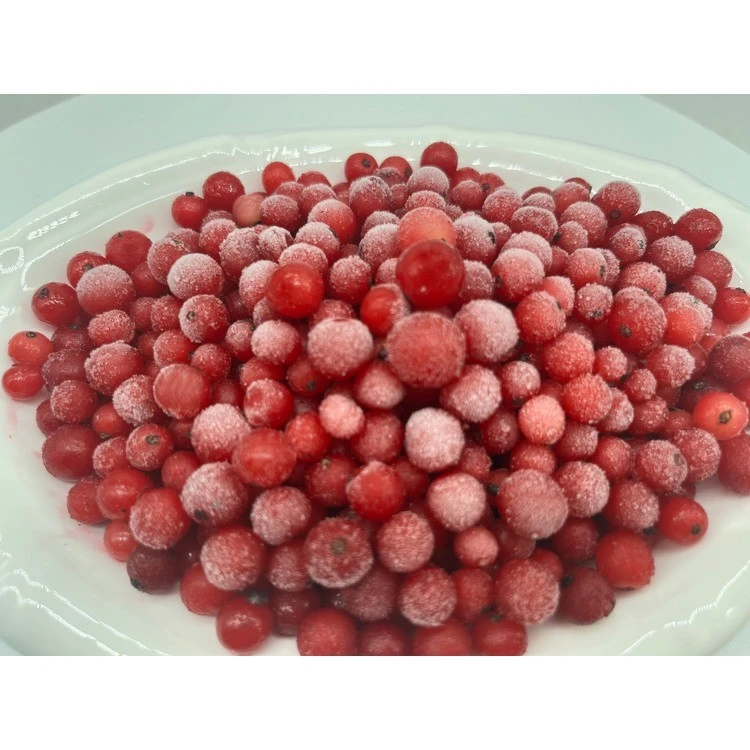
GreenLand product photograph of loose frozen redcurrants on a plate.
For any dried-fruit quotation used in a comparison, obtain the supplier's actual ingredient and form information. Confirm whether the product has added sugar, oil or other declared ingredients where relevant, rather than assuming a category-wide answer. The preparation used in a trial should match the material offered for supply. If a sample was hydrated, the quotation should still make clear whether it covers dried fruit or a prepared product. That avoids comparing prices on different weight bases.
Keep the approved recipe and ingredient specification connected. The record should identify the sample, intended preparation, fruit dose and acceptance result. If the recipe changes from Zante fruit to redcurrants, review the purchasing description, internal item and finished label together. A recipe team may understand the change while warehouse staff continue picking the old item. Clear version control prevents that gap and gives the next receiving team a definite reference.
Confirm pack size, quantity, destination, timing and requested documentation in the actual quotation. Those details depend on the current offer and route. A commercial sample can establish whether the fruit works in a recipe, but it does not independently confirm shipment availability, lead time or a particular test result. Ask for the documents needed for the defined lot and destination. Claims about cultivar, origin, treatment or certification should remain tied to evidence supplied for that order.
The purchasing decision becomes straightforward once the full name and form are retained. Redcurrants supply a juicy tart berry character; Zante currants supply a small dried-grape inclusion. A deliberate recipe can make good use of either. For a frozen redcurrant project, send us the intended food, required berry condition and preparation route so we can discuss a suitable sample and quotation. The accepted material should arrive under the same clear identity that the kitchen used to approve it.
Related reading
Resolve another ingredient name: cassis identifies blackcurrant, while the supplied form still needs confirmation.
Follow blackcurrants through clear and pulpy syrup routes, with attention to filtration and pourability.
Distinguish standing liquid separation in a prepared puree from the behavior of whole thawed berries.
Source frozen redcurrants with GreenLand-food
GreenLand-food is a professional frozen redcurrants supplier and manufacturer in China, providing factory-direct wholesale supply for importers, food manufacturers, foodservice distributors, and private-label programs.
Send the product form, specification, packing, quantity, application, destination, private-label needs, and requested documents.