


How Much Does a Pineapple Weigh?
Sep 07, 2026
Leave a message
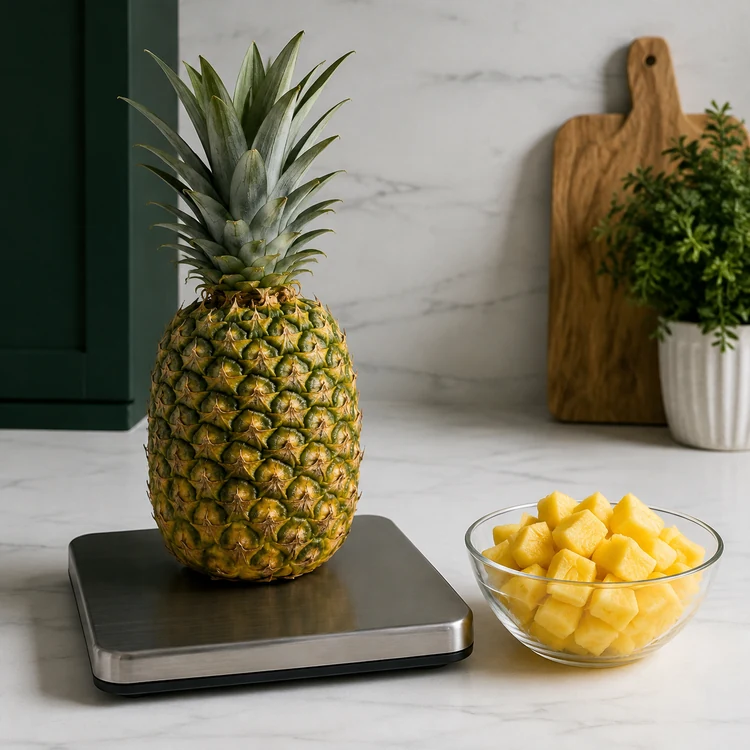
Buy the weight your recipe can actually use
For a recipe or purchase order, weigh the prepared ingredient you need. For an early budget, compare several clearly labeled yield scenarios, then replace the assumptions with a representative cutting or frozen-product trial before committing volume. Keep whole weight, peeled weight and accepted chunk weight on separate lines. A measured mass balance reveals the real conversion. For frozen pieces, define whether the recipe uses released liquid or requires a separate drained-weight assessment.
Whole-fruit weight varies by variety and grade; always state whether the crown and other non-recipe material are included.
Use clearly identified yield assumptions only for early planning, then replace them with representative preparation measurements.
Compare cost per acceptable output, including labor, cut suitability and any defined frozen thawing or draining loss.
A useful whole-pineapple weight range
UF/IFAS lists different fruit weights for named pineapple varieties. Examples include approximately 2–3 lb for Queen, 3–4 lb for MD-2 and 5–6 lb for Smooth Cayenne. These cultivar descriptions explain why online averages vary. They are not a promise that every fruit of a named variety will fall within the same narrow interval.
For ingredient format details, see What Is MD2 Pineapple? Variety, Acidity and Frozen Processing Choices.
| Variety example | Published approximate range | Approximate metric conversion |
|---|---|---|
| Queen | 2–3 lb | 0.9–1.4 kg |
| Red Spanish | 2–4 lb | 0.9–1.8 kg |
| MD-2 | 3–4 lb | 1.4–1.8 kg |
| Smooth Cayenne | 5–6 lb | 2.3–2.7 kg |
Conversions are rounded. Actual retail and export lots are graded and packed according to their own arrangements, so weigh the fruit or use the seller's declared weight basis when precision matters. A fruit count is convenient for shopping but weak for production planning. Two pineapples with similar crowns can contain quite different amounts of usable flesh.
For a kitchen making one dish, a scale resolves the question immediately. For a buyer ordering cartons, ask for the size or count grade and the net weight definition. Establish whether the quoted weight includes the crown and whether the expected range describes individual fruit or the carton as a whole.
Crown-on, crown-off and peeled weights
Whole-fruit weight and prepared weight belong to different stages. A crown-on pineapple includes leaves and attachment material. A crown-off fruit still includes the outer skin, eyes, core and any sections later trimmed away. A peeled fruit may retain its core. A bowl of ready-to-use chunks represents a further stage with its own acceptance standard.
| Weight term | Material included | Common source of confusion |
|---|---|---|
| Whole, crown-on | Fruit body and attached crown | Comparing with a crown-off offer |
| Whole, crown-off | Fruit body before peeling | Treating it as peeled yield |
| Peeled | Flesh and whatever core remains | Assuming all of it meets a core-free specification |
| Prepared chunks | Accepted pieces after defined trimming | Ignoring liquid, fragments or rejected pieces |
Write the stage beside every recorded weight. If a supplier says a pineapple weighs 1.5 kg and a chef reports 750 g after preparation, those figures may be perfectly compatible. They become a dispute only when the basis is omitted. The same discipline helps compare fresh and frozen products: incoming net weight and usable output after a defined process should be recorded separately.

What determines usable yield
Usable yield depends on the fruit and the product you are trying to make. Thick peeling removes more flesh; careful eye removal may retain more. A core-free chunk specification removes material that a different cooked or blended application might accept. Damaged or overmature areas introduce additional losses that are not inherent to sound pineapple.
For preparation details, see Can Pineapple Be Frozen?.
For preliminary planning, a buyer can test illustrative whole-fruit recovery scenarios of 40%, 50% and 60%. Those percentages are sensitivity assumptions, not a universal natural yield range. They show how much the purchasing requirement changes while the operation gathers real data. A final purchase calculation should use measured recovery under the actual cutting and acceptance method.
| Illustrative recovery assumption | Prepared output from 10 kg whole fruit |
|---|---|
| 40% | 4.0 kg |
| 50% | 5.0 kg |
| 60% | 6.0 kg |
The difference between the first and last row is substantial. It is large enough to affect purchasing, labor and waste handling. That is why a supplier comparison based only on price per whole kilogram can be misleading. Establish the accepted output first, then measure what it takes to produce it.
A transparent example of peel and core losses
Consider a hypothetical 2.0 kg crown-on pineapple. After preparation, the operator records 0.20 kg of crown and end trim, 0.50 kg of peel and eyes, 0.15 kg of removed core, 0.05 kg of other trim or handling loss and 1.10 kg of acceptable chunks. The figures add to 2.0 kg, and the usable yield is 55%.
| Output in the worked example | Weight | Share of the 2.0 kg input |
|---|---|---|
| Crown and end trim | 0.20 kg | 10% |
| Peel and eyes | 0.50 kg | 25% |
| Removed core | 0.15 kg | 7.5% |
| Other loss | 0.05 kg | 2.5% |
| Accepted chunks | 1.10 kg | 55% |
This is an accounting example, not a measured GreenLand production result or a standard pineapple composition. Its purpose is to make the categories explicit. If the weights do not approximately reconcile, check the tare settings, spilled liquid and material left on equipment. Do not force the difference into the peel category merely to make the spreadsheet balance.
Repeat the exercise on a representative sample and retain the range as well as the average. An operation that produces 55% once but usually obtains 45% should not budget from its best run. Use the result that reflects the actual supply and preparation conditions.
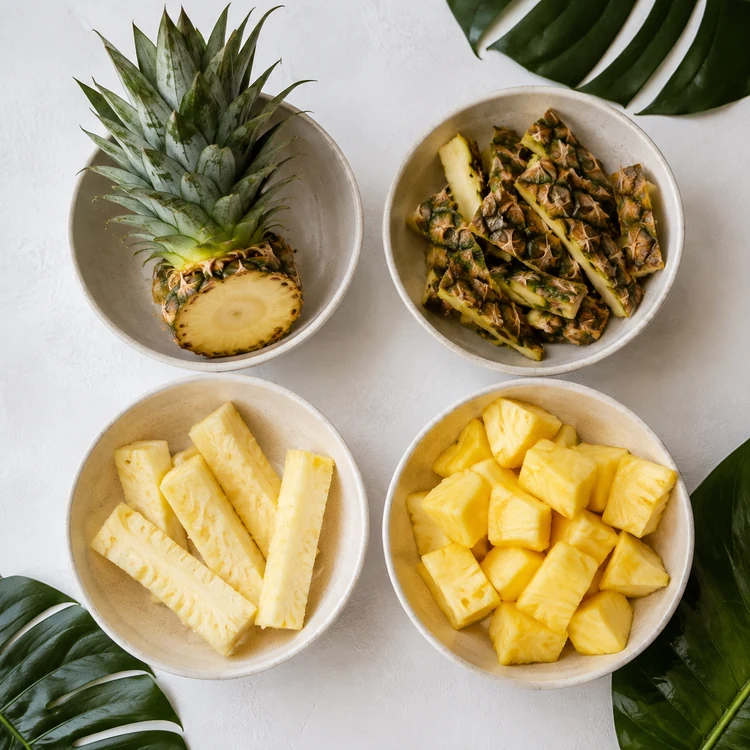
Calculate how many fruit a recipe needs
Start with the required prepared weight. Divide that by the expected prepared yield per fruit, then round up for whole-fruit purchasing. If a recipe needs 3.0 kg of chunks and a representative trial gives 0.75 kg per fruit, the arithmetic requirement is four fruit. That calculation is only as reliable as the measured yield and the similarity of the next delivery.
When fruit size varies, calculate from whole weight instead. Required whole weight equals required prepared weight divided by the measured yield fraction. At a 50% recovery, 3.0 kg of chunks requires 6.0 kg of whole fruit. At 60%, it requires 5.0 kg. The formula avoids pretending that "six pineapples" is a stable production unit.
Allow for the operation's normal variation through an explicit planning allowance, not an invisible extra fruit count. Keep food waste and overproduction in view: buying a large buffer can solve one preparation shortfall while creating leftovers elsewhere. For a regular menu, review actual usage over several deliveries and adjust the order basis when the size grade or accepted cut changes.
When several size grades are mixed, use a weighted calculation rather than a simple average of percentages. Suppose one trial contains 8 kg of smaller fruit and produces 3.6 kg of accepted chunks, while another contains 12 kg of larger fruit and produces 6.6 kg. Combined recovery is 10.2 kg divided by 20 kg, or 51%. Averaging the separate 45% and 55% recoveries would give 50%, which ignores the different input weights.
The difference is modest in this illustration but can matter across larger orders or more unequal lots. Retain the input and output masses so the combined result can be calculated correctly. A spreadsheet that stores only percentages loses useful information. It also becomes harder to investigate whether a changing average reflects fruit size, quality or a different preparation method.
Apply the same discipline to fruit counts. If ten small fruit and two large fruit are sampled, the average weight per fruit should be calculated from their total measured mass and count. Do not average the two grade averages without considering how many fruit each represents. A purchasing conversion should follow the actual mix expected in the next delivery.
Convert whole fruit to frozen chunks
Frozen chunks arrive after peeling and cutting, so one kilogram of whole fruit is not equivalent to one kilogram of prepared frozen pineapple. A first comparison converts whole fruit to acceptable prepared flesh using the measured recovery. Then assess any additional frozen handling or application loss separately.
Suppose a kitchen needs 10 kg of acceptable pieces. At an illustrative 50% whole-fruit recovery, it would need 20 kg of whole pineapple. If a frozen-product trial retains 95% as acceptable pieces after the kitchen's defined thawing and sorting procedure, the frozen requirement would be about 10.53 kg: 10 ÷ 0.95. The 95% figure is also a trial assumption, not a product guarantee.
Liquid release must be interpreted in context. A smoothie may use the fruit and its released liquid, while a pastry topping may require drained pieces. A drained-weight test is useful only when its method is defined: temperature, duration, screen and draining time all affect the result. We review frozen pineapple supply against the intended use so the comparison measures the ingredient the buyer will actually consume.
Cups are useful in a kitchen, weights in a contract
A cup of pineapple chunks is a volume measure. Its weight changes with piece size, packing, void spaces and whether liquid is included. A cup filled loosely with large wedges is not necessarily equivalent to one filled with small dice. Use a scale when the recipe needs repeatability or when quantities are being scaled for production.
To convert an existing household recipe, fill the cup the way the recipe intends, weigh its contents in a tared bowl and repeat the measurement several times. Record the average and the preparation state. This creates a useful local conversion without claiming that it applies to every pineapple cut. Once the recipe is approved by mass, staff can use the recorded weight directly.
For unit conversion, 1 lb equals approximately 0.454 kg and 1 kg approximately 2.205 lb. Keep enough precision during calculation and round at the purchasing or portioning stage. A scale labeled in grams avoids unnecessary conversions for small recipes. In a contract, specify the unit, net-weight basis and relevant tolerance rather than relying on a loosely packed volume description.
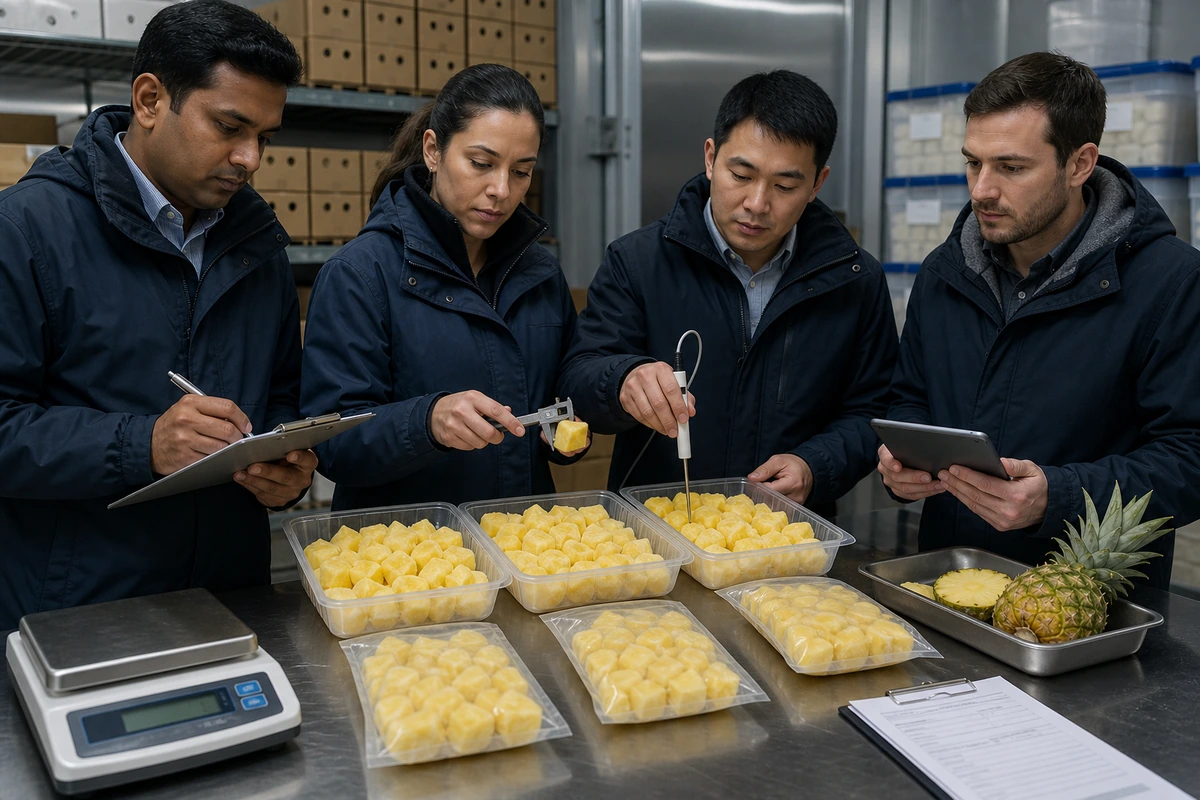
Compare price per usable kilogram
Divide the purchase cost by acceptable output to obtain the raw-material cost per usable kilogram. Then add preparation labor and other relevant costs on a consistent basis. This does not require a complicated financial model, but it does require that both options are measured at the same stage of use.
For example, a hypothetical 20 kg whole-fruit purchase costing 40 currency units and yielding 10 kg of accepted chunks has a raw-material cost of 4 units per usable kilogram. A 10 kg frozen purchase costing 45 units and yielding 9.5 kg of accepted pieces has a raw-material cost of about 4.74 units per usable kilogram. These are arithmetic examples, not current prices.
The whole-fruit option in that example still requires peeling, cutting and waste handling. The frozen option requires its own storage and handling. Include those costs before choosing. Also compare the finished application: a product that fails the texture or flavor requirement is not a useful bargain even if its calculated yield is high. A fair purchasing review combines acceptable output, labor, repeatability and the actual quoted terms.
Measure a representative delivery
Use a repeatable procedure so the next trial answers the same question as the first. The sample should represent the supplied fruit or product, not a selection of the largest or best-looking items. For a commercial acceptance program, agree the sample size and decision criteria with the supplier and the site's quality team.
- Identify the lot and weight basis. Record product description, variety or grade where available, carton details and whether crowns are included.
- Check the scale. Use an appropriate scale, a stable surface and clean containers. Tare each container and record the units.
- Weigh the input. Keep packaging weight separate. Record individual fruit weights if size variability matters to the program.
- Prepare to the required standard. Use the actual peel, eye and core-removal rules, not a lighter trim chosen to improve the trial result.
- Weigh each output. Record acceptable pieces, defined trim streams and other losses. For frozen material, use the agreed handling and assessment method.
- Calculate and retain the result. Record yield, variability, defects and preparation time. Keep the method with the data so the result can be repeated.
Photographs of the accepted pieces and reject categories help explain the numbers. They should show the specification, not merely an attractive bowl of pineapple. If the method changes, label the new trial rather than merging it into the old yield history without explanation.

Cut size changes piece count and handling loss
Weight and piece count are related through size, but natural fruit is not a perfect geometric material. A nominal cube dimension gives a useful target; it does not guarantee identical mass for every piece. Irregular chunks have an even wider piece-count distribution, particularly when a pack contains both large wedges and small fragments.
For a portioned dessert, count or weigh acceptable pieces using the actual cut. If staff need three similar pieces per cup, a broad irregular mix may create extra sorting even when total net weight is correct. For a blender, the same size variation may be much less important. Define the application before deciding whether uniform dimensions are worth the additional specification.
Our frozen pineapple cubes and pineapple pieces should be compared against their confirmed cut descriptions. Measure small-fragment content and handling loss if those affect the operation. A smaller cut can change the number of portions available, but it does not create additional fruit mass.
For ingredient format details, see How to Cut Pineapple into Chunks.
A portioning trial can reveal a cost that a yield percentage misses. Suppose two accepted cuts both deliver 1 kg of usable pineapple. One contains fairly even cubes; the other includes large wedges and many small pieces. If a dessert cup needs a consistent visible portion, staff may have to sort the second cut or weigh each serving more carefully. The total fruit mass is the same, but preparation time and presentation consistency are different.
Measure the work with the actual serving utensil and container. Record the number of acceptable portions, the average portion weight and any pieces left because they do not fit the presentation. Do not discard those pieces from the calculation without recording their destination. They may be useful in another approved recipe, but they are not automatically part of the dessert-cup yield.
For a blended product, repeat the trial with the blender's actual loading conditions. The irregular cut may perform perfectly well and make strict cube geometry unnecessary. This is why cut specifications should be driven by the application. Paying for tighter uniformity has little value if the next step deliberately breaks every piece down.
Use these results when comparing quotations. State whether the target is a kilogram of general-purpose fruit, a defined number of visually consistent portions or a quantity of drained pieces. Each can be a legitimate buying objective, but the supplier needs to know which one the price comparison is meant to support.
Specify net weight and thawed performance
Net weight excludes the packaging, but the precise product and assessment basis still need to be stated. Do not confuse a carton's gross shipping weight with the declared product weight inside. For inner bags, confirm the number of units and their individual net weights so receiving and production can reconcile the order.
If thawed performance is part of acceptance, agree a separate method and tolerance. Record how the sample is thawed, whether liquid is retained or drained, and which defects are removed before weighing the accepted pieces. A supplier's frozen net-weight declaration and a buyer's drained application yield answer different questions; one should not silently replace the other.
Also confirm ingredients and any relevant treatment or coating information from the actual specification. Avoid assumptions based on frost seen in a photograph. Visible ice, clumping and texture should be assessed with product and cold-chain records. A meaningful discussion identifies the observation and the agreed test rather than jumping directly from one image to a conclusion about the entire shipment.
Packing and receiving checks for frozen supply
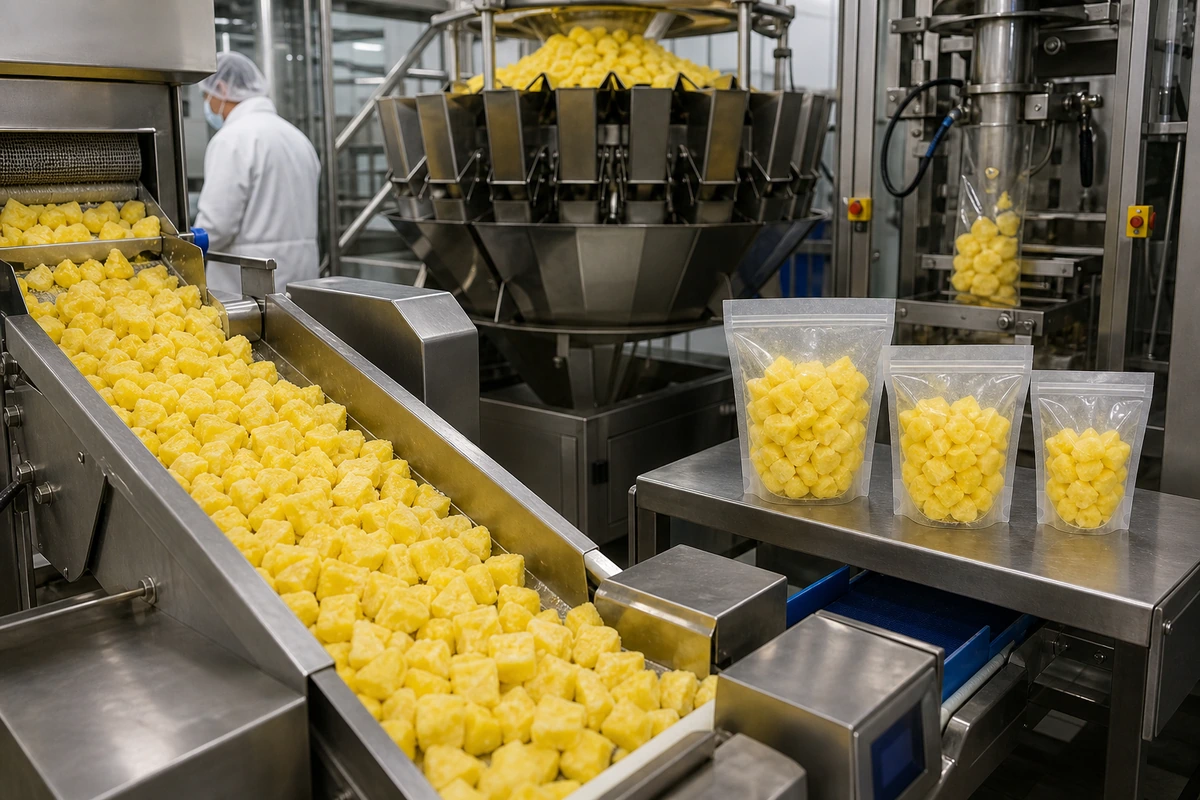
Choose the inner pack around the quantity used in a normal run. A 10 kg outer carton may contain several smaller bags or another arrangement; confirm the actual configuration. Smaller inner packs can simplify portioning, while larger formats may suit a continuous processing operation. Packaging should support the way the buyer uses the fruit.
At receiving, reconcile the product, lot, quantity and packing with the order. Review the agreed transport and storage conditions, inspect packaging integrity and follow the site's temperature and release procedures. Keep the product frozen under its supplied instructions and maintain lot identification during internal distribution. Do not let an accurate weight check distract from a damaged or unsuitable product condition.
We can review a pineapple requirement using the required prepared quantity, cut, pack format and application. Send the destination, shipment size, timing and documentation needs so MOQ, lead time and loading arrangements can be confirmed. A useful inquiry states whether the target quantity means purchased net weight, drained pieces or acceptable fruit in the final recipe. That one distinction prevents many avoidable conversion errors.
Questions about pineapple weight
Can I average the yield percentages from unequal-size trials?
Use total accepted output divided by total input when combining trials of different weights. A simple average of the percentages gives each trial equal influence even when one contains much more fruit. Keep the underlying masses so the combined result is correct.
Why can equal-weight packs give different numbers of dessert portions?
Cut distribution and the portion standard can differ. Large wedges or small fragments may require sorting even when net weight is correct. Trial the actual serving method and record accepted portions and any material directed to another approved use.
Source frozen pineapple with GreenLand-food
GreenLand-food is a professional frozen pineapple supplier and manufacturer in China, providing factory-direct wholesale supply for importers, food manufacturers, foodservice distributors and private-label programs.
Tell us the product form, required specification, packing and quantity, along with the application, destination and delivery timing. Include seed or cut preferences where relevant, private-label requirements and the documents your team needs. We will review the sample, MOQ, lead time and loading arrangement for the proposed order.