


Why Is It Called Passion Fruit?
Sep 24, 2026
Leave a message


The edible fruit most people meet in shops and recipes comes from Passiflora edulis. It grows from a flower whose corona filaments, anthers and stigmas give it an unusually intricate appearance. The name's history can be told without treating those symbolic interpretations as botanical facts. It is a record of how people read a New World plant through the beliefs of their time. For a beverage or dessert buyer, that story is useful context; a specification still needs to say whether the order is seeded pulp, seedless puree, juice base, concentrate or another confirmed form.
Where the name passion fruit comes from
The route is flower first, fruit second. Early Spanish observers encountered climbing Passiflora plants in the Americas and associated the complicated bloom with Christian images of the crucifixion. The expression "flower of the Passion" passed into the Latin genus name Passiflora and the English common name "passionflower." The edible berry produced by a passionflower became "passion fruit." Kew's genus account records that association between the flower's appearance, the Spanish name and the later botanical name.
In this context, "Passion" has a specific historical religious meaning. A modern reader might hear enthusiasm, romance or intense flavor in the word; those are present-day associations rather than the source of the plant name. The name was attached to a flower centuries before a frozen fruit buyer chose puree for a drink formulation. A clear explanation should therefore point to the flower, then to the story people told about it, and finally to the fruit that grows from a member of the genus.
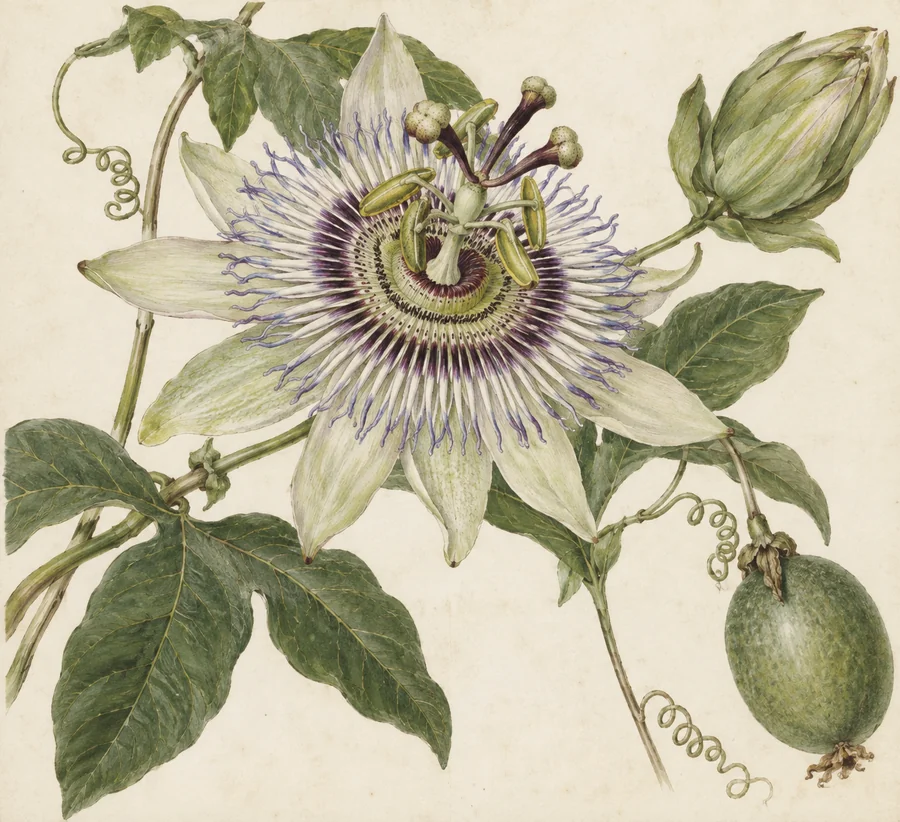
A historically plausible natural history drawing of the passionflower observed by early European botanists, showing the actual flower rather than imagined....
The historical timeline is more nuanced than a single person naming a single fruit on a single day. The National Museum of Costa Rica describes Spanish missionary interpretations that led to flos passionis and notes the subsequent adoption of Passiflora as a genus name. University of Florida extension likewise traces the symbolism and the botanical naming. The precise date cited for formal naming can depend on which botanical work a writer is discussing. The defensible answer is the path of the name, rather than an oversimplified date claim.
The history also reflects contact between European visitors and plants already known in the Americas. Indigenous people had their own knowledge, uses and names for the vine and fruit. The English term did not create the fruit or define all of its local identities. In many markets, Spanish- and Portuguese-derived names such as maracuyá or maracujá are more familiar than "passion fruit." A trade label may use one of those market names, yet the purchase specification should still identify the edible species and supplied format.
The flower in the accompanying botanical illustration is drawn as a plant, without placing a religious symbol in it. That distinction matters. The physical structures are observable; the meanings assigned to them were an interpretation made by historical observers. Readers can understand the origin of the English word while seeing the flower as a living reproductive structure.
How the passionflower shaped the name
A passionflower does not resemble a conventional orchard blossom. It has an outer ring of petals and sepals, a conspicuous ring of slender corona filaments, and raised reproductive parts at the center. These layers are visible in a close photograph and are the visual reason the flower attracted elaborate explanations. Kew's morphological description notes the prominent corona and three styles, as well as the berry-like fruit of the genus.
Historical accounts mapped these physical parts onto elements of the Passion story. The corona was compared with a crown of thorns; the three stigmas with nails; and the five anthers with wounds. Different tellings assign slightly different meanings to other features. It is more accurate to say that observers read these symbols in the flower than to say the plant was made of religious objects. The Plant Humanities Lab's historical account shows how those readings circulated through natural history, devotional images and European gardens.

Accurate close view of passionflower corona filaments, five anthers, three stigmas and outer petals/sepals.
The center of the flower is also a useful botanical lesson. The anthers hold pollen, while the stigmas receive pollen. The corona filaments form a ring around that center. Pollination can lead to the development of the fruit. A grower or botanist describes those parts through reproductive function; the old name preserves a different layer of cultural history. Both perspectives can be stated without allowing one to replace the other.
Photographs of passionflowers sometimes show other Passiflora species, including ornamental vines whose fruits do not resemble the commercial purple or yellow fruit in a grocery store. A beautiful flower image by itself cannot establish the identity of an edible passion fruit ingredient. This is why we describe the common edible species separately. When teaching the name, a flower close-up can illustrate its structure. When sourcing the ingredient, the fruit, cultivar or commercial form must be checked against the supplied lot.
The botanical interpretation also helps avoid a common shortcut in public copy. The flower's historic symbolism explains the word, but it says nothing about sweetness, acidity, nutritional composition or processing quality. Those product attributes come from the particular fruit, harvest condition and processing method. A beverage maker comparing two pulps will learn more from measured Brix, acidity, seed level and sensory trials than from a romantic description of the name.
Which Passiflora produces the fruit we eat
Passiflora is a large genus, and its members do not all supply the same commercial fruit. The standard passion fruit in international food trade is usually Passiflora edulis, including purple and yellow forms. University of Florida's taxonomy guide identifies P. edulis as the most widely cultivated type and explains that many other passionflowers are grown as ornamentals or produce different edible fruits. The fruit is a many-seeded berry with aromatic pulp around its seeds.
The flowers and fruit in the image sit on the same vine, which makes the naming relationship tangible. A flower develops into the edible fruit after successful pollination. The outside may be purple, yellow or another variety-dependent color, while the edible interior contains juicy pulp and dark seeds. Neither shell color nor the English name alone tells a processor exactly how the fruit will behave in a recipe. Fruit maturity, soluble solids, acidity and the ratio of pulp to seeds vary across varieties, origins and lots.
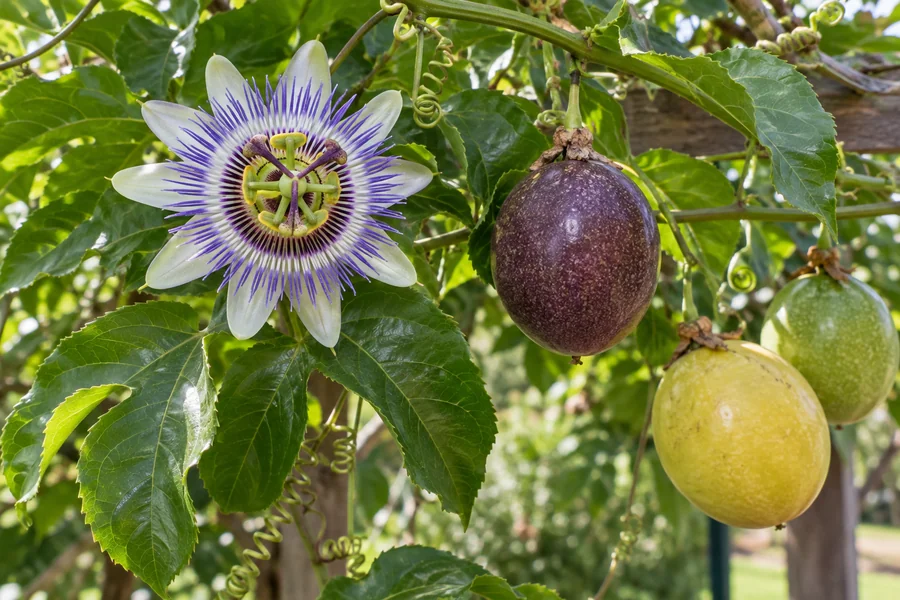
Passiflora edulis vine with flower and nearby ripe purple and yellow edible fruits.
Yellow and purple passion fruit can differ in size, aroma, acidity and supply profile. They should be identified in a sourcing discussion when those differences matter to the finished product. A fruit tea with visible seeds may call for one pulp profile, while a smooth dairy preparation may need screened puree. The word "passion fruit" covers both until the specification narrows it. We therefore ask buyers to identify the fruit form and intended application before we confirm a product proposal.
Some edible fruits from other Passiflora species carry regional names such as granadilla. A label using "granadilla" may refer to a different species or a regional commercial convention; it should be checked rather than translated mechanically into one standard passion fruit SKU. The University of Florida guide lists several edible species and cautions against confusing P. edulis with the maypop, P. incarnata. This matters in botanical explanations and in ingredient declarations intended for a particular market.
For raw fruit selection, the visible shell gives a starting point, but processors ultimately use the edible pulp. The maturity of incoming fruit influences color, aroma and the balance between acid and soluble solids. Sorting and sampling tell more than the external name. The GreenLand frozen passion fruit range describes pulp, puree and other agreed forms; the exact availability and product identity should be confirmed for each order rather than inferred from the broad category name.
Names that travel with passion fruit
English uses "passion fruit," "passionfruit," and occasionally a hyphenated form. Packaging, menus and search results can use any of them, but they point back to the same flower-derived English name. Maracuyá, maracujá, parcha and granadilla appear in different regions and contexts. These names help buyers speak to local consumers, yet they are not a substitute for a formal ingredient description. Some are broad colloquial names; others can indicate a particular fruit or market convention.
The cut fruit in the image shows the recognizable black seeds in golden pulp. That visible detail is more useful to a beverage or dessert developer than a translation alone. A menu may promise "passion fruit" and display the seeds in a drink; another product may use a smooth, seedless puree and still use the same fruit name. The customer will judge these very different textures in the final serving. If seeds are part of the sensory promise, the buyer should write an acceptable seed profile into the specification.
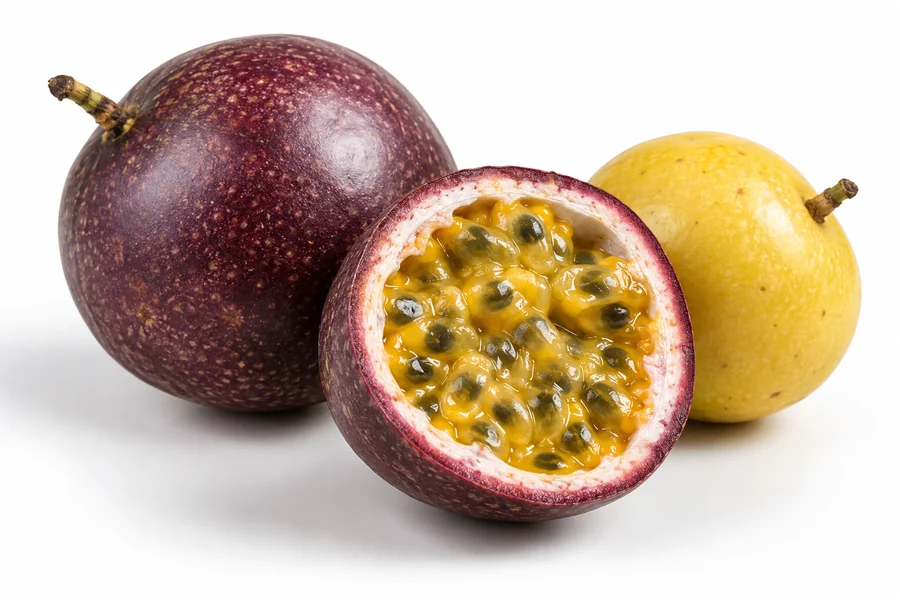
Purple passion fruit cut open beside intact fruit, seeds in yellow-orange pulp clearly visible, no unrelated citrus.
Trade names can also describe processing. "Pulp" often retains a more natural seed and membrane character. "Puree" usually describes a smoother processed texture, sometimes screened to reduce or remove seeds. A "juice base" may have a more fluid, pumpable profile. "Concentrate" has a substantially different soluble-solids level and requires a separate formulation calculation. The words are not perfectly standardized between every market or supplier, so the written product sheet and sample remain decisive. Our frozen passion fruit juice page treats a single-strength juice or puree base separately from higher-Brix concentrate.
This distinction becomes more important when a buyer translates a brief across languages. "Passion fruit drink," "maracuyá pulp" and "frozen passion fruit puree" could describe three separate commercial requirements. A quotation should specify the fruit species or agreed market description, whether seeds are retained, the target Brix and acidity range, pack size, application and expected processing state. That prevents a persuasive product name from hiding a mismatch in the ingredient that arrives.
The historical name can still be useful in communication. A small note explaining the flower can give a menu or brand story a true point of interest. It should stay within its factual limits. A statement that the flower was interpreted through the Passion story is supportable; a statement that the fruit has special medicinal or romantic properties because of its name is not. The origin of a word cannot establish a nutritional or functional claim.
What the name does and does not tell an ingredient buyer
For purchasing, "passion fruit" answers only the first question: which fruit category is being discussed? It does not say whether the product is whole, halved, seeded pulp, seedless puree, juice base, cubes or concentrate. It does not establish the fruit percentage in a formulated drink, the actual Brix of a released lot, the acid balance, the pack size or the freezing status. These fields affect recipe yield, processing equipment, storage space and freight planning.
Consider a beverage line that wants tart tropical flavor with no visible seeds. A bottle of seeded pulp may be a genuine passion fruit product but create filtration work, line downtime or an inconsistent appearance. A seedless puree may handle more predictably. Conversely, a dessert topping designed to show natural seeds could lose its intended appearance if the supplier sends a fine-screened puree. The correct choice follows the finished product, not the poetry of the fruit's name.

Two orange sample bottles and measurement instruments show a photographed ingredient check.
When we prepare a sample discussion, we ask for the end use and the physical form first. Brix and acidity should be stated with a method and acceptable range if the formula depends on them. Color, aroma and pulp consistency should be compared against an approved sample after controlled thawing. A seed tolerance should be stated if the form is described as seedless. Packaging may be a retail bag, foodservice pack, carton, pail or other agreed format. The final document set can include a product specification, lot-linked certificate of analysis and destination-market documents requested by the buyer.
The frozen form also changes the receiving test. A buyer should evaluate whether the pack arrives fully frozen, intact and correctly coded; whether the ingredient separates or flows as expected after thawing; and whether a representative sample tastes and performs like the approved standard. If a high-solids concentrate is quoted, the formula must be tested at the correct dilution and declared concentration. A single-strength juice base cannot be substituted by a concentrate simply because both are described as passion fruit.
Existing background on the fruit and its commercial formats is covered in Understanding Frozen Passion Fruit. The name-origin question has a narrower purpose: it helps readers understand why the label exists, then shows why that label alone is too broad for a purchasing decision. A sample and written acceptance criteria turn the familiar word into an ingredient a factory can receive consistently.
Choosing a passion fruit form for food production
The application sets the useful form. Beverage producers may want pumpable, seed-controlled puree or juice base, with defined Brix and acidity so sweetness and sourness can be balanced in the final formula. A smoothie chain may prefer a frozen portion format suited to batch blending. A yogurt or ice cream producer needs the fruit to distribute evenly without unwanted seed texture or excessive water separation. A bakery filling may require thicker pulp or an additional downstream stabilization step. These are formulation trials, not assumptions attached to the fruit name.
The photographed bottles beside this section show actual orange passion fruit liquid samples. They establish that a liquid form exists, but a photograph cannot certify Brix, seed control, microbial status or batch identity. Those require a product specification and actual lot records. Similarly, the separate frozen cubes photo shows a different physical form; it does not imply that every order is supplied in cubes. We keep the image and the commercial statement at their proper levels of evidence.

Two actual orange passion fruit liquid sample bottles show industrial liquid form.
At GreenLand-food, we supply frozen passion fruit for commercial buyers and discuss form, pack and destination before quoting. Our frozen passion fruit puree page describes seeded and seedless options, while the juice product page presents a separate liquid-base route. Availability, processing status and final specification should be confirmed for the order. We do not treat a page's example values as the measured result for an untested shipment.
A practical approval sequence begins with a brief describing the finished food, target fruit contribution and sensory goal. The buyer then compares matching ingredient samples under the real production conditions: dilution or blending for beverages, heat treatment for fillings, freezing and thawing for desserts, or pumping and dosing for industrial lines. Observe seed distribution, color and aroma after processing. Record the acceptable range and choose packing that works with the line and shipment volume. A matching commercial order can then reference that approved sample and specification.
The fruit's name may invite curiosity; the commercial decision depends on repeatable material. Send the desired form, seeded or seedless preference, Brix and acidity requirements, packing, quantity, destination, intended application and requested documents. That information lets our team confirm which frozen passion fruit product and supply plan fit the work the ingredient must do.
When a beverage team samples seeded pulp, it should mix the ingredient uniformly before taking a test portion. Seeds and pulp can settle differently after thawing; a scoop from the top may not represent the whole pack. The team can record whether seeds pass through its pump and filling equipment, how many remain visible in a standard serving, and whether the appearance changes after shelf-life testing of the finished drink. If the answer points toward a smoother base, a seedless or controlled-seed product can be sampled against the same recipe. This is a functional comparison rooted in the finished drink rather than a broad preference for one fruit name.
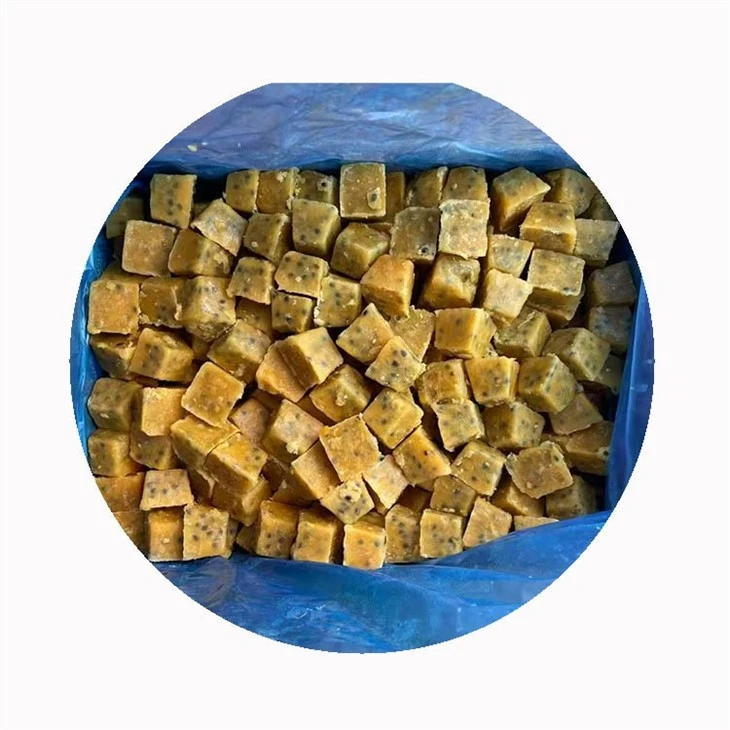
Frozen passion fruit cubes on blue liner show a distinct frozen form.
For a dessert manufacturer, freeze-thaw behavior can be as important as the first taste. A passion fruit preparation that looks bright in a fresh spoonful may release liquid after a frozen dessert is tempered for serving. A sauce may separate after heating or acidify a dairy base more than expected. Test the ingredient through the real process and record any added sugar, stabilizer or heat treatment in the finished formula. The fruit supplier should describe the fruit ingredient accurately; the manufacturer remains responsible for validating the final formulated food.
Label language deserves a separate check when products cross borders. The historical term "passion fruit" is recognizable in English, but the ingredient declaration may need an approved common name in the destination market and a truthful description of concentrate or reconstituted material. A package photograph cannot resolve those requirements. The buying team can send a draft label and the product's processing description for review before printed packaging is ordered, then verify it against local rules. This prevents a useful botanical story from becoming an inaccurate ingredient statement.
Crop and logistics planning can also affect the choice between pulp and puree. A line that draws a measured portion every day may prefer a pack that thaws and doses predictably; a seasonal menu may accept larger bulk units if its demand is concentrated. Agree on carton configuration, frozen storage capacity, expected call-offs and the testing needed at receiving. If the product will be repacked or used under a private label, confirm the original lot coding and traceability path. The name's origin remains a memorable opening, but these operational details determine whether the ingredient can be used consistently.
A useful educational label can pair the common name with a restrained botanical note: passion fruit comes from a Passiflora vine whose flower acquired its English name through historical symbolism. Any further claim about flavor, source or processing should be checked against the actual ingredient. If a package uses a picture of a whole cut fruit but contains a filtered concentrate, the ingredient wording and image should still make the supplied format clear. Good storytelling remains truthful when it helps the customer recognize the fruit and understand what is in the pack.
Source Frozen Passion Fruit with GreenLand-food
GreenLand-food is a professional frozen passion fruit supplier and manufacturer in China, providing factory-direct wholesale supply for importers, food manufacturers, foodservice distributors and private-label programs.
Send your product form, specification, packing, quantity, application, destination, private-label needs and requested documents so we can discuss a relevant sample and quotation.